
Research Signal – Source date 2026-02-01
Designing a sound absorber with winding internal passages can mean repeatedly asking a computer how air will behave inside a complicated maze. Change a passage, calculate the response, then try again. When each calculation must capture tiny regions near the walls where sound loses energy, that search can become prohibitively slow.
A February 2026 study in Scientific Reports explores a simpler approach for structures whose cross-section stays the same along one axis. The researchers modeled them in two dimensions, investigated how much numerical detail the calculations needed, and checked predictions against six independently generated, 3D-printed samples. The laboratory results give a qualified answer to the question of trust: the models located absorption peaks much more closely than they predicted their height.
How a maze absorbs sound
Acoustic metamaterials are structures engineered to control sound through their geometry. In the maze-like absorbers studied here, sound sets air moving through narrow passages. At resonant frequencies, the response favors absorption, producing peaks in a graph of absorption against frequency. The placement and height of those peaks describe different aspects of the absorber’s behavior.
The walls are central to the process. Viscosity resists the motion of air close to a surface, while temperature changes associated with sound produce heat exchange near the walls. These effects dissipate acoustic energy in thin viscous and thermal boundary layers. A model that describes the passages but handles those losses poorly can misrepresent the absorber. “Thermoviscous” modeling means explicitly accounting for both effects.
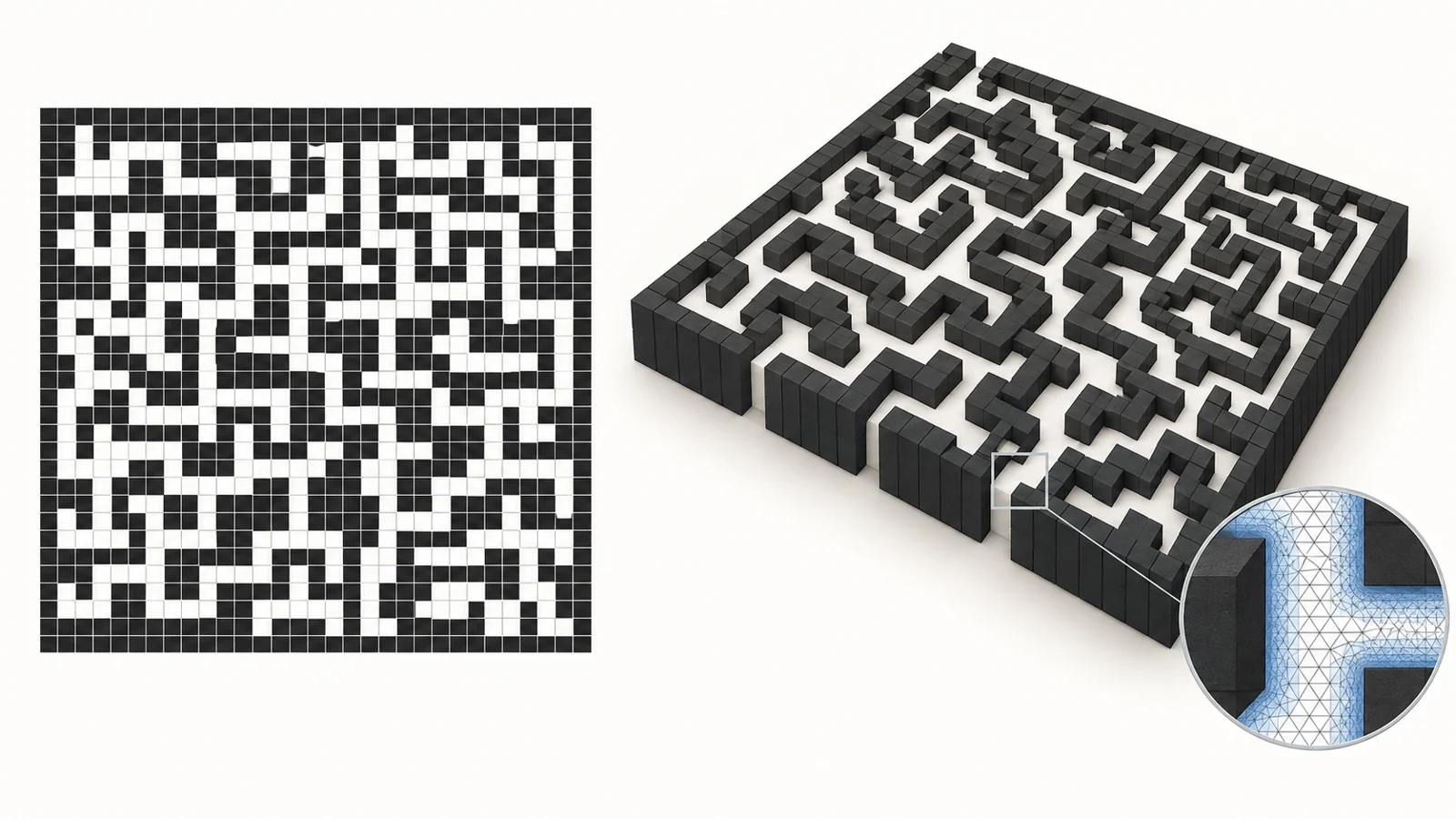
To specify their test geometries, the researchers used black-and-white bitmaps within a 32-by-32-pixel container. Each pixel represented a square two millimeters across, assigned either to solid wall or to air. Connected air pixels formed the passages. Extending that cross-section along a third axis produces a three-dimensional structure with the same maze pattern throughout its height. The proposed model leaves that height out of the calculation, making the geometry representable in a plane.
The bitmap and the numerical mesh serve different purposes. The bitmap defines the physical shape. The mesh subdivides the modeled air into smaller computational elements, allowing the software to approximate how pressure, motion, and temperature vary within it. Changing the mesh can change the amount of calculation without changing the maze itself.
Why the available shapes matter
Engineers already have efficient ways to calculate the behavior of connected acoustic channels. The Transfer Matrix Method, one approach examined in the paper, uses analytical descriptions of resonators and their connections. Its usefulness depends on having suitable descriptions for the channel cross-sections involved. That can constrain a design to combinations of familiar shapes.
The Finite Element Method can represent more complicated passages directly through a numerical mesh. The researchers compared two-dimensional and three-dimensional models using the Finite Element Method, alongside Transfer Matrix Method calculations and impedance-tube measurements. Among the approaches they compared, the two-dimensional and three-dimensional thermoviscous models could accommodate the arbitrary geometries they wanted to investigate. That geometric freedom motivated the choice to develop the two-dimensional approach further.
The comparison also illustrated the computational burden. The three-dimensional thermoviscous calculation took more than 140 hours, even on a more powerful computer than the one used for the other models. Its mesh was not fully optimized, and the numerical configuration differed, including its frequency step. That makes the result an example of an expensive calculation rather than a controlled measure of how much faster every two-dimensional simulation would be.
How much mesh detail is enough
Reducing a model from three dimensions to two is one simplification. Reducing the density of the mesh within the two-dimensional model is another. The latter was the focus of a much larger numerical experiment.
The team generated 20 maze-like geometries and tested 75 pairs of mesh settings for each, producing 1,500 numerical variants. The settings adjusted the mesh within the air passages and the elements used to resolve the boundary layers near their walls. For each calculation, the researchers recorded the absorption response, calculation time, mesh-building time, and number of degrees of freedom—the numerical unknowns the solver had to determine.
The range was substantial. Across mesh-setting pairs, average model sizes ran from about 30,000 degrees of freedom to more than 1.4 million. The densest setting served as the reference against which less detailed meshes were compared. Those extremes describe the search space; they do not mean the smallest model satisfied the study’s accuracy criterion.
The useful finding was that selected coarser settings could retain relative numerical deviations below 0.5%, while the discussion reports a potential 72.4% reduction in model complexity. Here, the small error measures agreement with a denser numerical reference. It does not establish agreement with a manufactured absorber to within half a percent. Similarly, the complexity reduction concerns the size of the numerical problem, not an equivalent percentage saving in runtime, electricity, or engineering cost.
The printed samples reveal two different prediction tasks
A numerical comparison checks what happens when the calculation changes. Testing a physical sample asks whether the modeled behavior survives manufacturing and measurement. For that check, the researchers generated six new geometries independently of the 20 used in the mesh study, printed them, and measured their absorption in an acoustic impedance tube.
The simulated and measured responses contained corresponding resonance peaks, although their heights differed. The researchers assessed peak frequency and peak amplitude separately between 100 and 1,000 hertz, counting peaks whose absorption coefficient exceeded 0.4. An absorption coefficient describes the fraction of incident sound energy absorbed under the test conditions; its peak height therefore says how strongly the sample absorbs at that frequency.
For the evaluated peaks, mean frequency divergence was 2.6%, with a standard deviation of 2.5%. The average peak-amplitude difference exceeded 27%, with substantial variation. These results support different levels of confidence in the two predictions. An engineer trying to place a resonance near a troublesome tone needs a dependable peak location. Estimating how much sound the finished absorber will absorb also requires a dependable peak height. Success at locating the resonance does not settle the second question.
The measurements also showed relatively small variation within the test results: the reported mean standard deviation of the absorption coefficient was below 0.05 for every geometry and below 0.01 at peak frequencies. Consistent measurements can still disagree with a model. Repeatability describes the spread of the measurements, whereas the model comparison concerns their distance from a prediction.
The authors discuss several possible contributors to the amplitude mismatch. Printed surfaces can depart from the ideal smooth walls assumed in a simulation, and the printing material can itself absorb sound. They also raise possible nonlinear effects under the measurement excitation. These are plausible explanations, not a single experimentally isolated cause. Including the solid material’s mechanical behavior would introduce further modeling complexity, so the discrepancy also exposes a practical choice about which physical details a design calculation needs to include.
Where the approach applies
The word “arbitrary” refers to considerable freedom within the chosen geometric representation. The channels still have to fit a two-dimensional description that can be extended along one axis. A structure whose passages change through its height falls outside that description. The authors also identify a limitation for classical Helmholtz resonators, whose behavior depends on a defined cavity volume: their discretized two-dimensional approach does not provide an independently specified volume in the required way. Labyrinth-like and duct-based structures are its intended territory.
The demonstrated conditions matter as well. Experimental verification covered 100–1,000 hertz, and the geometry used a two-millimeter pixel scale that constrained the basic channel dimensions. The model assumes small acoustic velocities, no steady background airflow, and channels much wider than the thermal and viscous boundary layers. Applying it to a different channel scale, stronger excitation, or flow through the passages would require checking those assumptions and validating the response under the new conditions. The impedance-tube results establish laboratory behavior for the tested samples; performance in an installed setting remains a further engineering question.
What this could change
The potential payoff is a more practical way to search for compact absorbers that fit an available space and target selected sound frequencies. A designer could vary the internal maze while preserving the external dimensions, then calculate how those changes move the absorption peaks. If optimization can identify useful geometries and physical testing confirms their absorption strength, this could support sound-control components shaped around spatial constraints that make conventional resonator arrangements awkward.
The authors also propose using the approach to generate datasets for machine learning, potentially supporting systems that suggest geometries from requested acoustic properties. That possibility depends on the simulations providing suitable training examples and on the proposed structures surviving experimental checks. From the study’s February 2026 perspective, the concrete opportunity is to make a broader range of maze geometries available to design searches, with printed samples providing the necessary connection between a calculated resonance and a useful physical absorber.
Key Sources
- Primary source: Mesh sensitivity and experimental verification for randomized arbitrary geometry cavity-based acoustic metamaterials designed with 2D FEM simulations.
DOI or Journal Page · Peer-Reviewed Paper · 2026-02-01
Keep exploring