
Research Signal – Source date 2024-02-05
A scientist can ask an AI model a question and receive an answer without being able to investigate how it arrived there. That distinction becomes decisive when the research involves examining an internal calculation, changing part of the model, or following what happens between its input and output. Making a very large model available for queries leaves some scientific experiments out of reach.
A survey-and-vision preprint posted on February 5, 2024, explores the infrastructure needed to close that gap. Trillion Parameter AI Serving Infrastructure for Scientific Discovery describes an ecosystem of researchers and providers built around models with more than a trillion parameters—the numerical values that shape a model’s computations. Its subject is serving, meaning running a model so that users can work with it.
The authors outline requirements and unresolved engineering problems for such services. The paper is a proposal for how scientific use could be supported, rather than a demonstration of a complete working ecosystem. Its central question is practical: what must the surrounding software allow a researcher to do?
Different research tasks need different behavior
Consider a researcher discussing scientific literature with an AI trained on it. The authors envisage a collaborative process in which the researcher asks questions, receives summaries, and develops hypotheses. For that exchange to work as an ongoing conversation, the model must respond in near real time. A long wait changes the activity itself, interrupting the sequence of questions that one answer might prompt.
Here, response time is part of scientific usability. A service could eventually return a useful answer yet still be poorly suited to helping someone think through a problem interactively. The paper connects this particular workflow to responsive inference, the computation through which a model produces an output.
Other scientific work creates a different demand. Much research data is non-textual, motivating models that can learn from multiple kinds of input. The authors also discuss data whose structure does not fit conventional geometric representations. Converting such data into numerical vectors can make it usable by familiar neural-network components, but may fail to express its full original structure.
That creates a representation problem before the service returns any answer. The way data is presented to a model affects what information the model can work with. Faster execution alone cannot restore relationships that the input representation leaves out. Supporting this research may therefore require accommodating different model components and architectures as scientists explore how to preserve scientifically meaningful structure.
Keep stable components ready and open others to experiments
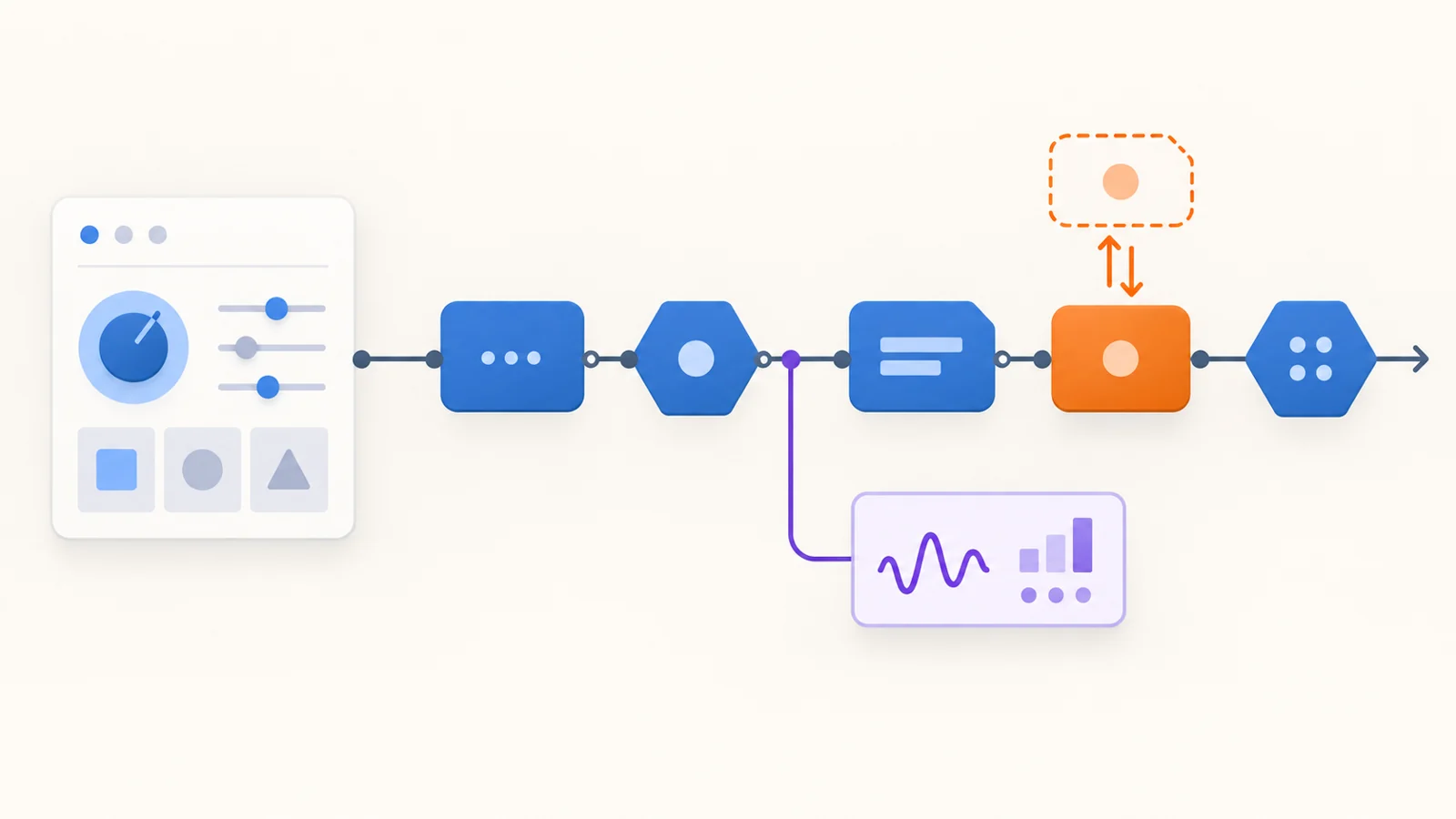
The proposed modular approach divides model computation into parts. Those parts could range from individual mathematical operations to layers or groups of layers. Researchers would be able to attach custom layers, inspection tools, or hooks—points where software can observe or intervene in an ongoing calculation.
Meanwhile, components whose weights remain unchanged could stay precompiled. Compilation prepares a computation for execution; doing that work in advance allows the service to retain prepared versions of the stable portions. In the authors’ design, a researcher’s experiment with one component would coexist with unchanged components that the provider can continue serving efficiently.
Picture a sequence of computational blocks. Several remain fixed, one contains an experimental modification, and an observation point exposes a value produced between blocks. Each feature serves a different purpose. The fixed blocks preserve prepared computation, the experimental block changes part of the process, and the observation point lets a researcher examine something that the final answer alone would hide.
The harder case combines observation with modification. The authors identify the challenge of making intermediate outputs and model weights observable and editable at the same time. Their example involves applying a normalization across the weights and observing the effect on the output. Such an experiment reaches across the model, rather than neatly replacing one isolated component.
A service must then support the requested intervention while keeping its execution machinery consistent with the altered computation. The paper raises the possible need for on-the-fly recompilation when researchers interact programmatically with internal model components. Modularity offers a way to preserve work on unchanged portions, but the authors leave significant interface and system-design questions open. They do not supply measured latency or cost improvements for a completed version of this architecture.
Infrastructure has to survive changes to the model
Building a service around one enormous model requires an investment that may outlast that model’s usefulness. The authors warn that organizations could hesitate to commit time and money to infrastructure that quickly becomes obsolete as architectures change.
There are two timescales to accommodate. Future models may require different arrangements of computation, while a model already being served may itself evolve. The maintenance challenge is therefore continuous as well as generational. Infrastructure needs ways to accommodate those changes if providers are to justify maintaining it beyond a single model release.
Seeing inside a model does not reveal its whole history
Even a service that exposes internal operations would leave another kind of scientific scrutiny dependent on the provider. The authors identify training and validation data, training procedures, and model weights as information needed for greater transparency. Scale and intellectual-property concerns may prevent some of that information from being made available.
These disclosures answer different questions from an inspection tool. An intermediate value reveals something about a particular computation. Training information helps researchers examine how the model came to behave as it does. One does not automatically supply the other, and access to weights or internal values does not by itself guarantee an understandable explanation, a reproducible result, or a scientifically correct answer.
This distinction also sets the evidential limits of the proposal. The preprint brings together existing approaches and a design agenda. The proposed ecosystem’s ability to satisfy the full set of scientific requirements remains unvalidated. A trillion parameters is the scale under discussion, not an established requirement for useful science or a guarantee of better discoveries.
The value of the paper is in making the requirements concrete enough to examine together. Responsiveness, suitable data representations, experimental control, maintainability, and disclosure each address a different obstacle. Success on one would leave the others to be resolved.
What this could change
If responsive serving can be combined with scientifically useful model outputs, researchers could develop and refine hypotheses during an ongoing conversation with literature-trained AI. A summary could prompt a follow-up question; that answer could help the researcher reconsider an assumption or sharpen a possible explanation while the original line of thought is still active.
Short enough waits would sustain the interaction, while useful engagement with scientific literature would give that interaction substance. Researchers would gain a tool for working through possible explanations as questions emerge. The prospect described in February 2024 is a more interactive form of hypothesis development, with infrastructure capable of supporting the pace and demands of that work.
Key Sources
- Primary source: Trillion Parameter AI Serving Infrastructure for Scientific Discovery: A Survey and Vision
arXiv · Preprint · 2024-02-05
Keep exploring