
Research Signal – Source date 2025-07-18
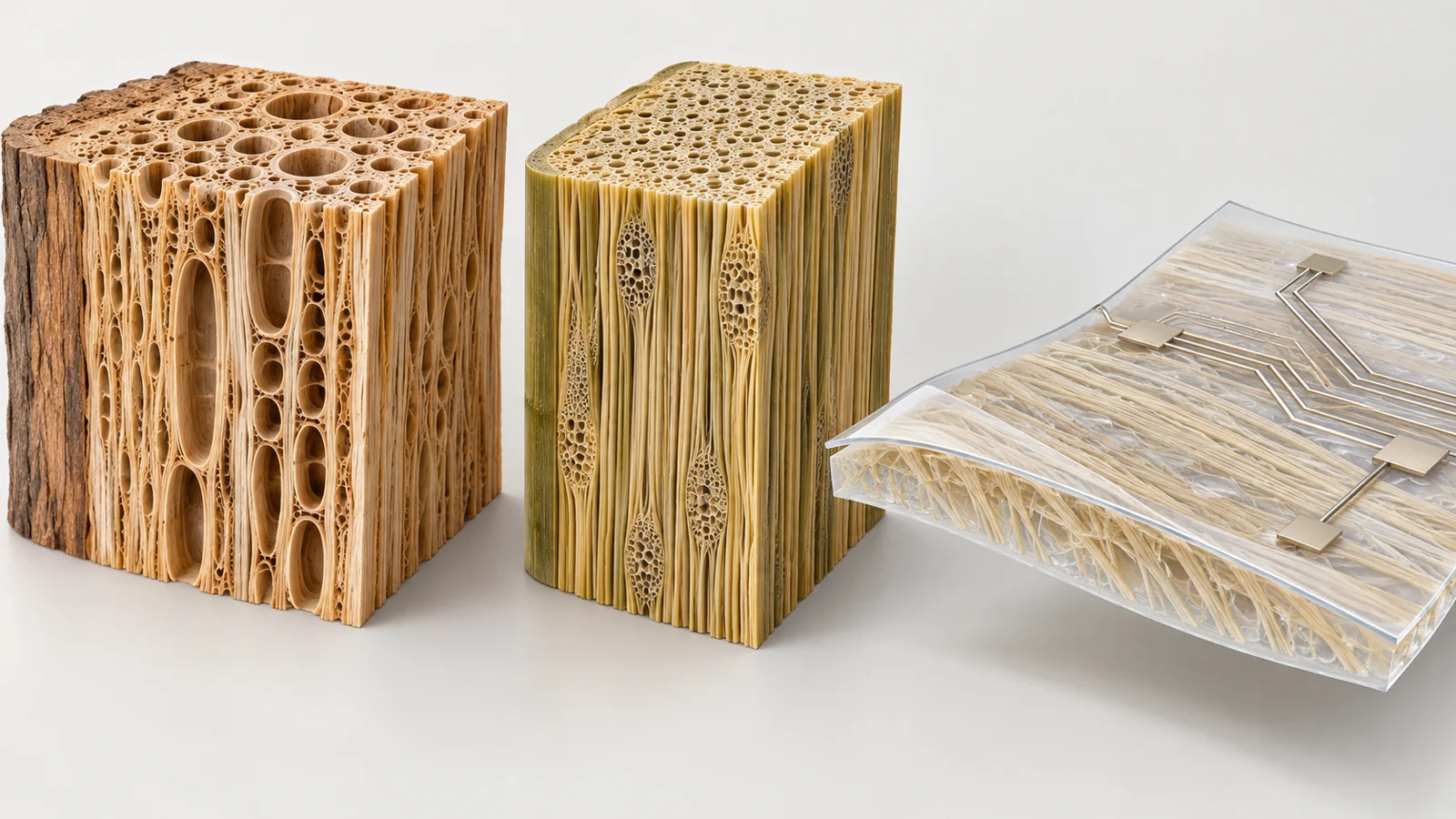
Bamboo’s strength can work against it when the goal is a clear, bendable support for electronics. Its compact structure resists the chemical treatments and resin filling that help turn wood into a transparent film. A review published July 18, 2025, brings together reported ways to address that challenge and examples of circuits and sensors made with these materials.
The idea is not to make a tree or a bamboo stalk conduct electricity on its own. Researchers process a thin plant structure, then add materials that change how it handles light, bending or electrical signals. The result can serve as a support for a circuit, or become part of a composite that responds to movement. Those are different functions, and the reported demonstrations use different recipes and tests.
Clearing the path for light
Untreated wood and bamboo are opaque for two related reasons. Lignin, one of their main structural components, contains colored groups that absorb light. The review estimates that these groups account for about 80% to 95% of light absorption in the materials. Their internal structure also scatters light: air and moisture in pores sit beside cell walls with different optical properties, so light changes direction at those boundaries instead of passing straight through.
Making a transparent film means addressing both effects. In a common approach, chemical treatment removes lignin or alters its colored groups, turning the material pale. A transparent polymer is then introduced into pores and channels. By filling spaces that would otherwise scatter light, the polymer reduces the optical mismatch between the cell walls and the air-filled structure. The plant framework remains, but its light-transmitting behavior changes.
The sequence matters. If treatment does not reach enough of the material, lignin can remain and the finished film may be less transparent or more hazy. If the pores are not filled consistently, empty spaces can continue to scatter light. A clear appearance therefore depends on how the natural structure is treated as well as on the material added to it.
Bamboo’s structure makes the recipe harder
Wood often gives treatment chemicals a route inward. Its tubular vessels and fiber cells create permeable channels, and the review gives a typical porosity range of 30% to 70%. That network can help chemicals enter and lignin leave while the cellulose framework retains its layered structure.
Bamboo is denser, with a reported porosity range of 15% to 60%, and lacks transverse tissue that would help hold its structure together across the grain. Chemicals and resin can have a harder time penetrating it. Prolonged treatment may weaken the bonds across the bamboo, allowing fiber bundles to separate or layers to collapse. The compactness that contributes to bamboo’s mechanical strength can therefore make it more difficult to preserve that strength while processing it into a transparent, flexible film.
The review describes approaches that add steps to protect the structure. One reported method used alkaline pretreatment, crosslinking, delignification and compression densification. Another used alkaline pretreatment and a crosslinking agent before lignin removal, followed by flexible epoxy resin impregnation. In these methods, pretreatment helps open the material to processing, while crosslinking is used to reinforce connections between cells. They illustrate why bamboo may need a more carefully staged recipe than wood; they do not establish that one recipe works for every bamboo source or production scale.
A circuit support and a movement sensor do different jobs
A transparent film can be a platform on which electronics are built. In one example discussed by the review, researchers formed graphene transistors on a transparent wood substrate made through a top-down process: they treated and flattened wood directly rather than first extracting cellulose fibers to rebuild a film. The review describes transistor behavior consistent with electrical contact and control through a gate voltage. This is a circuit demonstration on a plant-based support, not evidence of a ready-to-use consumer device.
Other work described in the review used transparent conductive wood as a sensing material. In one reported composite, a deep eutectic solvent was polymerized within the wood structure. The material reached a tensile strain of up to 80% and an electrical conductivity of 0.16 S/m in that study. Attached to skin, it produced repeatable changes in electrical signal as facial movements loaded and released the material. Here, the composite itself responds to movement; the example is different from placing a transistor on a transparent support.
The review also recounts a flexible transparent bamboo film used as a substrate. Conductive ink adhered to its surface and formed a circuit that illuminated a diode. Near-field communication circuits on the film could be read quickly by devices, and the film could adhere to skin in a demonstration relevant to electronic-skin research. These examples show several possible roles for the materials, but they do not show that a large area of film can be made with the same performance every time or that a wearable will retain it over long use.
Filling and coating change the balance
The polymer is not just a way to fill empty space. It affects how much the film bends, how strong it remains and how clearly light passes through. The review describes a familiar tradeoff: a hard resin such as epoxy can add mechanical strength but leave a film too stiff for comfortable bending, while a flexible polymer such as polyvinyl alcohol can improve bendability yet provide less strength. Adjusting a resin mixture can shift the balance, but the best choice depends on the intended device and processing conditions.
A surface coating can also change optical performance. In one wood-film example, brushing epoxy onto the surface reduced haze from 76% to 43% while slightly increasing transparency. Haze describes the portion of transmitted light that is scattered rather than passing through clearly. The same coating was reported to help keep moisture away from the wood film. Those figures belong to that particular sample and method; they are not a general performance level for transparent wood.
Newer methods may simplify production, but they still need control. The review discusses brushing resin directly onto a wood film and self-compacting approaches as alternatives to more involved impregnation or hot pressing. It also notes that conditions such as humidity, temperature and pretreatment can affect whether resin enters evenly or leaves air bubbles. Simpler steps do not automatically guarantee consistent films.
Plant-based does not settle the environmental question
Replacing a fossil-derived plastic support with a plant scaffold could reduce reliance on some petroleum-based materials. But the full process matters. Delignification uses chemicals, and the review distinguishes cleaner approaches, such as hydrogen peroxide or biological enzymes, from sodium-salt treatments that can use solvents and produce harmful by-products such as chlorides and chlorates. Transparent films also commonly rely on polymers, some of which are petroleum-derived.
The material’s useful lifetime matters too. Wood’s porosity and natural variation can affect device stability, while biodegradability may complicate long-term durability. A plant-derived scaffold by itself does not show that a complete electronic device has a lower environmental burden than a plastic-based alternative. That comparison depends on the materials and energy used to make it, how consistently devices perform, and what happens over their service life.
What this could change
A clear wood- or bamboo-based film could eventually serve as the flexible base beneath a skin-worn motion sensor’s circuit. The review reports circuit components on treated plant films and movement signals from a conductive wood composite, but those were separate demonstrations. A useful device would need reliable performance over time; any claim of environmental benefit would also need a full-device comparison with a plastic-based alternative.
A nearer sign of progress would be multiple production batches of larger sensor films retaining their optical and electrical performance through repeated bending and humidity exposure. Consistency across batches and conditions would help show whether the material can move beyond promising individual demonstrations toward a dependable support for wearable electronics.
Key Sources
- Primary source: Transparent Wood and Bamboo for Next-Generation Flexible Electronics: A Review.
DOI or Journal Page · Review or Meta-Analysis · 2025-07-18
Keep exploring