
Research Signal – Source date 2025-05-21
A small post crossing the sides of a root-treated back tooth improved its resistance to breaking in laboratory tests, compared with a large cavity filled with composite alone. The review behind that finding also shows why “stronger” needs context: the supported teeth still fell short of intact teeth in pooled comparisons, and results differed across tooth types and restoration designs.
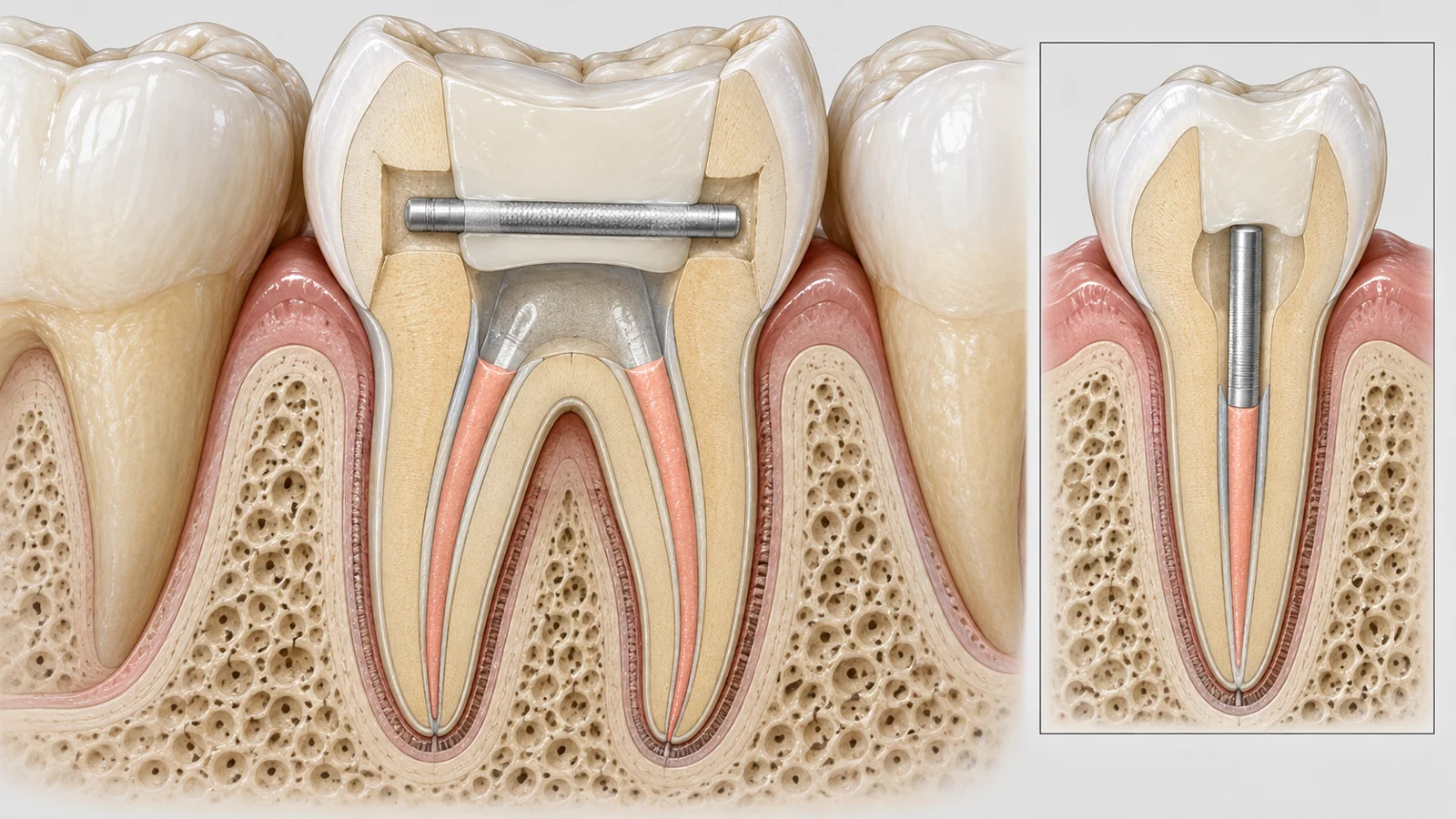
The post in question runs from one side wall of the tooth to the other beneath a composite filling. It is a horizontal brace, not a post placed down the root canal. Researchers have studied whether this crosswise support can help the remaining tooth structure withstand forces after a large filling removes support from its cusps.
A wide cavity can leave the cusps less supported
A MOD cavity extends across the chewing surface and into both sides of a back tooth. When a root-treated premolar or molar has this large three-sided preparation, the remaining cusps may have less support. The review describes how cusps can flex under stress, with larger cavities and the access made for root-canal treatment adding to the strain. Premolars may be especially vulnerable because of their anatomy and the support left around their cusps.
The horizontal-post technique places a post through the tooth’s buccal and lingual walls—the cheek-facing and tongue-facing sides—before the cavity is filled with direct composite. In principle, that gives the filling support across the tooth. The lab studies tested different posts and materials, so the review does not describe one uniform design.
This is different from a root-canal post, which sits inside the canal and is mainly used to retain a restoration when little tooth structure remains. In the review’s premolar comparisons, root-canal posts did not improve fracture resistance over composite restorations and performed worse than horizontal-post-supported composite. Preparing space inside the root can also remove tooth structure, which may reduce resistance rather than add support.
The pooled tests favored support, but intact teeth remained stronger
The review included 26 studies, of which 16 supplied results for quantitative analysis. In both premolars and molars, pooled comparisons found that horizontal posts with composite resisted fracture better than prepared MOD cavities left unrestored or filled with composite without the extra support.
The gap from intact teeth remained. For premolars, the pooled comparison found lower fracture resistance with horizontal posts and composite than in sound premolars. The same was true for molars. So the improvement over an unsupported filling did not restore the benchmark measured in an intact tooth.
One individual premolar experiment illustrates how particular combinations can perform differently from the pooled result. In that study, horizontal posts combined with fiber-reinforced and nanohybrid composites reached a mean fracture resistance close to the sound-tooth comparison. That result belongs to a specific tested setup; it does not overturn the pooled comparisons or show that every such restoration matches an intact tooth.
Fracture resistance here means how much force a restored tooth withstood in a laboratory test before it broke. Those results do not tell us how long a restoration will last in a person’s mouth.
Other supports did not produce one universal winner
The review compared horizontal posts with fiber ribbons placed on the chewing surface, reinforced composite fillings, and inlay or onlay restorations. Some molar comparisons found no clear difference in fracture resistance between horizontal posts and onlays or chewing-surface fiber ribbon. Premolar comparisons also found no clear difference from one ceramic inlay design or from fiber ribbon, although the ribbon results varied widely between studies. Other comparisons favored horizontal posts, including those against root-canal posts and some inlay designs.
Fiber-reinforced composite sometimes performed similarly to horizontal posts, and the review describes promising results when fiber ribbon and horizontal posts were combined. But the comparisons varied by tooth type, material, cavity and test setup. The findings do not establish one best restoration for every root-treated back tooth.
Fracture resistance is also different from fracture repairability. A tooth can withstand more force before breaking, yet the way it breaks still matters: some fractures may leave the tooth repairable, while others may not. Across the included studies, several comparisons reported fewer non-restorable fractures with horizontal posts than with unsupported MOD cavities or some other restorations. Other studies found competing approaches had fewer such failures, and some comparisons reported similar fracture patterns. The pattern evidence was mixed, so the strength results alone cannot establish that the technique prevents unrepairable breaks.
Bench tests leave important questions about chewing
These were laboratory studies, not clinical trials tracking how restorations perform in patients over time. Most applied force vertically, while real chewing also involves forces from other directions. The review notes that oblique loading may better approximate sideways forces during jaw movement, and that repeated loading and aging would help assess behavior over time.
Methods varied across the studies, including the tooth type, cavity design, materials and testing conditions. That variation contributed to substantial heterogeneity in several pooled comparisons. The authors also reported gaps in study design and reporting: many papers did not describe sample-size calculations or randomization, and none used blinded assessment of results under the review’s evaluation. These limitations make precise comparisons less certain and leave clinical durability unresolved.
The remaining side walls matter to the proposed brace. The authors say horizontal posts may be useful in wide cavities when the cheek-facing and tongue-facing walls retain reasonable thickness, and discuss more than 2 mm as a contextual condition. That is not a patient-specific cutoff or a guarantee of benefit. If those walls are already very thin or damaged, making openings for a crosswise post could weaken the structure it is meant to support; the authors discuss cusp reduction and coverage restorations for some severely depleted teeth. Which approach fits a particular tooth requires clinical assessment.
Where this research could lead
If the laboratory advantage translates to patients, horizontal support could give dentists another way to preserve a root-treated back tooth with a large cavity while restoring it with a direct filling. That could matter most when useful side walls remain: a brace might help the filling share forces across the tooth without relying on a post inside the root canal. The benefit would be a more durable, repairable tooth, but that practical outcome has not been demonstrated by these tests.
The evidence bridge is a clinical comparison that follows patients long enough to assess both tooth survival and the kinds of fractures that occur, alongside the mechanical tests. Until then, the review offers a reason to study this support method—not proof that it extends the life of a filling or tooth.
Key Sources
- Primary source: Effectiveness of horizontal posts to support MOD cavities compared with other restorative approaches in endodontically treated teeth: systematic review with meta-analysis of laboratory studies.
DOI or Journal Page · Review or Meta-Analysis · 2025-05-21
Keep exploring