
Research Signal – Source date 2025-05-15
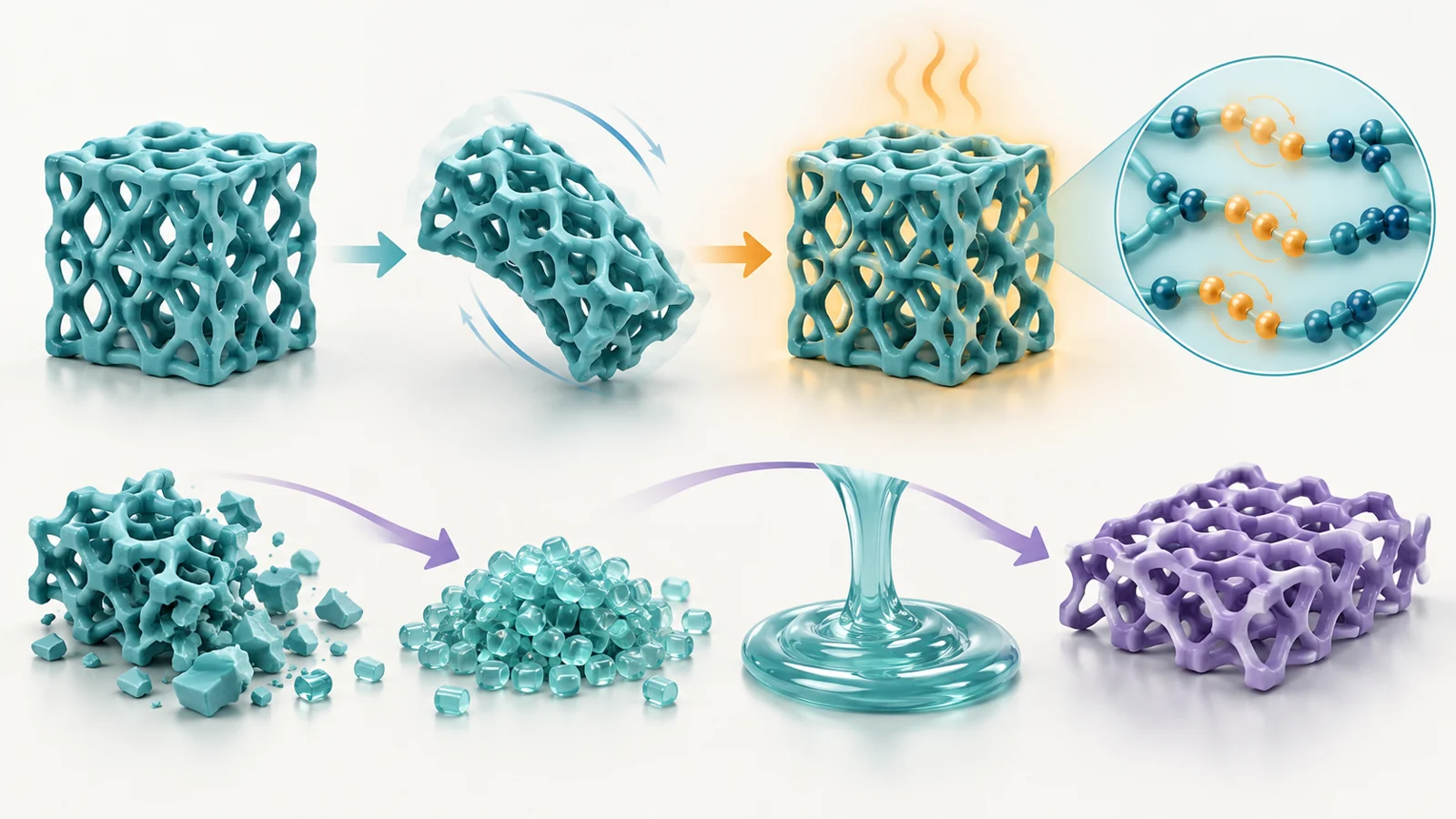
A plastic part can be bent into a temporary form, held there, and later return to a shape set earlier. Some thermoplastic shape-memory polymers can also be processed again after forming. Those are related capabilities, but they are not the same operation: recovery uses stored internal stress to return the material, while reprocessing means forming the material again.
A review published on 15 May 2025 surveys how thermoplastic shape-memory polymers and their composites work, how they can be activated, and where researchers have explored using them. Its examples span different materials and devices; they are not a demonstration of one plastic that combines every trigger, strength, recovery behavior, and recycling benefit. The central design question is how to make a material easy to shape while retaining a reliable return to its intended form.
A temporary shape is fixed, then released
In a common heat-triggered cycle, the material starts in its permanent, or original, shape. Heating it to a transition temperature makes parts of its molecular chains mobile. An external force can then deform it. The force is maintained while the material cools, fixing the temporary shape. Heating it again allows the chains to move and the material to recover its original form.
The mechanism depends on two kinds of structural behavior. More stable regions help hold the permanent shape and resist the chains slipping or flowing during deformation. Reversible regions switch between more mobile and less mobile states, allowing the material to be deformed and then fixed temporarily. The review describes transitions involving glass-like and rubber-like behavior, melting and crystallization, changes in liquid-crystal order, or associations between molecules that can form and separate.
A simple way to picture the cycle is as a temporary arrangement held by constrained, oriented chains. Cooling or another reversible change fixes that arrangement; a later stimulus releases the stored stress, allowing a return toward the permanent shape. The exact transition depends on the material. The review’s explanation is a general mechanism, not a claim that every polymer uses the same molecular switch.
Easier to reshape can mean a harder stability problem
Thermoplastics have mostly linear molecular chains held together by interactions between chains. Heating can let those chains move, which supports processing through methods such as molding, extrusion, and additive manufacturing. The material can also be processed again after forming. Thermoset polymers, by comparison, have crosslinked structures that connect chains into a network.
That difference matters for shape memory. A thermoplastic’s linear structure can make processing more flexible, but its shape-memory properties may be weaker than those of a thermoset. The review describes two broad responses: add reinforcing fillers to increase stiffness, or combine the shape-memory material with elastic materials to increase the stored elastic strain energy. These approaches address a materials-design tradeoff; they do not make reprocessing and shape recovery interchangeable.
The range of thermoplastic matrices discussed is broad. Examples include polylactic acid, polyurethane, and polycaprolactone, as well as polynorbornene, liquid-crystal elastomers, chitosan, and lignin. The variety allows researchers to explore different processing and performance combinations, but a polymer’s name alone does not establish how a finished component will behave in a particular use.
Different triggers reach the shape change by different routes
Heat is the most established trigger described in the review. Electrical and magnetic activation can provide heat indirectly. In an electrically activated composite, conductive particles form connected pathways; an applied voltage drives current through them, generating heat. Once the polymer reaches its transition temperature, recovery can begin. The review discusses conductive materials including metal particles, graphene, carbon nanotubes, carbon fibers, and carbon black.
A magnetic field can also heat a composite remotely. Magnetic particles absorb energy from an alternating field and transfer it as heat to the polymer. The review describes studies using iron oxide particles in proposed biomedical structures, including an occluder meant to close an opening and a stent meant to support the windpipe. Those examples show ways researchers have explored remote actuation and tailored geometry; they do not establish clinical benefit or readiness for an installed device.
Light can trigger recovery through photothermal heating, where added particles convert light into heat, or through photosensitive chemical groups that respond to irradiation. The review discusses a carbon-nanotube composite that bent a paper bilayer into an artificial flower, and materials designed to respond selectively to different light wavelengths. Solvents offer another route: molecules entering a polymer can increase chain flexibility or disturb interactions between chains, lowering the transition needed for movement. Water-triggered examples include composites based on polyvinyl alcohol and graphene oxide.
These routes differ in how energy or molecular interactions reach the shape change. A voltage or magnetic field can still rely on heat; light may heat the material or act through photosensitive groups; a solvent can change chain mobility. Changing the trigger does not necessarily change the underlying recovery principle.
Geometry becomes part of the design
A shape-memory material can make a device that changes form more adaptable. In one study discussed by the review, transparent shape-memory polyimide composites supported flexible electronic components that could move from a flat, two-dimensional form to a three-dimensional one and recover when heated. The review also describes a multi-material 3D-printed actuator whose conductive filament enabled electrically triggered recovery. These are separate examples with distinct materials and designs, rather than evidence for one universal shape-changing electronic device.
Four-dimensional printing extends 3D printing by designing a printed object to change shape after fabrication. The added “dimension” is the planned change over time in response to a stimulus. Thermoplastics are useful to this approach because they can be processed into complex forms without a mold. The shape-changing response then depends both on the polymer and on the geometry built into the part.
The review describes printed triangular, square, and honeycomb lattices that can deform substantially. Their topology—the arrangement of the repeating cells—can affect properties such as stiffness and the ratio between sideways and lengthwise deformation, called the Poisson’s ratio. In the cited examples, changing the lattice design and temperature enabled adjustable behavior. A printed mesh made from polyetheretherketone was also discussed as a reconfigurable structure. These examples point to geometry as an additional design choice; they do not show that every lattice will behave alike.
A separate route uses rearrangeable networks
Dynamic covalent networks offer another way to approach the balance between stability and reprocessing. They are not simply the same linear-chain mechanism described for thermoplastics. In these materials, covalent bonds form a network, and the network’s topology can rearrange when dynamic bonds are activated. The intended combination is network-like strength and stability with the ability to process or reprocess the material under suitable conditions.
The review describes studies that used rearrangeable networks to control molecular architecture and macroscopic shape, including designs with multiple programmable shapes and reversible memory behavior. This strategy could broaden the ways a material’s shape and mechanical properties are set. Its usefulness depends on how the network behaves in the specific conditions and application involved.
What this could change
If researchers can pair dependable shape recovery with practical reprocessing, a component could be formed for one use, adapt its shape during operation, and later be reshaped into another form. Printed lattices offer a route to tune that behavior through geometry as well as polymer chemistry; dynamic networks offer a distinct route to combine stability with rearrangeability. Together, these ideas could expand the range of flexible electronics, actuators, and engineered structures that can be designed around changing shapes.
The bridge from these examples to useful parts is application-specific testing: a design must show that it retains the needed shape, performance, and processing behavior through the conditions it will encounter. Reprocessing by itself does not establish an environmental advantage for a finished product. The review maps out materials and design strategies that make such components conceivable; it does not show that one material already delivers all of these capabilities in a deployed application.
Key Sources
- Primary source: Research Status and Potential Direction for Thermoplastic Shape Memory Polymers and Composites: A Review.
DOI or Journal Page · Review or Meta-Analysis · 2025-05-15
Keep exploring