
Research Signal – Source date 2021-04-25
A woven kenaf composite has been studied for a car bumper beam because its plant-fiber reinforcement can help a material absorb impact. Yet the Malaysian research described in a 2021 review had not brought woven kenaf composites close to broad commercial use. The contrast is useful: a promising material property is only one part of making a dependable product that can be produced and adopted.
Published April 25, 2021, the review brings together earlier work on kenaf fibers, thermoset plastics, composite manufacturing and Malaysia’s production and uptake challenges. It is a synthesis of prior studies, not a new bumper-beam experiment or a pooled estimate of performance. Its account shows why the fabric’s structure matters, but also why the result depends on the resin, the bond between fiber and resin, and how a part is made.
From stem fiber to a woven reinforcement
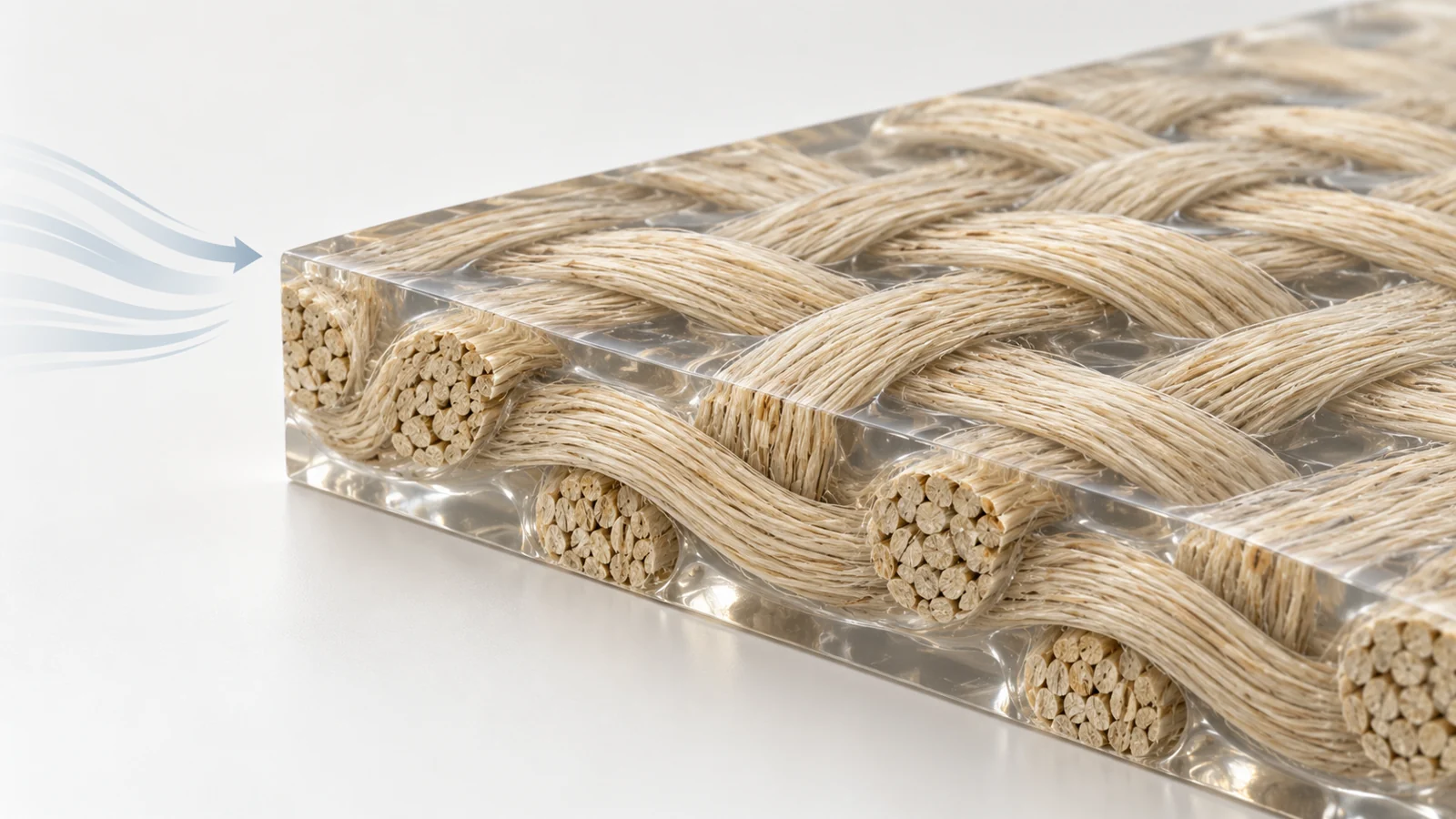
Kenaf stems contain bast fibers on the outside and a different core material inside. The review describes separating these parts before processing because they respond differently to heat, chemicals and water. Bast fibers can then be made into several forms, including short fibers, long fibers and yarn. To make woven reinforcement, strands are twisted into yarn, and the yarns are interlaced into a fabric pattern that can be cut to fit a composite part.
That fabric is more organized than loose fibers. The yarns form paths through the material, and their crossing pattern influences how forces travel through it. In studies summarized by the review, woven kenaf reinforcement helped resist the spread of cracks. The authors also describe work on external medical equipment that reported improved mechanical properties, particularly impact resistance. These examples show what the fabric can do in specific studied composites; they do not establish that every woven kenaf part will behave the same way.
Even fabrics made from the same plant can differ in important ways. The review notes that yarn thickness and weave structure affect tensile properties, while fabric count and pattern can shift the mechanical performance of the finished composite. In one set of studies, composites with a loose plain weave had the highest bending stiffness, while tighter fabrics showed greater tensile and impact strength. In practical terms, a design that bends favorably is not automatically the one that carries a pulling force or absorbs an impact best.
The amount of fiber also matters, but simply adding more is not a universal route to improvement. The review discusses studies in which higher kenaf content improved thermal performance in hybrid composites. It also describes ballistic-material investigations where the added fabric increased composite thickness and density, with greater energy absorption reported. These findings concern particular designs and measurements. They are not a general performance ranking against synthetic reinforcement.
The bond determines whether the fabric can help
A composite combines reinforcement with a surrounding matrix. In the systems covered by the review, that matrix is often a thermoset resin: a liquid or soft material that hardens through curing into a network that cannot be melted and reshaped. Epoxy, polyester and vinyl ester are among the resins discussed. The cured resin holds the fibers in place and transfers load between them, so the interface where fiber and resin meet is central to performance.
Plant fibers can be difficult to bond well with some resins. The review describes the natural fiber surface as hydrophilic, meaning it interacts readily with water, while common resin matrices can be more water-repelling. When adhesion is weak, the reinforcement and matrix may not work together effectively. Water in the fiber can also evaporate during processing and form bubbles or voids, weakening the bond and the finished composite.
The reviewed studies explored ways to improve this interface. Treatments can remove some non-cellulose material from kenaf’s surface and improve how resin wets the fiber. For example, the review describes alkali cleaning and heat treatment among the approaches studied; reports included improved tensile, flexural or impact properties under particular conditions. In one study described by the review, adding vinyl silane increased Young’s modulus, a measure of stiffness under tension, while other mechanical properties did not change. The variation matters: treatment effects depend on the fiber, resin and manufacturing route, and no single treatment guarantees better results across all measures.
A plant fiber does not make the whole part biodegradable
Kenaf is plant-derived, but that fact alone says little about what happens to a finished composite at the end of its useful life. In a thermoset composite, curing creates a crosslinked resin network that cannot simply be melted down and reshaped. The review notes that conventional thermoset resins are not biodegradable. It also describes grinding cured material into fine particles for use as filler in new laminates or other products, which is a recycling route rather than a return to natural decomposition.
The review also considers bio-based thermoset resins, including bioepoxies made from plant oils. It describes reports of favorable mechanical or thermal properties, alongside studies with different outcomes, and notes reported biodegradability properties for some bioepoxy composites. “Bio-based” identifies something about the resin’s origin; it does not, by itself, establish that a kenaf composite as a whole will biodegrade or provide a lower environmental impact. The finished material still depends on the particular resin and its formulation.
Making repeatable parts takes more than a good weave
Manufacturing affects whether the fibers are properly surrounded by resin and whether different parts come out consistently. The review describes hand lay-up, in which workers position and impregnate reinforcement layers by hand. This approach has relatively low start-up costs and can accommodate complex parts or design changes, but it is slow and depends heavily on worker skill. Differences in how people apply resin or remove trapped air can lead to variation from one part to another.
Closed molding takes a different route. Dry reinforcement is placed in a mold, then resin enters the enclosed cavity, often with a pump or vacuum. The review describes this method as offering more repeatable production, shorter cycle times and lower material and disposal costs, though it requires specialized equipment and is generally suited to larger production volumes. Those are general process tradeoffs in the review, not proof that a particular Malaysian kenaf component has been manufactured at scale.
A kenaf example in the review shows how processing choices interact with material design. In pultrusion, fibers are drawn through resin and a heated shaping die to produce continuous parts. The process can be productive, but resin flow and curing need control. In a study of kenaf fiber and vinyl ester, increasing filler content to a substantial level was associated with lower mechanical properties. The review attributes this to higher resin viscosity, which can reduce wetting and increase porosity. More fiber can therefore leave less room for resin to coat and bind the reinforcement effectively.
Malaysia’s gap is also a production and uptake problem
The review’s Malaysian account is not limited to laboratory performance. It identifies inconsistent reinforcement quality, limited public awareness of woven kenaf composite products and insufficient government support for research and public knowledge-sharing as key challenges. It also describes low production output, a shortage of skilled workers and low returns per area of land as difficulties facing kenaf plantations. These issues connect the material’s technical promise to the conditions needed for a supply chain.
A steady product pipeline would need to link cultivation, fiber processing, fabric production and industrial use. The authors point to the need for such a production chain, along with more visible ways to communicate research beyond universities. They suggest platforms such as social media, newspapers, public campaigns and community activities, and argue for stronger research funding. Those are the authors’ proposed responses to barriers they identify; the review does not test whether a particular outreach or funding measure would create a viable market.
The distinction between a research prototype and a commercial part runs through each stage. Fiber batches need sufficient consistency. A fabric pattern must suit the mechanical demands of the part. Resin has to wet and bond with the reinforcement, and manufacturing must produce repeatable results. Then a product must be known and accepted beyond the research community. Progress in any one step cannot substitute for the rest.
What woven kenaf could bring to car parts
If those supply, bonding and production challenges can be addressed, woven kenaf could offer Malaysian manufacturers another reinforcement option for parts where impact resistance matters. The review points to automotive structural research, including a studied bumper-beam design using glass and woven kenaf in an epoxy composite. That is evidence of investigation, not a commercially deployed component or a vehicle safety certification.
A more developed chain could also create greater demand for kenaf and potentially benefit growers and local communities. The authors present that economic possibility as a future perspective, not as a demonstrated outcome. Whether it materializes depends on a durable path from cultivation to reliable composite parts and real market uptake. The review’s central lesson is that the weave can shape impact performance, but adoption depends on the whole system around it.
Key Sources
- Primary source: The Challenges and Future Perspective of Woven Kenaf Reinforcement in Thermoset Polymer Composites in Malaysia: A Review.
DOI or Journal Page · Review or Meta-Analysis · 2021-04-25
Keep exploring