
Research Signal – Source date 2021-03-26
Glioblastoma vaccines aimed at one tumor marker can run into a moving target: not every cancer cell displays the marker, and some tumors lose it as they recur. A 2021 review describes a different idea: prepare a patient’s own tumor cells with a mixture of immune stimulants, then use the immune system to encounter a wider range of tumor features.
The approach is called MBTA, for mannan-BAM, Toll-like receptor ligands, and an anti-CD40 antibody. It remains an investigational proposal for glioblastoma. The concrete results highlighted in the review came mainly from mouse models of other cancers, especially colon carcinoma, so they show why researchers considered the strategy—not that it works against human brain tumors.
A vaccine built around more than one marker
One glioblastoma vaccine strategy reviewed in the paper targeted EGFRvIII, a variant of the epidermal growth factor receptor. The review says roughly 20–30% of patients have tumors with this variant. But even when present, EGFRvIII can be unevenly expressed among cells in the same tumor. In patients whose tumors had the mutation, the review cites its loss in about 30–50% of recurrences. A vaccine that trains immunity against a marker that some cells lack may leave those cells outside its reach.
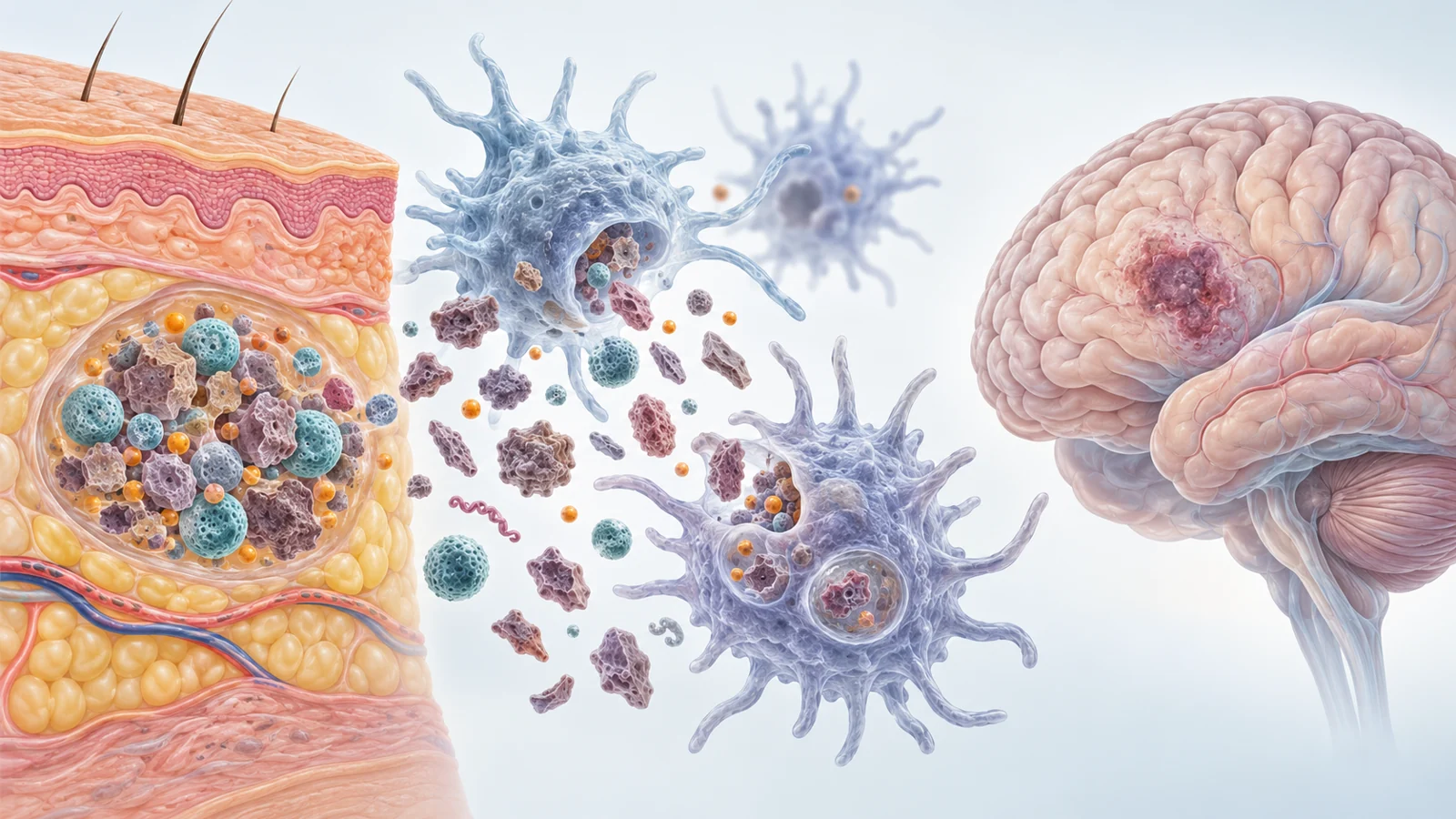
MBTA’s proposed answer is to use tumor material itself as the source of targets. In the approach described, a resected tumor sample would be irradiated so its cells are inactivated, then combined with MBTA. The preparation would be injected under the skin, away from the brain tumor. Immune cells would encounter and process material from the tumor, allowing antigen-presenting cells—the cells that display protein fragments to other immune cells—to help start an adaptive response.
MBTA’s ingredients are meant to prompt different parts of the immune response. Mannan, a sugar from baker’s yeast, is attached to the prepared tumor cells with BAM, a membrane anchor; it helps immune cells take up the material. Three other ingredients stimulate the body’s early immune response, while anti-CD40 helps the cells that display tumor fragments activate T cells for a more targeted response. The goal is to offer the immune system several tumor features instead of one marker chosen in advance.
The clearest results came from colon cancer mice
The review describes earlier experiments using CT26, a mouse colon carcinoma model. In one, researchers injected MBTA directly into a primary tumor. Treated mice had smaller primary and metastatic tumors and better overall survival than saline-treated controls.
A separate experiment tested a vaccine made of irradiated whole tumor cells pulsed with MBTA and delivered under the skin. Compared with saline or irradiated tumor cells alone, vaccinated mice had smaller median tumors and higher survival. Four mice whose tumors completely regressed were later exposed to CT26 cells again at a new site; none showed tumor growth. In a further challenge, the same four mice received CT26 cells implanted in the brain. None showed intracranial tumor, while all four control mice developed tumors and died within 30 days.
Those rechallenge groups were very small, and the brain challenge used CT26 colon carcinoma cells—not glioblastoma cells. The result is evidence of immune memory in that mouse model, not evidence that MBTA prevents glioblastoma recurrence or treats brain tumors in people. The review also mentions preliminary work involving GL261-Luc cells, a glioblastoma mouse model, but the central supporting experiments it details are not human studies.
Moving the injection site changes the problem
Directly injecting an immune stimulant into a tumor can be difficult when inflammation or swelling in that location could harm nearby tissue. The review notes that earlier MBTA work relied on injection into the tumor, limiting its potential where secondary inflammatory damage or mass effect would be a concern. Delivering irradiated tumor cells with MBTA under the skin was explored in the colon cancer mouse model as a way to prompt an immune response from a peripheral site.
For glioblastoma, that proposal raises a different set of questions. The disease can infiltrate surrounding normal brain tissue, making it difficult to target cancer without affecting nearby cells. The skull also leaves limited room for swelling; the review warns that an immune reaction in the brain could carry serious risks. It raises possible toxicities by comparison with other T-cell therapies, including neurologic complications and systemic inflammatory reactions. These are concerns about a proposed use, not adverse events demonstrated in patients receiving an MBTA glioblastoma vaccine.
There are also gaps between the mouse experiments and a practical human treatment. The review cautions that cell culture and mouse models differ from human glioblastoma, so they cannot establish how reliably immune cells activated under the skin would move into the brain. And injecting irradiated tumor cells at a distant site presents a concern of possible tumor seeding, even though the cells are irradiated. The review describes that as a pragmatic safety obstacle, not as an observed outcome of the proposed human treatment.
Could a whole tumor vaccine widen glioblastoma’s targets?
If researchers can make the preparation safely and reproducibly, a patient-specific whole tumor vaccine could give immune cells several tumor features to recognize, including features a single-marker vaccine might miss. That could eventually complement surgery, chemotherapy, and radiation for a cancer whose cells vary within a tumor and can change over time. The route to that capability depends on showing that the immune response can reach human glioblastoma effectively without harmful brain inflammation, off-target injury, or tumor seeding. The 2021 review presents MBTA as a possible direction for future study, not a validated vaccine or clinical regimen.
Key Sources
- Primary source: Mannan-BAM, TLR Ligands, Anti-CD40 Antibody (MBTA) Vaccine Immunotherapy: A Review of Current Evidence and Applications in Glioblastoma.
DOI or Journal Page · Review or Meta-Analysis · 2021-03-26
Keep exploring