
Research Signal – Source date 2021-03-25
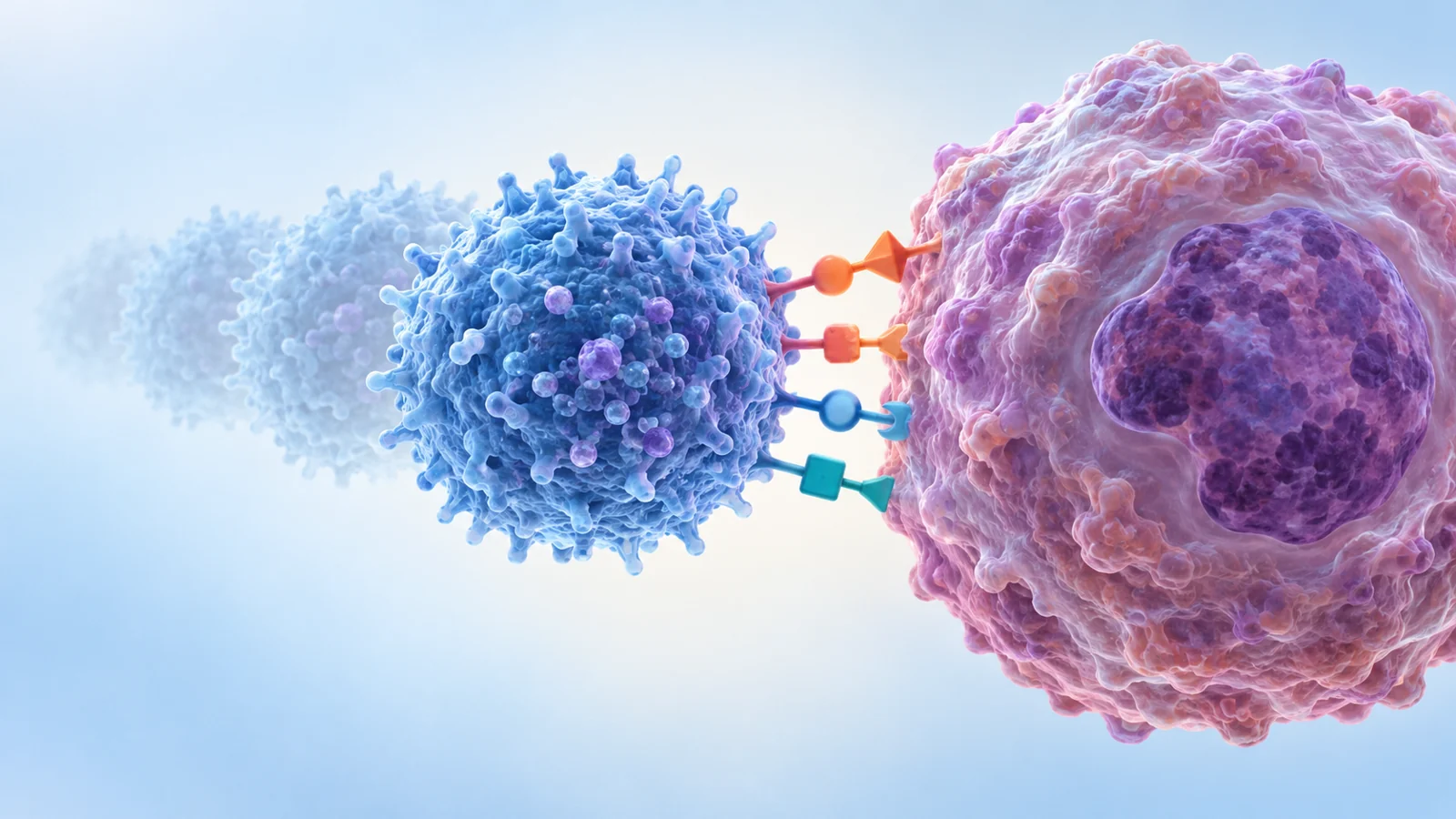
Natural killer cells are immune cells that can attack abnormal cells without first recognizing a specific tumor antigen. That makes donated cells appealing for blood cancers: some early studies used them across donor-recipient immune mismatches, and cells prepared in advance might be available sooner than a custom-made treatment. But arriving quickly is only part of the problem. The cells must also survive in the patient and still recognize a cancer that can evade them.
A 2021 review of natural killer cell therapy describes early clinical observations and the work to expand and prepare donor cells. It brings together different kinds of studies, rather than testing one treatment in a single trial. The findings offer reasons to investigate this approach, but they do not establish that donor cell infusions alone improve survival over standard care.
A mismatch can be part of the recognition process
Natural killer cells weigh signals from their surroundings. Activating receptors respond to signs of danger on a cell, while inhibitory receptors help them recognize the body’s own cells. The balance can make a cancer cell vulnerable even when it lacks the specific target that a T cell therapy might need.
This balance also helps explain why some donor-recipient mismatches were associated with anti-leukemia activity in transplant studies. In people receiving a transplant from a partly matched donor, researchers observed lower relapse in some cases when differences between donor and recipient favored natural killer cell activity. The review describes this as a graft-versus-leukemia effect: donor immune cells may help attack leukemia after transplantation. Transplant studies, however, involve more than an infusion of natural killer cells, so their results cannot be treated as a stand-alone cell therapy effect.
Early infusion studies added a different kind of evidence. One report described remission after natural killer cells from a partly matched donor were given following chemotherapy for poor-prognosis acute myeloid leukemia (AML). In a separate study, ten children with AML received donor natural killer cells after remission, with a mismatch in immune receptors between donor and recipient; none had relapsed at the time reported. Across the early studies summarized, the review reports favorable safety observations, including across immune mismatches, and no graft-versus-host disease (in which donor immune cells attack the recipient) in the cited donor-cell infusion studies. These small, varied experiences are encouraging observations, not proof that the same safety or outcomes would hold in larger or different patient groups.
Two other results show why the settings matter. An early-stage (phase I) study combining expanded natural killer cells with chemotherapy reported a 69% complete response rate among people whose AML had returned or resisted treatment. In a transplant study, three infusions of expanded cells on days −2, +7 and +28 were associated with relapse falling from 35% to 5% compared with historical controls. These are not directly comparable estimates: one was an early treatment combination, another involved transplantation and a historical comparison, and the other reports came from different patient groups and treatment contexts. They cannot be combined into one estimate of what donor cells would do on their own.
Building a supply before it is needed
A personalized cell product can take time to prepare. For someone with rapidly relapsing leukemia, the disease may progress while a donor is identified, cells are collected and a treatment batch is expanded. Cells from people with cancer may also be too few or function too poorly for effective self-donation, according to the review.
To make larger, repeat doses possible, researchers expanded donor cells outside the body. Methods included stimulating cells with immune signals, sometimes alongside feeder cells engineered to support growth. One method discussed in the review produced an average 3,000-fold expansion in two weeks and 20,000–80,000-fold in three weeks. Those figures describe laboratory expansion, not a clinical benefit. They show how researchers sought to increase supply enough for repeat infusions.
The review also describes an investigational donor bank for a clinical trial in relapsed AML and myelodysplastic syndromes. Healthy donors could be selected, their cells expanded and doses made available without starting collection for every patient from scratch. The review also discusses cord blood and stem-cell-derived natural killer cells as possible sources. Banking and expansion offered a route toward ready supply, but did not establish a routinely available treatment.
The cells may not stay long enough
A large dose is useful only if the cells remain active in the body. Natural killer cells are generally thought to last days to weeks, much less time than some other transferred immune cells. The review describes an observation in relapsed AML in which greater movement of infused cells into the bone marrow and their persistence there two to three weeks later were associated with clinical response.
Researchers explored several ways to extend that window: preparatory chemotherapy to make room for transferred cells and change immune signals, cytokines to support survival, and repeated infusions. In one early study, chemotherapy before infusion was followed by donor-cell expansion, with donor cells persisting for more than 28 days in some patients. Cytokine support can help cells grow and survive, but it brings its own tradeoffs; the review notes that stimulated cells may depend on continued signals and that some cytokine approaches have caused unwanted toxicities. These strategies were attempts to address a practical bottleneck: cells prepared in advance still have to persist long enough to act.
Cancer can hide the cues the cells need
Even surviving natural killer cells can struggle if a tumor stops displaying the danger cues that activate them. The review describes blood cancers with reduced activating signals on tumor cells, alongside natural killer cells from patients that have lower levels of receptors involved in recognizing or killing targets. In AML, reduced recognition receptors on natural killer cells and fewer matching cues on leukemia cells were linked to weaker contact and killing. The consequence is straightforward: a donor cell may be ready and present, yet have fewer opportunities to identify its target.
The marrow environment can add another obstacle. Low-oxygen pockets occur in the bone marrow, and the review describes hypoxia as impairing natural killer cell activity. Under those conditions, cells can lose some activating receptors. The cancer cells may also break down granzyme B, a substance natural killer cells use to kill targets. The tumor environment can therefore weaken both recognition and the damage delivered after contact.
An antibody can guide the attack and create a tradeoff
Some cancer antibodies help natural killer cells find tumor cells. The antibody attaches to a target, and the natural killer cell can bind to the antibody and kill the marked cell. The review describes this as one way treatments such as rituximab for some B-cell cancers and daratumumab for multiple myeloma can recruit natural killer cell activity.
Daratumumab also illustrates a complication. Natural killer cells carry the same CD38 target, so the antibody can cause them to attack one another and reduce their numbers. In experimental work discussed in the review, researchers used gene editing to remove CD38 from natural killer cells. The edited cells resisted this antibody-driven cell loss and showed improved activity against CD38-positive myeloma cells in those experiments. That result suggests a design approach, not an established treatment for patients.
What a donor cell bank could mean for urgent leukemia care
If donor cells can be prepared ahead of time, persist after infusion and keep recognizing cancer in the marrow, a banked supply could make cell therapy available on a timeline that fits rapidly progressing blood cancers. It could also support repeat dosing and reduce the wait and batch-to-batch variation involved in making a product for each patient. The early studies and laboratory advances described in this 2021 review point toward that possibility; whether it can deliver reliable clinical benefit depends on solving the linked problems of survival and tumor escape.
Key Sources
- Primary source: Natural killer cell therapy for hematologic malignancies: successes, challenges, and the future.
DOI or Journal Page · Review or Meta-Analysis · 2021-03-25
Keep exploring