
Research Signal – Source date 2021-03-16
Two complete tumor responses may sound more convincing than two partial responses. But in this case series, the complete responses happened while bevacizumab was given with chemotherapy and then continued afterward. The partial responses occurred during erlotinib alone, making it easier to connect the timing of those observations to that drug—though neither pattern proves that a drug caused the response.
The March 16, 2021 paper paired a retrospective review of patients treated at one cancer center from 2013 through 2019 with a search of earlier literature. Of 291 patients with vulvar squamous cell cancer (VSCC), 12 received at least one targeted drug after platinum-based chemotherapy. Five received erlotinib, nine received bevacizumab, and three received pembrolizumab. Those counts overlap because some patients received more than one drug; they are not three separate groups of patients.
A narrow set of options after platinum treatment
VSCC is the most common form of vulvar cancer, but it includes tumors with different biological features. When cancer returns or spreads and surgery or radiotherapy is not an option, treatment choices are limited. The patients in this series had already received platinum-based chemotherapy before starting a targeted drug.
The center recommended targeted treatment to 16 patients, but only 12 received at least one of the three drugs. The other four chose a different option after their health deteriorated, or their insurance did not cover the treatment. This helps explain why the treated group represents a small, selected slice of the center’s 291 patients, rather than a broad sample of everyone with VSCC.
Erlotinib blocks a cell-growth signal
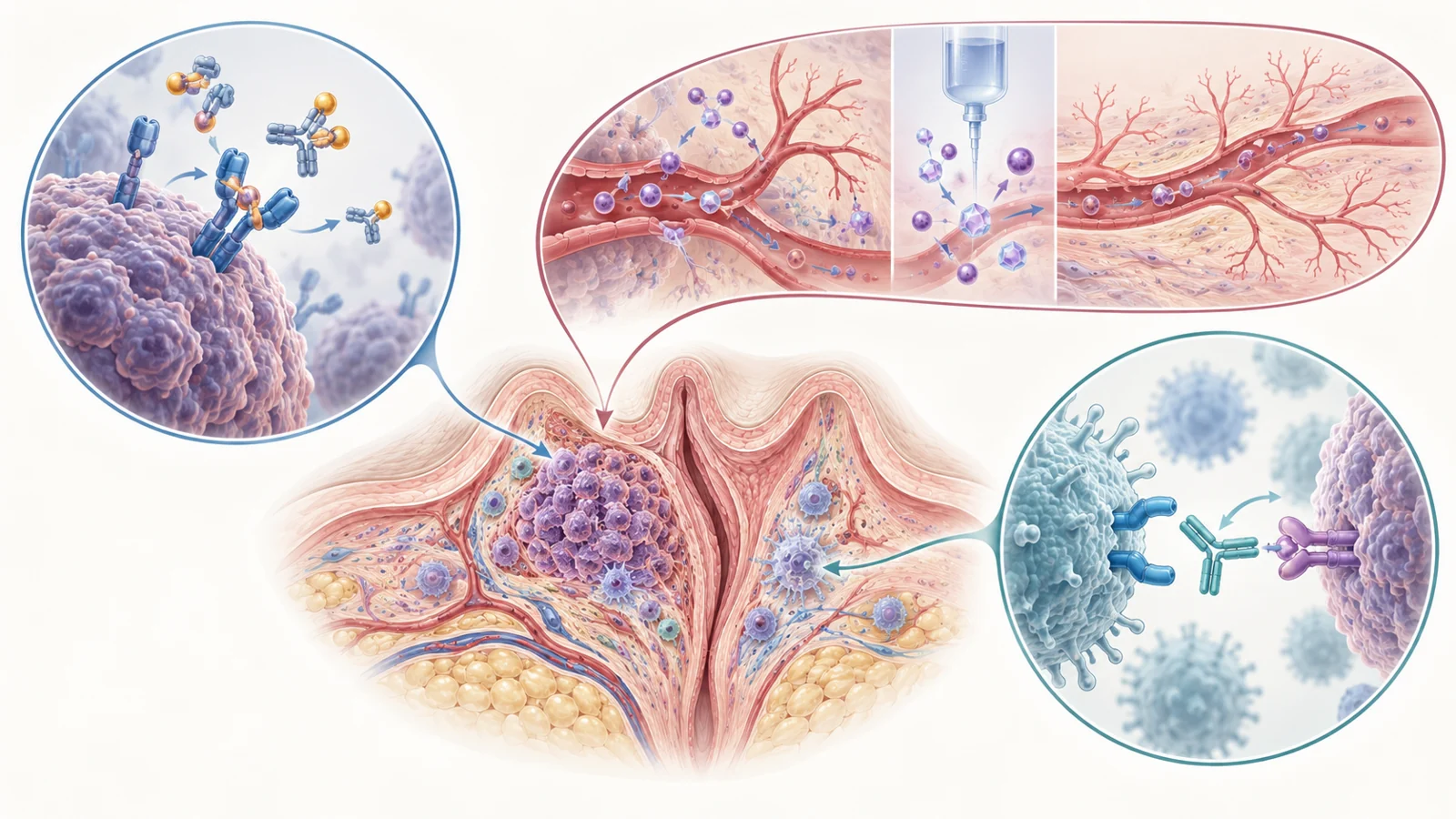
Erlotinib targets EGFR, a receptor on cell surfaces that helps pass along signals involved in cell growth. In the five patients who received erlotinib as a second- or third-line treatment, two had partial responses, meaning their tumors shrank, and two had stable disease, meaning the cancer did not meet the study’s criteria for either sufficient shrinkage or growth. One patient therefore did not fall into either of those reported response categories. Median time to progression was 3.4 months.
These outcomes were observed while patients took erlotinib alone, after earlier platinum treatment. That sequence makes the drug’s role easier to consider than when two treatments are given together, but it still cannot show what would have happened without erlotinib. The series had no comparison group to separate the effect of the drug from other influences on each patient’s disease.
Testing also did not produce a simple rule for choosing who might respond. Four of the five patients tested negative for EGFR mutations, and the five-person group had partial responses and stable disease; these observations do not establish whether mutation status predicts response. The paper discusses EGFR expression and gene copy changes as possible areas of interest, but the case series does not validate a test that can reliably identify likely responders.
Treatment had practical costs as well. Erlotinib was associated with diarrhea, including one grade 3 episode accompanied by a Clostridium difficile infection. Skin problems and elevated liver enzymes were also reported; one patient needed a dose reduction because of liver enzyme elevations.
Bevacizumab was part of a treatment sequence
Bevacizumab targets VEGF, a signal that helps tumors develop blood vessels. The nine patients who received it were given the drug alongside platinum-based combination chemotherapy and continued it as maintenance treatment afterward. The paper reports two complete responses, one partial response and three cases of stable disease as the best responses in this group. Two patients were still receiving treatment at the time described.
The complete responses are striking observations, but the treatment sequence makes their source difficult to untangle. Because bevacizumab was started with chemotherapy, a response could reflect the combined regimen; continuing the drug afterward does not show which treatment produced the initial change. The authors therefore could not report an isolated response to bevacizumab. The responses should not be read as evidence that bevacizumab alone produced two tumor disappearances.
Some adverse events led to meaningful changes in care. In two of the nine cases, bevacizumab was stopped because of a thromboembolic event or elevated blood pressure that resisted treatment. Those events make the treatment burden part of the result, alongside the tumor responses.
Pembrolizumab releases an immune brake
Pembrolizumab blocks PD-1, a protein on activated immune cells. This can release a brake on immune activity when PD-1 interacts with PD-L1, a protein that can be present on tumor cells. Researchers have explored PD-L1 measurements as a possible clue to response, but the relationship is not settled by this small series.
Three patients received pembrolizumab after prior treatment. One had stable disease, while two had progressive disease. Two of the tumors were negative for human papillomavirus (HPV) and positive on a PD-L1 test. These three cases do not establish either marker as a dependable way to select patients for the drug.
For context, the paper also describes an 18-patient pembrolizumab cohort from the KEYNOTE-028 trial, in which the reported response rate was 6% and median progression-free survival was 3.1 months. That is the paper’s account of a separate study, not a direct comparison with the three patients in the Hamburg series. The small numbers and differing study settings make a simple comparison misleading.
The evidence has limits beyond sample size
The center’s review was retrospective: the researchers looked back at medical records rather than assigning treatment under a controlled study design. Patients could receive more than one targeted drug, and treatment sequences differed. The paper also reviewed prior reports, but those studies involved varied patient groups and treatment approaches. Together, these features prevent a reliable head-to-head ranking of the drugs, a conclusion that any one improves survival, or a population-wide estimate of benefit and harm.
Across the 12 patients, nine experienced treatment-related adverse events, most often mild or moderate. The more serious events described above show why tumor response alone is not enough to characterize a treatment. With such a small and selected group, however, these counts cannot predict how often similar effects would occur in a wider VSCC population.
What tumor matching could change for vulvar cancer
If future studies can identify which VSCC subtypes are most likely to respond, targeted treatment could give some patients with recurrent or metastatic disease an option when surgery and radiotherapy are no longer suitable. That could make care more tailored and help avoid exposing patients to treatments unlikely to help. Reaching that point depends on clearer evidence about which biological features matter, and on studies large enough to distinguish a drug’s contribution from the effects of other treatments given alongside it.
Key Sources
- Primary source: Targeted Therapeutic Approaches in Vulvar Squamous Cell Cancer (VSCC): Case Series and Review of the Literature.
DOI or Journal Page · Review or Meta-Analysis · 2021-03-16
Keep exploring