
Research Signal – Source date 2021-03-12
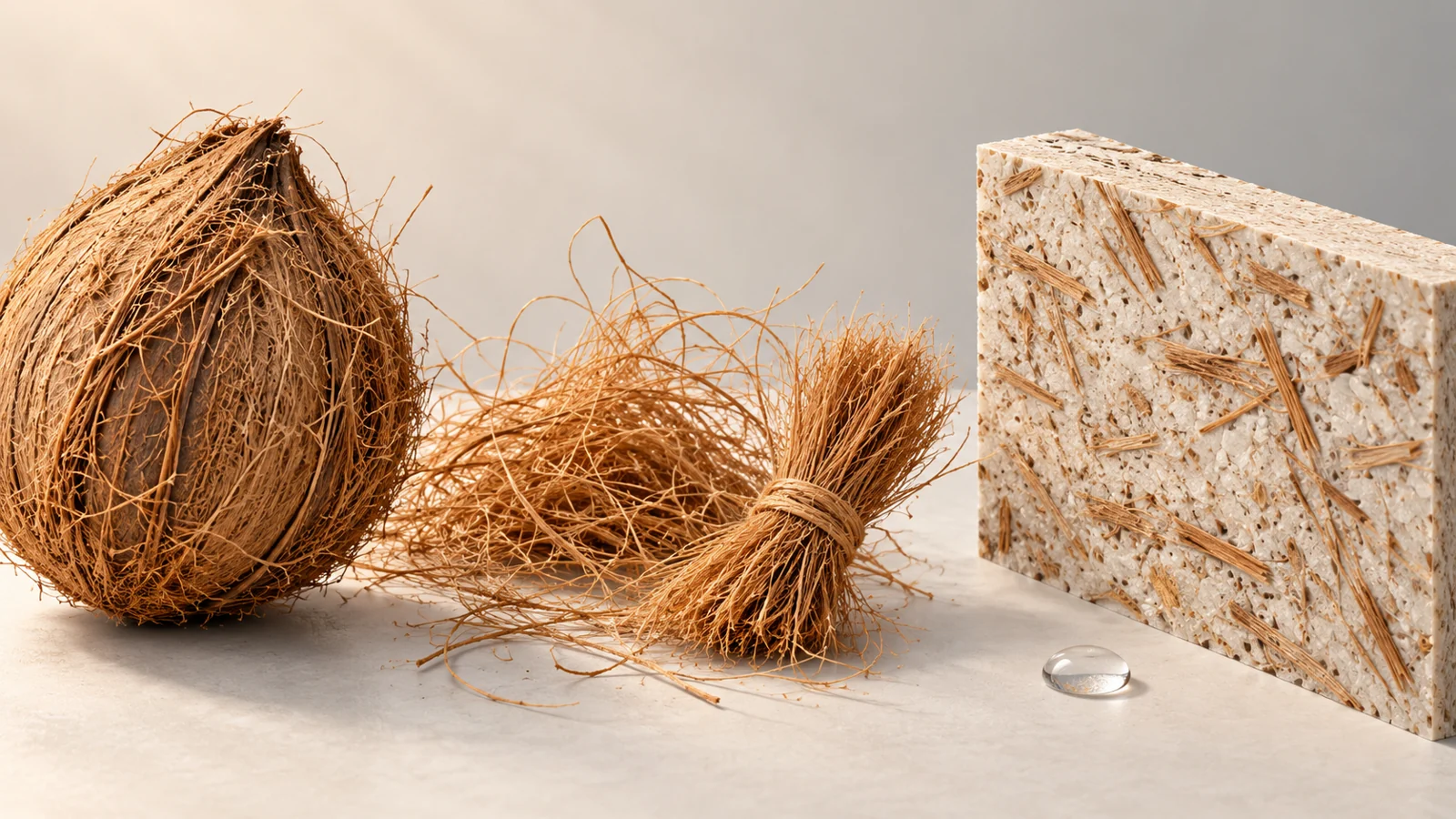
A coconut husk can become more than a discarded shell: its coarse fibers can be embedded in plastic or cement to reinforce a composite panel. But the fiber’s own strength is only part of the story. How well it joins the surrounding material, how the panel is made, and how much moisture it takes up all affect whether a particular formulation suits its intended use.
A 2021 review in RSC Advances gathers prior studies on coir, the fiber extracted from coconut husks, and composites made with it. The studies describe possible building panels, insulation and sound-absorbing materials, and automotive components. They also show why “strong” is not one simple property: a material that resists pulling or bending may still absorb water, or respond differently to impact. The results vary across fibers, treatments, mixtures and tests; they do not amount to a standardized trial of one finished commercial panel.
From husk to reinforcement
Coconut husks are often left as waste after the fruit is used. Coir has long been made into ropes, mats, brushes and other products, and researchers have also tested it as reinforcement inside composites. The fiber’s natural stiffness and durability make it an appealing candidate, while using a locally available byproduct could offer a raw material for manufacturers in coconut-growing regions. Reusing husks, by itself, does not establish the environmental balance of the finished material.
The fiber has a structure that helps explain both its appeal and its variability. The review reports that coir contains about 40–50% lignin, 27–45% cellulose, and 0.15–20% hemicellulose, alongside smaller constituents and moisture. Lignin is associated with the fiber’s hardness and rigidity. The wide ranges reflect differences in the plant material and its origin and processing, rather than a single uniform feedstock.
Measured coir-fiber properties also vary. Across studies summarized in the review, tensile strength—a measure of resistance to being pulled apart—ranged from 54 to 250 megapascals, more than a fourfold spread. Elongation at break, or how far a fiber stretches before failure, ranged from 3% to 40%. These are fiber measurements, not finished-panel results; panel behavior also depends on how forces pass between the fibers and surrounding material.
The bond between fiber and surroundings
When a composite is pulled or bent, the surrounding matrix—the polymer or cement that holds the fibers—must transfer force to them. The quality of the fiber-to-matrix interface affects that transfer. A weak or uneven connection can limit the contribution of the reinforcement, even when the fibers themselves have useful properties.
Coir surfaces can be treated to change that interface. The review describes approaches such as alkali treatment, bleaching, dewaxing and silane treatment. In alkali treatment, for example, a sodium hydroxide solution can alter the fiber surface and remove some surface impurities. The intended effect is to improve adhesion between fiber and matrix; the resulting performance depends on the treatment and the rest of the formulation.
This matters because coir composites can use different surrounding materials. Studies in the review include thermoplastics such as polypropylene and polyethylene, thermosetting resins such as polyester and epoxy, and cement-based matrices. A treatment or fiber amount that works in one combination does not establish the best choice for another. The review’s examples describe design options, not one recipe that applies across materials and uses.
Strength has more than one test
Tensile strength measures resistance to being pulled apart. Flexural strength measures resistance to bending. Impact tests capture a material’s response to a sudden blow, while water absorption and thickness swelling indicate how moisture can affect dimensions. These tests answer different questions, so an improvement in one does not settle how a panel will behave in service.
One polyester-composite study summarized in the review found bending strength increased as coir loading rose to 20%, then declined at higher loading. That turning point belongs to the tested polyester composite; it does not set a universal fiber loading. The review also notes that changes in treatment or fiber-to-matrix bonding can improve resistance to pulling or bending while reducing impact strength. A panel therefore needs tests matched to its intended use, rather than one strength figure.
Moisture adds another tradeoff. Coir contains hydrophilic groups that attract water, and the review reports that greater fiber content can increase water absorption in composites. Longer fibers, void content and composite density also influence moisture behavior. Some pretreatments reduce the water-attracting groups on coir fibers and can lower water uptake, but a treatment’s effect on moisture does not alone establish its effect on bending, impact or durability.
A panel intended for a dry interior may face different demands from a component exposed to damp conditions or repeated impacts. The studies collected in the review offer measurements under particular test conditions, rather than a direct comparison proving suitability for every end use. Practical performance needs to be understood property by property.
Making a consistent panel takes control
Even a promising combination of coir and matrix has to survive manufacturing. The review describes compression molding, extrusion, injection molding, resin transfer molding and open molding. Processing choices affect fiber distribution and the finished part, while fiber content, moisture, temperature and pressure are among the parameters that need attention.
Compression molding presses material in a closed, matched mold, with heat and pressure used during curing. The review describes it as suitable for higher-volume parts and notes that it can accommodate short or long fibers. Open molding, including hand lay-up, can be economical for larger panels and does not require the same closed tooling, but it can involve longer curing, manual labor, more waste and less uniform products. Those constraints matter when repeatable panel properties are the goal.
The choice of process is therefore part of the material design. Controlling the amount and condition of fiber, as well as the molding conditions, helps determine whether a recipe can produce panels with consistent properties. A laboratory result from one formulation cannot on its own show that a process will deliver dependable parts at larger scale.
Fiber extraction has its own environmental cost
Turning husks into reinforcement also requires extracting and preparing the fibers. Traditional water retting submerges husks so biological processes loosen the fibers from surrounding material. The review describes this as a prolonged process, in some cases taking four to twelve months.
During retting, substances including tannins, pectin, fats and phenolic compounds can enter the water. The review connects this waste to pollution concerns, including reduced dissolved oxygen and changes in other water conditions that can affect aquatic life. Researchers have investigated alternative retting methods, but using a discarded raw material does not by itself establish a net environmental advantage over a specified competing material. Extraction practices are part of the production question, not a footnote to the panel’s material properties.
What coconut-husk panels could change
Dependable coir panels could give manufacturers in coconut-growing regions another way to turn husk fiber into building panels, insulation or interior components. That possibility depends on producing material with consistent performance, controlling moisture where it matters, and using extraction methods that address the pollution associated with prolonged water retting. The review describes a promising set of material choices and applications; it does not establish one commercially deployed panel or a universal environmental win.
Key Sources
- Primary source: A state-of-the-art review on coir fiber-reinforced biocomposites.
DOI or Journal Page · Review or Meta-Analysis · 2021-03-12
Keep exploring