
Research Signal – Source date 2021-03-01
A used bottle or failed print can become feedstock for another 3D print, but getting from waste to a dependable plastic strand takes more than melting scraps. The plastic must be sorted and prepared, then formed into filament—the strand a printer feeds through its nozzle. Along the way, heat and repeated processing can change how the material flows and how strong a printed part becomes.
A review published on March 1, 2021, gathered earlier studies on recycled thermoplastics, commercial recycled filaments and small-scale equipment for making filament. It describes a promising route for giving some plastic waste another use, alongside a practical challenge: filament can look ready to print while changes in the plastic affect its flow or the strength of a printed part.
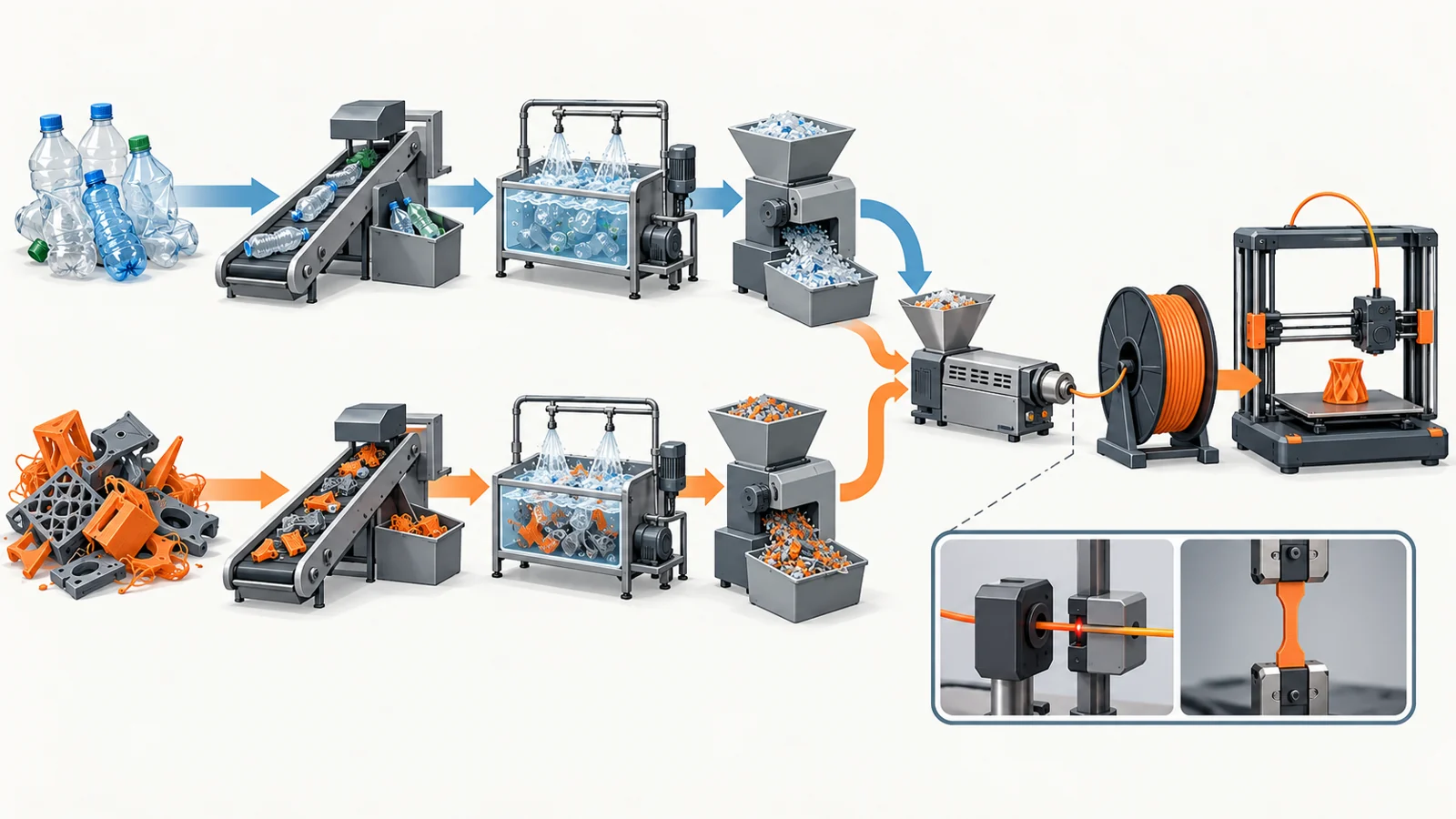
From sorted plastic to printer feed
The route starts by separating suitable plastic, washing it, and grinding it into smaller pieces. The pieces are heated and pushed through an extruder, a machine that melts plastic and forces it through an opening to form a continuous strand. The resulting filament needs a diameter suited to the printer. After printing, a part can be examined, ground up and processed again; some methods add components to the ground plastic before extrusion.
Each step matters to the feedstock. Mixing unsuitable plastics or leaving impurities in the material can affect the consistency of the strand. One cited desktop-recycling study mechanically cleaned computer waste to remove impurities that could make filament inconsistent or clog a printer nozzle. In another example, the material needed to be dry and crushed to avoid bubbles on the filament surface. These are process-specific findings, but they show why a waste item cannot be treated as ready-made printer feed just because it is plastic.
The review describes commercial filaments made from several kinds of recovered material. Examples included different plastics recovered from bottles and food containers (PET), factory waste or yogurt pots (PLA), car dashboards (ABS), and refrigerators (HIPS); these feedstocks are not interchangeable. It also described nylon made from discarded fishing nets and thermoplastic polyurethane from recycled ski boots. These products show that waste can enter established filament production through different routes. The share of recycled material varied by product and producer; a product’s recycled label alone does not tell the full story of its composition or performance.
A familiar-looking strand can still behave differently
A spool can appear consistent in diameter and surface finish even as the plastic’s internal behavior changes. That matters because extrusion depends on the material flowing in a controlled way, while a printed part’s performance depends on more than how the filament looks. A strand that feeds and prints is not automatically equivalent to one made from fresh material.
The reviewed studies describe heat, shear stress and oxygen during extrusion as contributors to polymer degradation. Repeated processing can alter viscosity—the material’s resistance to flow—as well as molecular weight and breaking strength. The review’s PLA examples illustrate how changes can accumulate, but they do not define a universal number of recycling cycles for every plastic or process.
In one cited PLA study spanning five reprocessing cycles, specimens became weaker when pulled and stretched less before breaking. Tests also found changes in how the material flowed and in its molecular structure. Another study found that PLA filament still had a similar diameter and surface finish after two extrusion cycles and one print, while its mechanical properties deteriorated slightly. Its lower viscosity, which the cited researchers attributed to breaks in the polymer chains, was a concern for further printing. These are results from particular PLA experiments, not a cycle limit for every plastic.
Printing itself also adds heating and cooling to the material’s history. The review describes how those cycles can affect stresses in a printed part and the bonds between deposited strands and layers. In practical terms, testing the filament’s appearance alone cannot establish whether a part made from it will have the mechanical behavior needed for its intended use.
The recipe changes the result
Adding another material can improve some properties, but the effect depends on the formulation and on what is measured. In one cited example, recycled PET from used bottles was combined with fine biocarbon. The study reported a 32% increase in tensile strength and about a 60% increase in elastic modulus, a measure of stiffness. The review also describes biocarbon used with PLA, where samples became stiffer. These findings point to possible ways of adjusting recycled material, not a single additive recipe for all plastics.
A different blend in the review illustrates why an additive is not a guaranteed upgrade. In one comparison, a plastic mixture’s tensile strength—its resistance to being pulled apart—fell from 23 to 19 megapascals (MPa) after a stabilizing ingredient was added. Pure recycled PET measured 35 MPa in the same report, but it was a different formulation. Those figures do not make the plastics interchangeable or establish a general ranking. They show that the result depends on the specific blend and property being measured.
The practical case depends on the whole route
Processing waste near where it is generated could avoid sending some plastic through a centralized collection and transport system. A desktop extruder, sometimes called a recyclebot, is one approach discussed in the review: it can turn prepared plastic into filament close to the place where the waste arises. Small businesses could also use shredders or extruders as part of their equipment.
That possibility is different from proving that local recycling will save money, energy or emissions in a typical setting. Collection, sorting, cleaning, grinding and extrusion all require equipment and work. The review identifies logistics and economics as obstacles, and notes that recycled filament prices in the examples were similar to conventional products. The full practical comparison depends on the waste available, the preparation needed, the equipment and the value of the filament produced. Having a product on the market does not settle whether making or buying recycled filament is cheaper or environmentally preferable in a particular case.
What local plastic recycling could make possible
If suitable waste can be sorted and processed into filament with dependable properties, printer users and small workshops could make useful custom parts closer to where the plastic is discarded. That would give some bottles, failed prints and other suitable plastic a route back into production rather than treating them only as waste. The benefit depends on the material performing reliably and on the complete process having a favorable cost and environmental balance; the review presents local reuse as a possibility whose practical value rests on those conditions.
Key Sources
- Primary source: 3D printing filament as a second life of waste plastics-a review.
DOI or Journal Page · Review or Meta-Analysis · 2021-03-01
Keep exploring