
Research Signal – Source date 2021-03-01
Radiation therapy is used to treat cancer, but its effects vary among patients. A systematic review published on March 1, 2021, considers two outcomes that may seem separate: how well radiation works against a tumor and whether treatment causes digestive problems. The gut microbiome—the community of microbes living in the digestive tract—could matter to both, through different routes.
One route involves immune activity throughout the body. The other begins when radiation aimed at the abdomen, pelvis, or rectum also exposes nearby intestinal tissue. The review brings together studies of these possible links; it does not make them the same process.
The gut can be part of a body-wide immune response
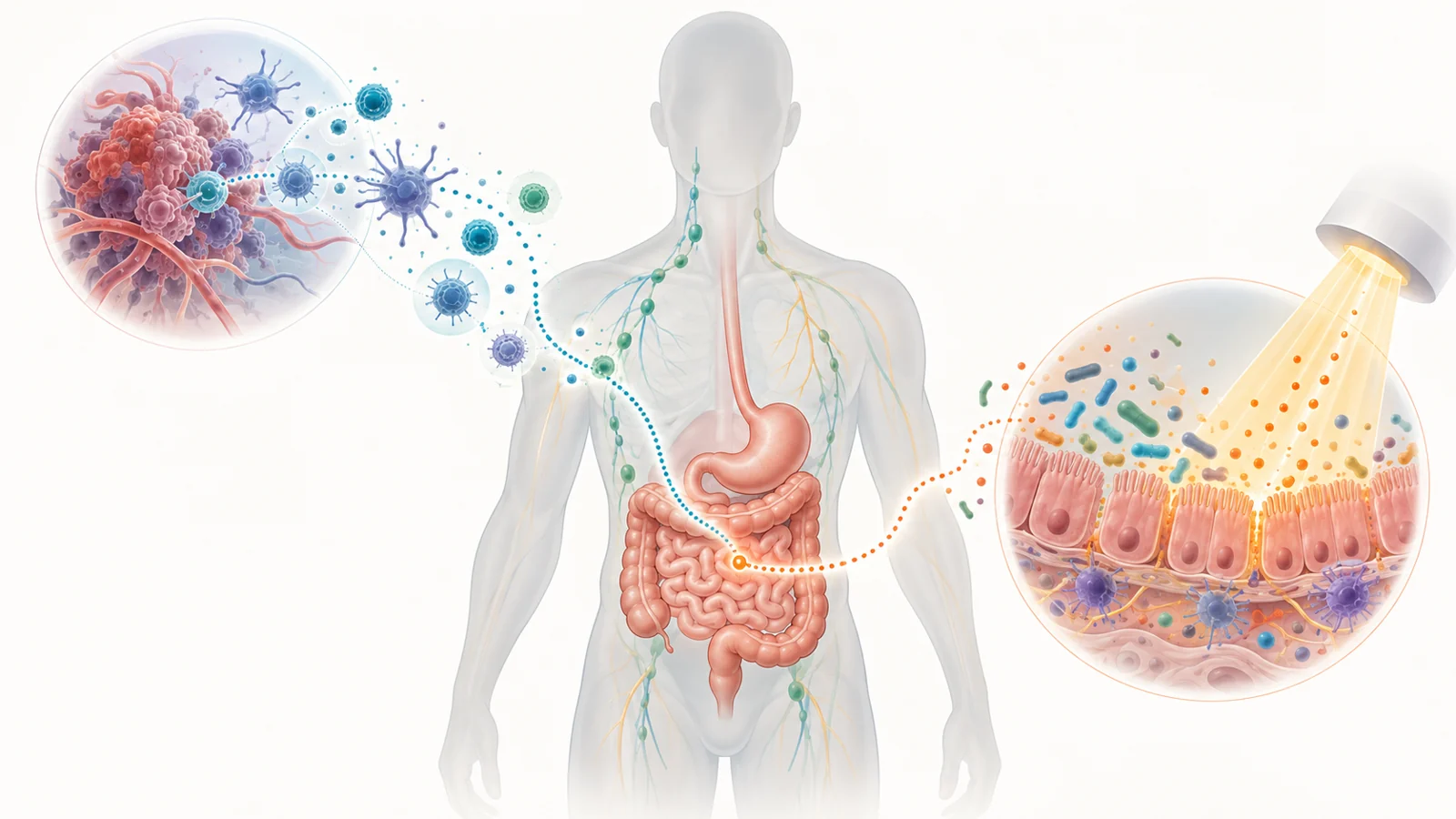
The immune system is the body’s network for recognizing and responding to threats, including cancer. Although gut microbes live in the digestive tract, the review describes evidence that they can influence immune responses beyond the gut. Because immune activity can be relevant to how the body responds to cancer treatment, researchers have studied whether microbial differences relate to radiation outcomes.
This is one reason the microbiome has drawn interest alongside immunotherapy, treatments that work through the immune system. The review notes that researchers have explored biomarkers derived from gut microbes in connection with immunotherapy, used with or without radiation. A biomarker is a measurable feature that may help researchers understand or track a biological process. Here, the idea is to investigate whether microbial features could help explain differences in treatment response—not to assume that a particular microbial profile already predicts success for an individual patient.
Radiation can also affect nearby intestinal tissue
The second question concerns where radiation is delivered. Treatment to the abdomen, pelvis, or rectum can expose the intestinal lining, the tissue that forms the gut’s inner surface. Injury to normal tissue in the treatment area can contribute to acute adverse effects, including gastrointestinal problems such as diarrhea.
That local tissue route is distinct from the proposed body-wide immune link. The first asks whether gut microbes influence immune responses relevant to cancer treatment. The second asks whether gut microbes influence digestive injury when radiation exposes tissue near the intestinal lining. Both matter to patients, but evidence about one does not by itself answer the other.
A vancomycin clue comes from preclinical models
The authors point to preclinical studies in which vancomycin improved radiation-induced diarrhea and oral mucositis. Preclinical findings come from research models rather than clinical treatment results in patients. The observation gives researchers a reason to investigate whether changing the microbiome might reduce some radiation-related toxicities, but it is not a basis for patients to take vancomycin or for clinicians to recommend it for this purpose.
A possible biomarker and a possible microbiome-restoring treatment also pose different questions. A biomarker could help researchers identify or understand patterns associated with treatment response. An intervention would attempt to change the microbiome’s function during care, raising separate questions about whether it helps, whom it might help, and whether it is safe alongside cancer treatment. The review discusses both directions as areas of interest; one does not establish the other.
What this review can support
This is a synthesis of earlier studies on possible direct and indirect ways the gut microbiome may relate to radiation efficacy and gastrointestinal toxicity. The abstract available for this article does not provide effect estimates, rules for selecting patients, or clinical results showing that microbiome changes improve radiation outcomes. It also does not establish a validated biomarker or support a treatment recommendation. Those details would be needed to judge how strongly the proposed links apply in patient care.
The central value of considering both outcomes is that cancer response and digestive injury may involve different biological pathways while still being relevant to the same treatment. Keeping those questions separate helps avoid treating an immune association as proof of protection from intestinal harm—or a toxicity finding as proof that cancer control will improve.
How gut research could shape radiation care
If researchers can establish which microbial features influence treatment response or digestive injury, and show that any intervention is safe and useful in people, this work could eventually help clinicians protect digestive health while preserving effective cancer treatment. The review points toward that possibility, but the path from proposed links and preclinical clues to reliable patient care still requires evidence in people.
Key Sources
- Primary source: The role of the gut microbiome on radiation therapy efficacy and gastrointestinal complications: A systematic review.
DOI or Journal Page · Review or Meta-Analysis · 2021-03-01
Keep exploring