
Research Signal – Source date 2021-03-01
Cancer immunotherapy asks the body’s defenses to help fight cancer. But a treatment’s effect can depend on more than which immune tool is chosen: it also matters where that tool goes and how the immune response behaves. A review published on 1 March 2021 considers engineered nanoparticles as a way to work on both problems—serving as delivery platforms while also interacting with the immune system.
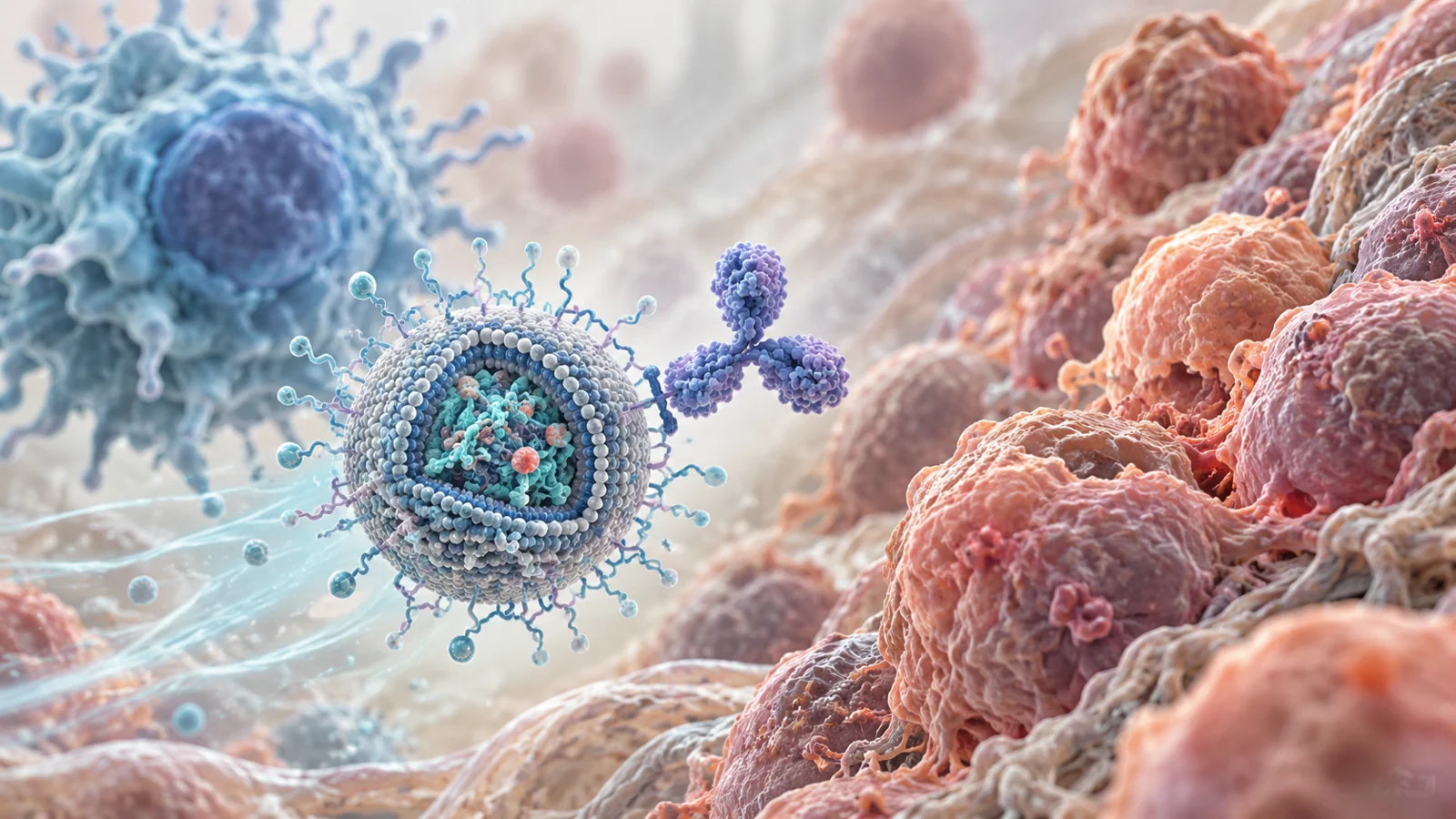
Here, “nanoparticle” means a very small engineered particle. The review presents these particles as adaptable platforms: their surfaces can be modified, and their delivery and targeting properties can be designed alongside possible immune effects. That is the field’s organizing idea in the paper, not evidence that one particle has already improved outcomes for patients.
Immunotherapy faces several different bottlenecks
The review describes conventional immunotherapy as promising, with approaches that have potential in preclinical and clinical applications. It also identifies several limitations. Getting the dose right can be difficult, and treatments may not become sufficiently concentrated in tumor tissue. Immune responses can be silenced, limiting activity, or become overactive. Cost is another challenge.
These are related but distinct problems. A delivery platform could be designed to influence where treatment components go, while features at a particle’s surface could affect how it interacts with its surroundings. Modulating an immune response is a further aim, not an automatic consequence of getting more treatment to a tumor. The review discusses nanoparticle strategies in relation to these challenges; its abstract does not establish a measured improvement in delivery, response, safety, or cost.
Surface design can combine functions
An engineered particle’s surface is a design space. Surface chemistry—the properties and arrangement of materials at that boundary—can be controlled, and the particle can be modified to carry different functions. The review highlights delivery, targeting, and the potential to combine multiple modifications on one platform.
In practical terms, this approach could bring a treatment component and features intended to guide or modify its interactions together in a single design. The review’s interest is in such multifunctional particles and strategies that combine treatments. It does not provide, in the supplied abstract, a specific material, recipe, dose, or comparison that would show which design works best. The platform idea is broad; its usefulness depends on what is attached, how the particle behaves, and which treatment problem it is meant to address.
The immune tools are not interchangeable
The paper surveys nanoparticles alongside several forms of cancer immunotherapy: cancer vaccines, immune checkpoint blockade, adoptive cell transfer, monoclonal antibodies, and cytokine therapy. These names describe different approaches. Vaccines aim to prompt an immune response; checkpoint blockade acts on controls that can restrain immune activity; adoptive cell transfer uses immune cells given as treatment. Antibodies and cytokines are also used to affect immune activity.
The review’s range of examples does not mean that a single particle design applies to all of them. Each approach presents its own delivery and immune-control questions. The paper discusses nanoparticle-mediated combinations and their proposed mechanisms as part of a developing field, while the supplied evidence does not support ranking particular designs or claiming a specific clinical benefit.
What the review can and cannot tell us
This is a review of progress and prospects, published in 2021—not a report of a new patient trial or one intervention shown to define the field. Its abstract summarizes a wide research landscape, including preclinical and clinical potential, but provides no study-level results for quantitative comparisons. So the case it makes is about why engineered particles are being investigated: they may offer ways to coordinate delivery, surface modification, targeting, and immune interaction.
That breadth is useful for understanding the research direction, but it cannot answer from the supplied evidence how much a particular particle changes tumor delivery, treatment response, safety, dosing, or cost. Those outcomes would need to be established for specific designs. The review points toward clinical translation as a prospect, rather than showing that a multifunctional nanoparticle is ready for routine care.
What more precise cancer immunotherapy could change
If engineered particles can safely deliver immune-treatment components to tumor tissue more reliably and help produce controllable immune responses in people, they could make some immunotherapies more precise in practice. Patients might then receive treatments whose effects are better focused and more manageable. That benefit remains conditional: the review describes a promising design direction, while the supplied evidence does not demonstrate those effects in patients.
Key Sources
- Primary source: Engineering Nanoparticles toward the Modulation of Emerging Cancer Immunotherapy.
DOI or Journal Page · Review or Meta-Analysis · 2021-03-01
Keep exploring