
Research Signal – Source date 2021-03-01
In a mouse model of oral cancer, activating the CD40 immune pathway was the most effective tested approach for reducing the progression of precancerous mouth lesions into cancer. Blocking the PD-1 pathway, blocking PD-1 together with CTLA-4, and removing PD-L1 also reduced progression, but less than CD40 activation did in this experiment.
The result is notable because the researchers tracked whether lesions advanced to oral squamous cell carcinoma, an invasive cancer, and also found different immune-cell patterns after CD40 activation and checkpoint blockade. Those patterns offer clues about how the approaches differed in the mice. They do not, on their own, establish which immune changes produced the difference in lesion progression.
A model that follows lesions into cancer
The researchers used mice exposed to 4-nitroquinoline 1-oxide, a carcinogen, to create a model of oral squamous cell carcinoma. They targeted immune pathways with antibodies; for the PD-1/PD-L1 pathway, they also studied mice genetically lacking PD-L1. After the interventions, they examined the tongues for malignant progression and the cervical lymph nodes for changes in the immune environment.
This setup let the team compare interventions at the stage when abnormal oral tissue could progress to invasive cancer. It also let them look for immune changes in a related tissue. The central comparison was therefore about both the lesion outcome and the immune response observed after treatment.
CD40 activation led the comparison
CD40 activation came out ahead of the other tested approaches in reducing the transition from oral premalignant lesions to cancer. A CD40 agonist is an antibody used to activate the CD40 pathway. The other approaches targeted checkpoint pathways: PD-1 and PD-L1, or PD-1 together with CTLA-4. In this study, those interventions also reduced progression, but to a lesser extent.
The paper’s reported result is a comparative ranking, not a numerical estimate readers can use to calculate how much more effective CD40 activation was. The available summary also does not provide the detail needed to compare harms or to establish how long any protective effect lasted beyond the observations reported. The finding is about progression in this mouse model, not proof that CD40 treatment prevents oral cancer in people.
The immune response differed by pathway
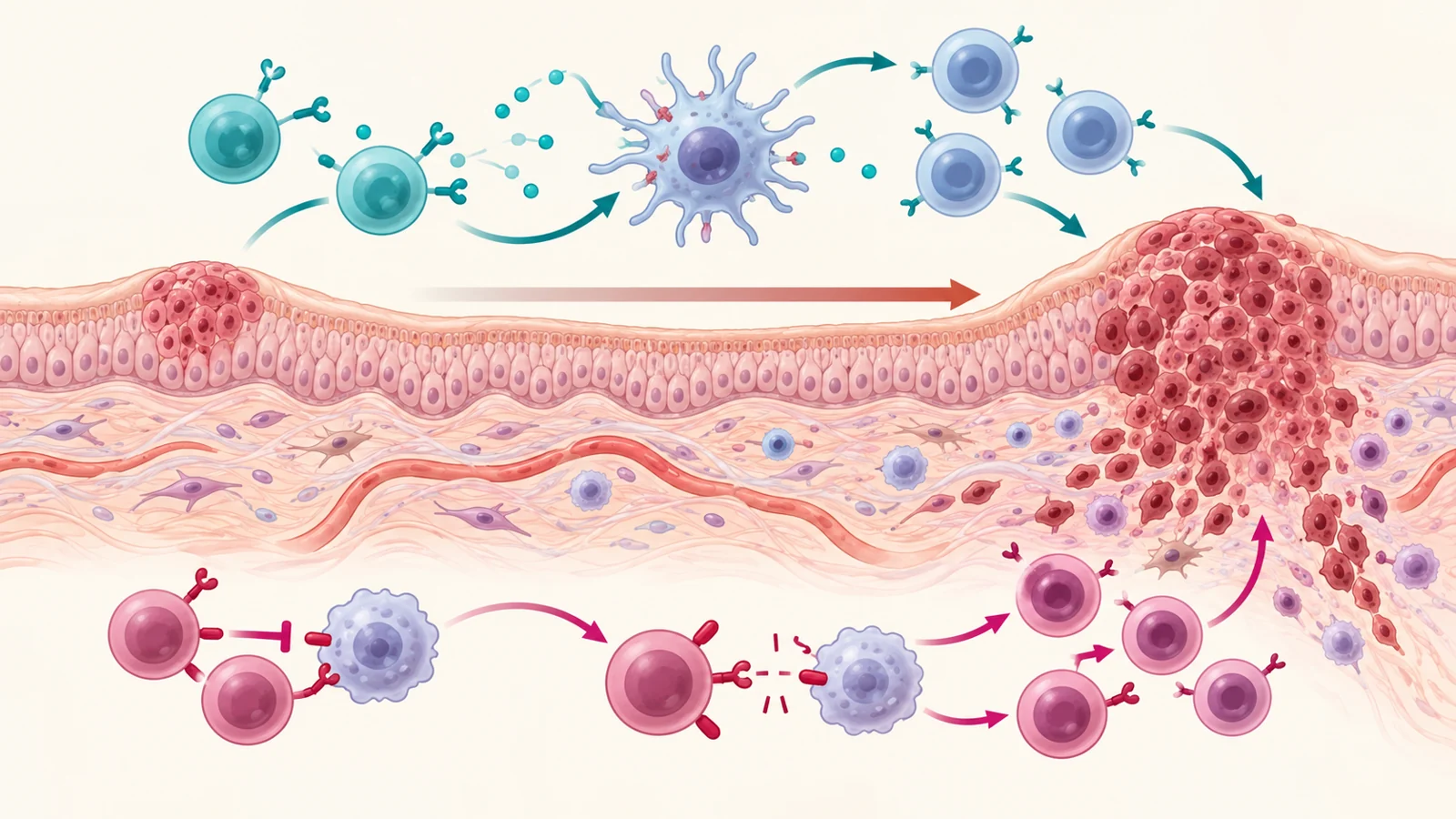
The CD40 agonist was associated with a lasting expansion of experienced or memory cytotoxic T lymphocytes, immune cells that can recognize and kill abnormal cells. The researchers also observed more M1 macrophages, a type of immune cell, after CD40 activation. These changes point to one pattern of immune activity after CD40 activation.
Checkpoint blockade showed a different pattern. Blocking PD-1 together with CTLA-4 was associated with a pronounced depletion of regulatory T cells, which help restrain immune responses, along with other immune changes. The study therefore did not show two interchangeable ways of producing the same immune response. The pathways coincided with distinct shifts in the immune environment as lesion progression changed.
These observations are associations. They do not show that expanding cytotoxic T cells or M1 macrophages, or reducing regulatory T cells, was the direct cause of the reduced progression. The study’s abstract does not provide enough detail to determine which immune changes were necessary, or how they relate to the different outcomes.
What this could mean for oral cancer prevention
The possible future capability is to intervene while oral tissue is still precancerous and keep high-risk lesions from advancing to invasive cancer. In this mouse study, CD40 activation offers a candidate route for that kind of prevention, with checkpoint blockade as another approach that also reduced progression. Making that capability useful for people would depend on establishing that an intervention can reduce progression safely and effectively in humans.
Key Sources
- Primary source: Targeting of CD40 and PD-L1 Pathways Inhibits Progression of Oral Premalignant Lesions in a Carcinogen-induced Model of Oral Squamous Cell Carcinoma.
DOI or Journal Page · Peer-Reviewed Paper · 2021-03-01
Keep exploring