
Research Signal – Source date 2021-02-23
A tumor can carry a change that looks targetable on a molecular test and still have no treatment proven to work for that patient’s cancer. In extrahepatic cholangiocarcinoma—bile duct cancer that forms outside the liver—the gap begins with biology: the 2021 review estimates that only about one-quarter of these tumors have a putative actionable driver. And a potential target is only a starting point. Researchers still need to show that a drug can act on it and improve outcomes in people whose tumors carry it.
The review describes frequent KRAS mutations in extrahepatic disease, but at the time it was published there was no directly approved drug targeting mutated KRAS. That contrast captures the treatment challenge: a molecular finding can be common and important to tumor growth without giving doctors a usable matched therapy.
Tumor location changes the research question
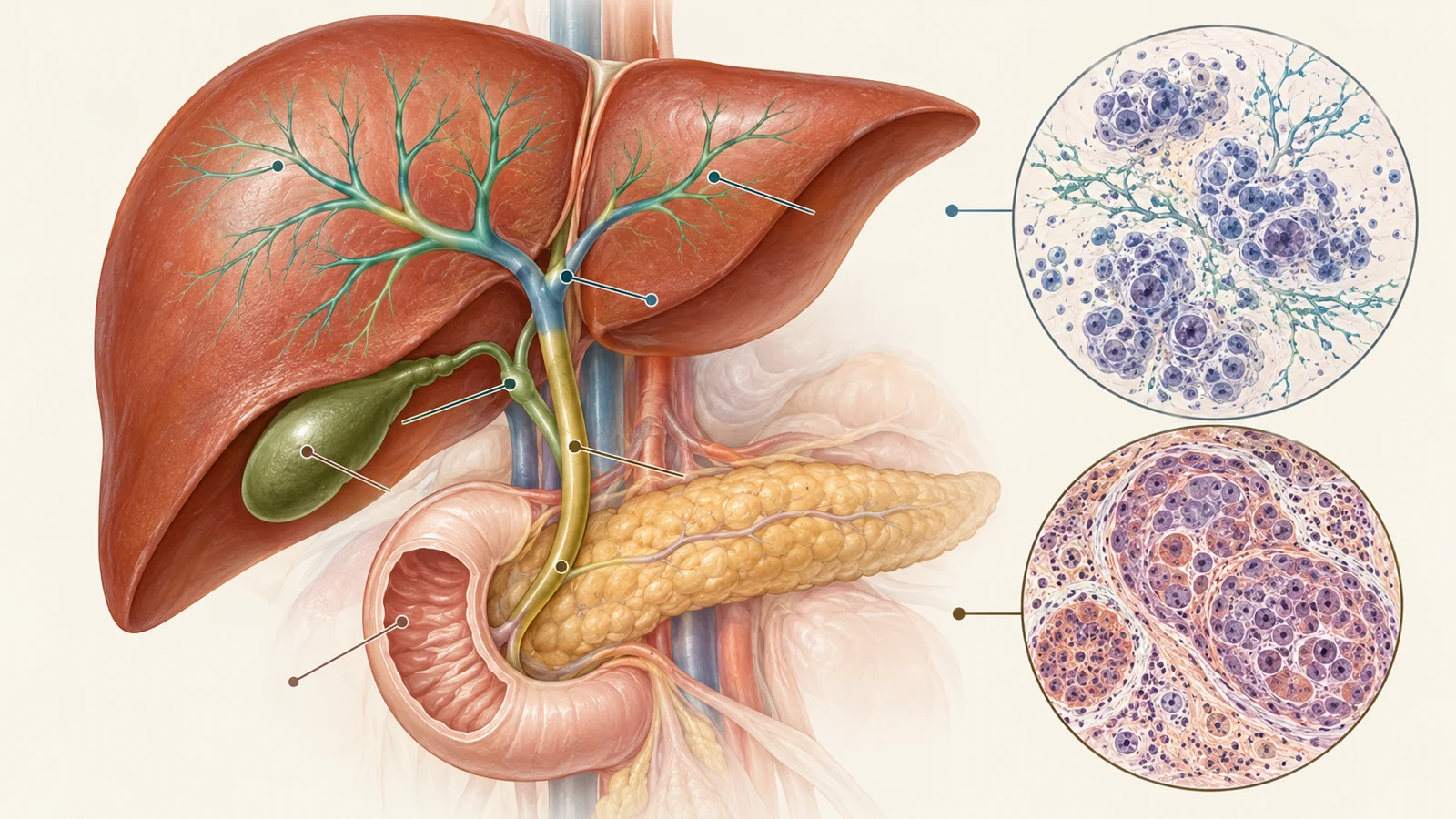
Cholangiocarcinoma can arise along the bile ducts, which carry bile from the liver toward the intestine. Intrahepatic tumors form within the liver. Extrahepatic disease usually groups two locations outside it: perihilar tumors, near where the right and left liver ducts join, and distal tumors, farther down the duct toward the intestine. The review notes that these two extrahepatic subtypes also differ from each other in clinical features and treatment options.
That geography matters when interpreting research. Many studies grouped bile duct cancers from different sites together, sometimes alongside gallbladder cancer. Such results may help researchers see activity across a broader group, but they cannot by themselves show that a treatment works specifically for perihilar or distal tumors. The review argues that treating cholangiocarcinoma as one disease has made it harder to develop therapies tailored to each site.
Molecular profiling adds another layer. It sorts tumors by patterns of altered genes and cell behavior, rather than by location alone. A large study discussed in the review proposed four extrahepatic classes—Mesenchymal, Proliferation, Immune, and Metabolic. These are descriptions of tumor biology and research hypotheses, not validated instructions for choosing treatment.
Two profiles point to different hurdles
The Mesenchymal class was the largest in the profiling study the review describes, at 47.3%, and was associated with more aggressive disease and poorer response to conventional chemotherapy. Its tumors showed a pronounced fibrotic reaction and features linked to cells changing toward a more mobile, invasive state. Fibroblasts, cells that help build and maintain tissue structure, were prominent in this environment.
That dense supporting environment suggests why focusing on a tumor’s mutations alone may miss part of the problem. The authors discuss experimental ideas aimed at the surrounding cells and signals, including compounds that could prompt some fibroblasts to die or interfere with pathways involved in tumor behavior. These ideas were research prospects in the review, not established treatments for patients with this profile.
The Proliferation class, estimated at 22.5%, has a different emphasis: signals that encourage cells to grow and survive. The review highlights HER2, a cell-surface receptor that can send growth signals, as one possible target. HER2 overexpression was reported more often in extrahepatic than intrahepatic tumors in the cited data, 17.4% versus 4.8%. Drugs that block HER2 or related growth pathways therefore offered a rationale for clinical testing.
But a class label does not establish that every tumor in it depends on the same pathway, or that blocking that pathway will help. The review estimates putative actionable drivers in about 25% of extrahepatic tumors, compared with about 50–60% of intrahepatic cases. “Putative” matters: a change may be biologically relevant or potentially druggable without having been shown to predict benefit from a particular medicine. The review also describes KRAS mutations in 36.7% of extrahepatic tumors, with no directly approved drug aimed at the mutated protein at that time.
Early treatment results show why the match matters
Clinical findings reviewed in 2021 offered a mixed picture. Lapatinib, a drug that blocks HER1 and HER2 signaling, had disappointing results in two phase II studies of advanced cholangiocarcinoma. Those studies did not establish a benefit for extrahepatic disease. The review nevertheless described other HER2-directed approaches as worth testing, including in trials that combined treatment with chemotherapy. A rationale for a trial and a demonstrated treatment benefit are different stages of evidence.
Immunotherapy, which aims to help the immune system act against cancer, also had findings from small or mixed groups. In a pembrolizumab study across cancer types, 86 people had tumors with mismatch-repair deficiency, a defect in correcting DNA copying errors. All four participants with cholangiocarcinoma had disease control, meaning their cancer did not worsen during assessment. In another study, 24 people with biliary tract cancers whose tumors expressed the immune-related marker PD-L1 received pembrolizumab; eight had a partial response (measurable tumor shrinkage) or stable disease. Biliary tract cancer includes more than extrahepatic cholangiocarcinoma, so that result does not identify an extrahepatic-specific response rate.
A nivolumab study enrolled 46 people with biliary tract cancer that had resisted earlier treatment. The review reports durable responses in two of the five participants with extrahepatic cholangiocarcinoma. That subgroup is very small, and its result cannot establish how often the treatment would help a wider extrahepatic population. Across the evidence, the patient’s tumor features, the cancer sites included, and the size of the relevant subgroup all shape what a result can tell us.
The review identifies pembrolizumab as the only then-approved targeted treatment relevant to extrahepatic disease, for tumors with mismatch-repair deficiency. The approval applied to cancers with that feature across tumor sites, not specifically to extrahepatic cholangiocarcinoma. It also cites an objective response rate of 7–13%—the proportion with measurable tumor shrinkage—in broader biliary tract cancers. Neither the approval nor that broader response figure establishes a general matched option for most extrahepatic tumors.
Trial design can make rare cancers easier to study
Extrahepatic cholangiocarcinoma is uncommon, so a separate large trial for every molecular change can be difficult to assemble. Basket trials address this by testing a treatment in people with different cancer types that share a target. Umbrella trials study different treatments or treatment arms within one cancer type, assigning people according to tumor features. The review describes both approaches as ways to bring eligible patients together and avoid enrolling people whose tumors lack the target being studied.
The design still affects what can be concluded. A basket trial may show that a drug has activity across cancers with a shared alteration, while leaving too few extrahepatic cases to establish a result for that site. An umbrella trial that combines extrahepatic tumors with intrahepatic or gallbladder cancers can have the same interpretive problem unless it reports the relevant groups separately. Testing for the target is essential to the match; reporting the tumor location and outcomes for that subgroup is essential to understanding whether the match mattered clinically.
The review’s count of 256 ongoing trials involving extrahepatic patients and 131 compounds reflects the landscape it surveyed at publication, not 256 trials dedicated to extrahepatic disease. Most were basket designs, and many included other biliary cancers. The authors call for more precise molecular testing, trials designed around relevant tumor features, and deeper study of the biology behind treatment resistance. They also emphasize that many common alterations remain without a proven matched therapy.
What more precise bile duct cancer trials could change
If tumor profiling can reliably identify which extrahepatic cancers depend on a druggable pathway, and trials then demonstrate clinical benefit specifically for those patients, doctors could gain treatment options matched to a defined group rather than relying on results averaged across different bile duct sites. That would offer a practical route from a molecular clue to a usable therapy for the minority of patients whose tumors carry relevant targets.
The review also makes clear why that possibility is conditional. The proposed classes must help predict response, and extrahepatic-specific trials must show that the treatment improves outcomes. For patients without an identified actionable alteration, the authors point to further work on tumor biology and the surrounding tissue environment as part of the search for future options.
Key Sources
- Primary source: Targeted therapies for extrahepatic cholangiocarcinoma: preclinical and clinical development and prospects for the clinic.
DOI or Journal Page · Review or Meta-Analysis · 2021-02-23
Keep exploring