
Research Signal – Source date 2021-02-22
Cities already collect grass clippings, leaves and hedge cuttings to manage parks and gardens. Much of this material becomes compost or biogas. A review published in 2021 considers another possibility: separating the plant matter into parts that could supply protein, fermentation feedstocks, chemicals or carbon materials.
The review uses “green waste” for mainly grassy and leafy material from parks, gardens and roadside greenery, with a small amount of woody matter. It is a narrower picture than every item that might enter a municipal organic-waste bin. Its central practical idea is to treat this varied plant matter as a source of materials as well as a waste stream.
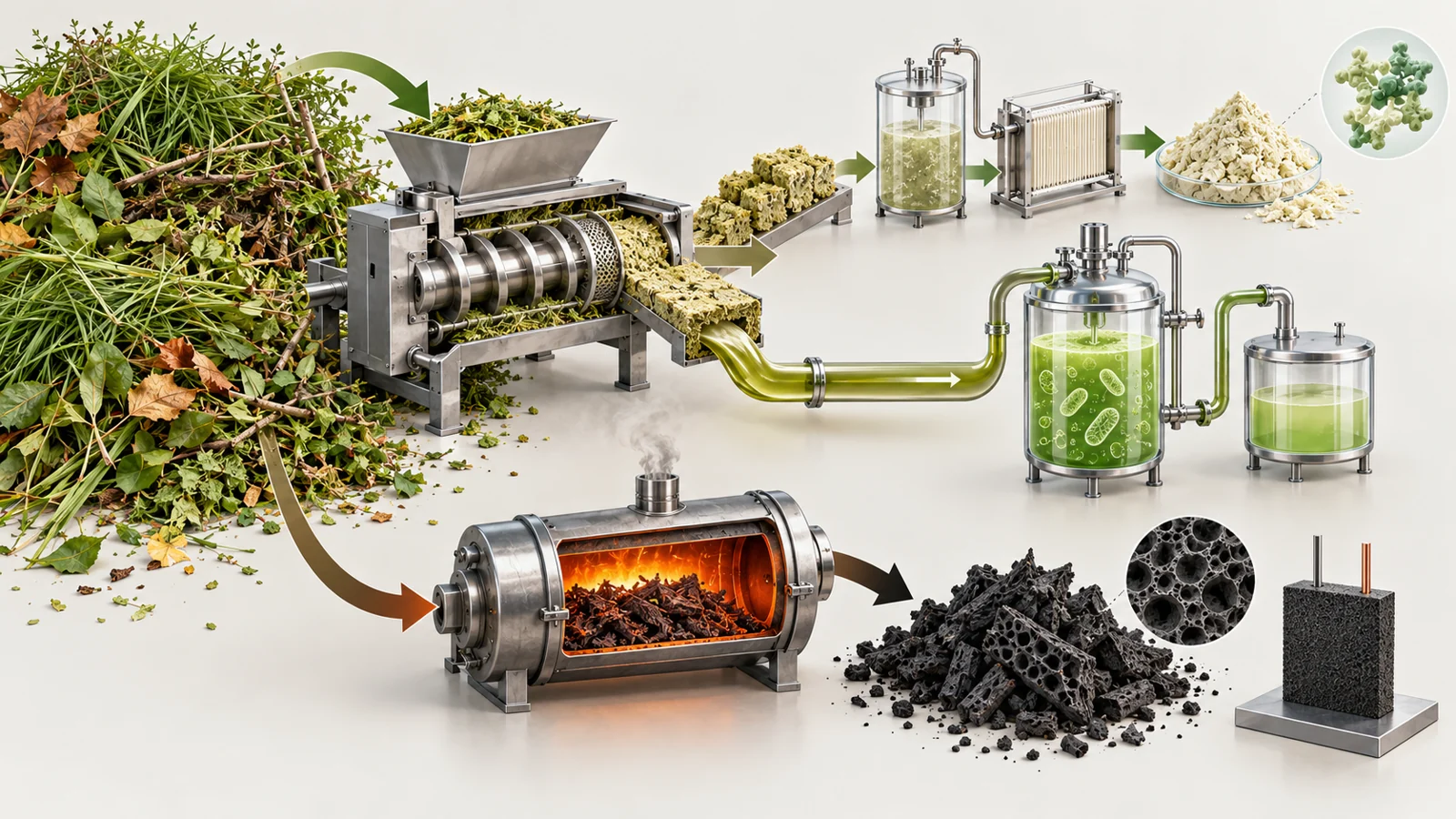
Pressing separates two useful fractions
Herbaceous plants can be pressed into a solid cake and a liquid juice. The fibrous cake retains more of the structural carbohydrates, including cellulose, while the juice carries more protein, organic acids and nutrients. In a study of Miscanthus, the review reports that cellulose made up 64% of the dry weight in the cake and 39% in the juice. Protein was 2.5% in the cake and 5% in the juice. These figures describe that plant and experiment, not a typical city collection.
The two fractions point toward different uses. Protein can be recovered from the juice by adding acid or salt, or by heating it. In a separate study of white clover and ryegrass press cake, water extraction recovered 40% of the crude protein present; treatment with protein-breaking enzymes raised recovery to 80%, and adding carbohydrate-breaking enzymes first raised it to 95%, as reported by the review. Those percentages refer to the protein already present in the studied plants, not the share of all green waste turned into a product.
After protein recovery, the remaining juice can still contain sugars and nutrients. Rather than treating it only as a residue, it may supplement the liquids used to grow fermenting microbes. Pressing therefore does more than split material: it can direct the fibrous portion toward carbohydrate processing and the liquid portion toward protein recovery or microbial growth.
From plant fibers to microbial products
The structural sugars in grass are not immediately available to microbes. Processing typically begins by reducing the plant material in size, then pretreating it so that cellulose and hemicellulose become more accessible. Enzymes can then break these carbohydrates into simpler sugars. Microorganisms can use those sugars to make products such as organic chemicals or biodegradable polyesters called polyhydroxyalkanoates, or PHAs.
A reported example makes the liquid route more tangible. Juice from ensiled perennial ryegrass supplied sugars to Burkholderia sacchari in a fermentation experiment. The review reports 44.5 grams of cell dry weight per litre, with 33% of that material being polyhydroxybutyrate, a type of PHA. This result belongs to that prepared grass juice and organism; it is not a yield estimate for unsorted municipal clippings and leaves.
Fermentation can also use sugars released from the solid plant fibers. But pretreatment is a balancing act. Conditions that open plant structure can also break down sugars or lignin into compounds that impede microbial growth. Furfural, for example, can form from the sugar xylose, while weak acids can also arise during processing. These substances may be valuable targets in a chemical route, yet troublesome contaminants in a microbial one.
A chemical target can also be a fermentation obstacle
Furfural and 5-hydroxymethylfurfural (HMF) illustrate the trade-off. Both can be made by chemical processing of plant material and are potential building-block chemicals. In fermentation, however, furfural can hinder cell growth; other breakdown products can also interfere with microbes. A process designed to produce a chemical directly may welcome a compound that a fermentation process must avoid or remove.
The review describes furfural production from Miscanthus and switchgrass under different chemical treatments, with reported yields that vary by method and feedstock. These examples show that grassy biomass can be converted into useful chemicals, but they do not identify one best treatment for a mixed city supply. Chemical conversion has to account for which sugars and other components are present, what product is sought, and whether the processing conditions preserve or degrade the material needed for the next step.
Some direct extraction options look less promising. The review describes low yields for lipophilic compounds such as fatty acids, long-chain carbohydrates and aldehydes, making their extraction from green biomass unattractive. Lignin may be recovered as a by-product of pretreatment, but the review notes that industrial valorization of that lignin remains unresolved. The material’s potential depends on selecting routes that recover enough of a desired product to justify the processing involved.
Carbonization makes a material, not yet an electrode
Green waste can also be heated in hot, compressed water through a process called hydrothermal carbonization. It produces a solid carbon-rich material, often called hydrochar, alongside liquid and other products. Temperature, processing time and reaction conditions affect the resulting material. The liquid can contain sugars and organic acids, so the solid is not necessarily the only fraction of interest.
Making hydrochar is different from demonstrating a useful electrode. An electrode for a microbial fuel cell or another electro-biotechnological system needs suitable properties, including conductivity, stability, surface structure and pores that permit bacterial growth and movement of nutrients. The review finds relatively little research testing electrodes made from carbonized herbaceous material in these applications. It cites an example using potassium-hydroxide-activated alfalfa leaves as a cathode catalyst in a microbial fuel cell, but that result does not establish routine electrode use for carbon made from mixed municipal green waste.
Variable collections complicate process choices
The input changes with plant species, location and season. A collection of leaves and grass from one place can differ in composition and physical form from another, and differences can affect storage and transport as well as the processing required. City green waste also arrives across many locations rather than accumulating in one field. It does not need dedicated cropland to grow, unlike an energy crop, but collection, sorting and pretreatment still take resources.
These differences matter because the studies summarized in the review use varied feedstocks and processing conditions. The review describes limited comparability among pretreatment studies, including inconsistent reporting of energy and material use. A result from Miscanthus, ryegrass, switchgrass or alfalfa can show what a particular route may do with that plant under those conditions; it cannot stand in for a representative, mixed city collection. A process would need to fit the material that can actually be collected and separated, rather than assume a uniform feedstock.
What cities could make from grass and leaves
A city could direct suitable portions of its existing grass-and-leaf stream toward recovered protein, fermentation inputs and selected materials alongside composting or biogas production. That wider capability depends on sorting and processing variable collections reliably, reproducing useful product performance, and making the economics worthwhile. The review lays out promising routes, while leaving the integrated performance of a real mixed municipal stream as a practical question.
Key Sources
- Primary source: Material utilization of green waste: a review on potential valorization methods.
DOI or Journal Page · Review or Meta-Analysis · 2021-02-22
Keep exploring