
Research Signal – Source date 2021-02-18
In one melanoma study discussed in a 2021 review, a tumor’s mutation count after treatment began was more closely associated with response than its count before treatment. By week four of nivolumab, a drug that releases a brake on immune cells, a decline in tumor mutational burden (TMB)—the number of mutations measured in a tumor—correlated with a favorable outcome. The association was more predictive of outcome than pretreatment TMB alone.
That finding shifts attention from a tumor’s starting profile to what may be happening as the immune system and cancer interact. It does not make a week-four measurement a validated test for an individual patient. It offers a clue about why treatment-time changes may matter, and about the complex biology such a clue has to represent.
A count can change as the immune contest unfolds
A pretreatment mutation count is a snapshot. It describes mutations measured in a tumor before therapy, but it cannot show how the tumor’s mix of cells may change under immune pressure. In the reviewed melanoma study, researchers compared tumor samples collected before nivolumab and during treatment. A decrease in TMB by week four was associated with response; the appearance of new single-nucleotide variants—changes at individual positions in DNA—was associated with stable or progressive disease.
The review describes these early shifts as part of immunoediting: the immune response can affect which tumor-cell variants remain. If immune cells recognize and attack some cancer cells, variants that are more visible to them may become less common. A falling mutation burden could therefore reflect a changing tumor population, rather than simply confirm that the starting tumor had a favorable profile.
The result is specific to a reviewed study of melanoma patients receiving nivolumab. It does not show that a falling count will predict benefit for every person, cancer, or checkpoint treatment. The observation is valuable because it connects a measured change with outcome; the review does not establish a reliable individual test based on that change.
Two immune brakes act at different points
Nivolumab blocks PD-1, a receptor that restrains T cells after they have been activated. T cells are immune cells that can recognize and kill cancer cells. Their activity is controlled in part by signals that prevent an immune response from continuing unchecked. PD-1 responds to the ligands PD-L1 and PD-L2, which can be present on tumor cells and other cells. Blocking this interaction can loosen that restraint.
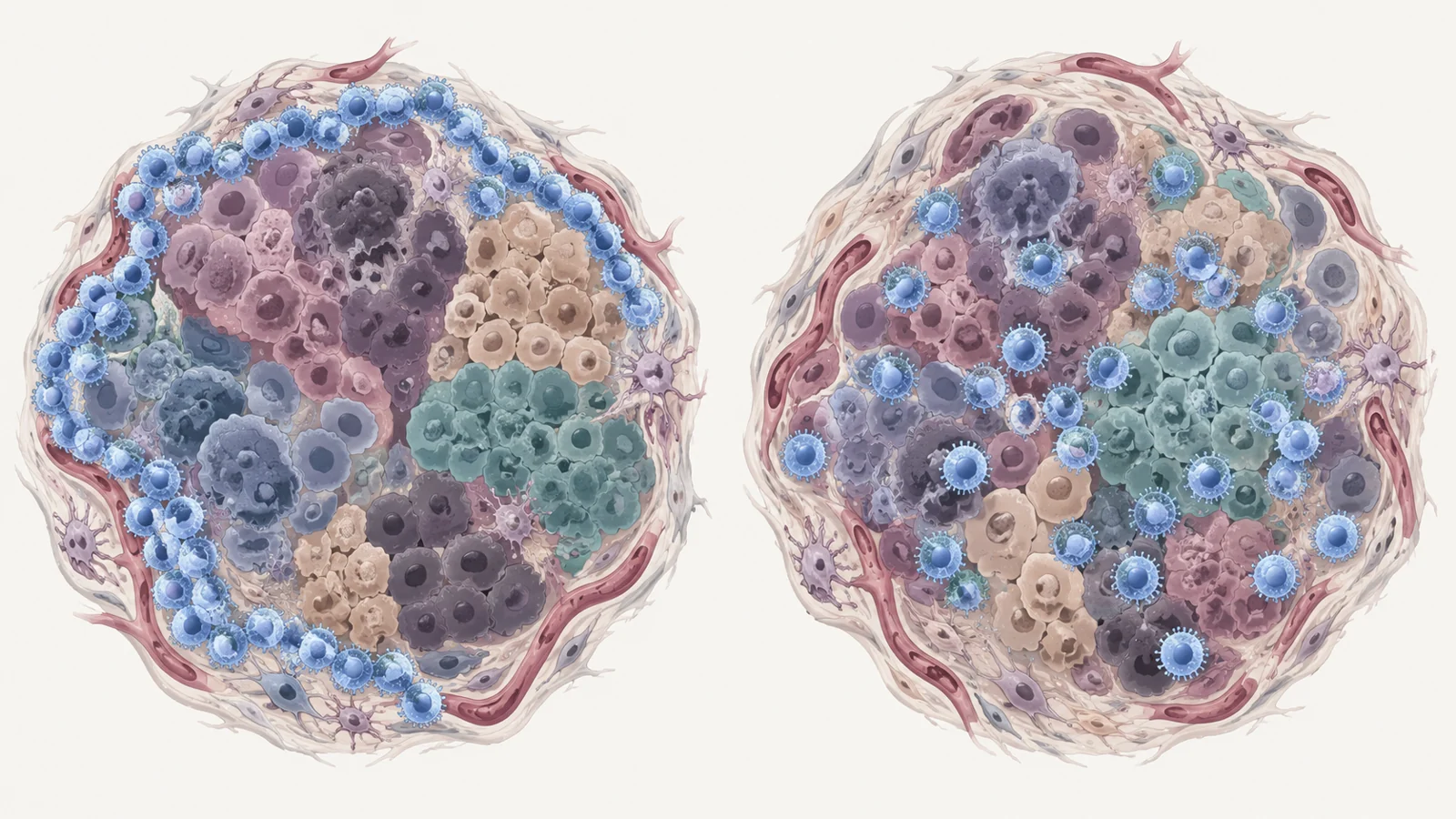
In paired tumor biopsies discussed in the review, PD-1 blockade was associated with an expansion of CD8 T cells inside tumors. Their density shifted from the tumor margins toward the center, and the cells became more clonally concentrated—a pattern consistent with the expansion of particular T-cell populations. The review links increases in genes associated with T-cell activity to response, but these cellular observations do not by themselves tell clinicians which individual will benefit.
CTLA-4 acts chiefly earlier, during the initial activation of T cells. After a T cell recognizes a target, CTLA-4 can compete with CD28, a signal that helps activate the cell. Blocking CTLA-4 can support T-cell proliferation and activation. In tumor models, anti-CTLA-4 treatment expanded both CD4 and CD8 effector T cells in the tumor environment; human studies reviewed in the paper also associated increases in tumor T cells with response to ipilimumab, an anti-CTLA-4 drug.
The distinction helps explain why the two treatments can produce different immune effects. CTLA-4 blockade can influence early activation and the expansion of T cells, while PD-1 blockade can release restraint on activated T cells in the tumor. Both can remodel the tumor environment, but neither acts on a simple, fixed population of cancer cells.
Immune activity can select for escape
An immune response can change the tumor without clearing every cancer cell. As treatment applies pressure, tumor variants that are less recognizable may gain ground. The review describes this as one route to acquired, or secondary, resistance: an initially responsive tumor can evolve toward immune escape.
One way cancer cells may become harder to recognize is by disrupting antigen presentation. This is the process that displays fragments of proteins on a cell’s surface, allowing T cells to identify potential targets. The review describes loss-of-function changes in beta-2 microglobulin, a protein needed to bring MHC class I molecules to the cell surface. When this machinery is impaired, a tumor cell may evade recognition by CD8 T cells. The review reports such changes in melanoma patients whose disease progressed during checkpoint treatment, and describes the expansion of altered tumor-cell clones despite a reinvigorated T-cell response.
Other escape routes can interfere with immune-cell entry into a tumor or strengthen inhibitory signals. The balance can shift in both directions: immune activity may remove some vulnerable variants, while the cells left behind may be better able to resist recognition. This makes treatment-time tumor changes biologically meaningful, but not automatically easy to interpret from a single measurement.
More than T cells shape the response
T cells are central to the effects discussed here, but they operate in a wider network. B cells, for example, can help coordinate immune activity by presenting antigens to T cells or producing antibodies. Some B-cell populations can also suppress immune responses. Their role depends on their state and the tumor setting, so simply counting B cells would not tell the whole story.
In mouse models of triple-negative breast cancer, the review describes a rise in tumor B-cell activity during combined PD-1 and CTLA-4 blockade. Removing B cells in those models disrupted treatment response and was accompanied by lower T-cell infiltration. In two melanoma patient groups discussed in the review, a pattern of gene activity linked to organized B-cell-rich structures in tumors was associated with response to PD-1 blockade when measured during treatment. These findings point to cooperation between immune-cell types, while remaining evidence from particular models and patient groups rather than a general rule for all cancers.
Myeloid cells—including monocytes, macrophages and dendritic cells—also influence whether T cells can mount an effective response. Some help present antigens and support immune activity; others, including certain tumor-associated macrophages and suppressor-cell populations, can inhibit it. Animal studies reviewed in the paper suggest checkpoint treatment can shift the mix of myeloid cells toward a more inflammatory state. Human studies, however, did not show a consistent pattern for all circulating myeloid-cell subsets. Their diversity and flexibility make broad labels or single measurements difficult to interpret.
Treatment order changes the context
Immune measurements also carry a treatment history. In a reported randomized study of people with advanced melanoma, the sequence of nivolumab followed by ipilimumab was associated with higher response rates than the reverse sequence, along with different adverse-event profiles. The review uses this comparison to illustrate that one checkpoint treatment may leave an imprint on the immune system that shapes its response to another.
In a reviewed melanoma cohort, T-cell receptor patterns linked to PD-1 response differed by treatment history: certain T-cell populations became more dominant without prior ipilimumab, while the range of populations broadened in previously treated patients. The review also describes a relationship between CD8 T-cell expansion under PD-1 treatment and response in patients without prior ipilimumab, but not in those previously exposed to it. A measurement therefore cannot always be interpreted apart from what treatment came before it. These reported differences do not establish a universal sequence for care; they show why treatment context matters when researchers compare immune changes.
One sample may miss a changing tumor
A tumor biopsy captures only one place and time. Different metastatic sites within the same patient can have distinct immune environments and follow different trajectories during treatment. Repeated biopsies may also place a burden on patients and carry a risk of complications. A single tissue sample can therefore miss changes elsewhere in the body, even when it offers valuable detail about the sampled lesion.
Blood tests could make repeated monitoring easier, and the review discusses evidence that checkpoint drugs can produce systemic immune changes. But changes measured in circulating cells may not reflect every process inside a tumor. Some resistance mechanisms depend on local tumor conditions, and the immune environment can differ among metastatic sites. The evidence reviewed does not establish that blood measurements capture all consequential changes across those sites.
The underlying evidence also varies. The review draws on animal models and human studies using paired biopsies, blood-cell analyses and other measurements. Animal experiments can reveal possible mechanisms, but they may not reproduce human cancer biology. Clinical associations also differ by cancer, cell population, treatment history and sampling site. Combining detailed molecular measurements may help clarify these interacting processes, though this review does not validate a clinical prediction tool.
How treatment-time clues could guide cancer care
If changes measured during treatment prove reliable across patients, clinicians could gain a better chance to recognize response or emerging escape while there is still time to make informed choices about checkpoint drugs. That could make treatment decisions more responsive to how a cancer and the immune system are changing, rather than relying only on a pretreatment snapshot.
Realizing that possibility depends on measurements that work across different cancers and treatment histories, and on monitoring that captures important changes within tumors. The week-four melanoma finding offers a reason to study that changing biology; it is not yet a stand-alone guide to an individual’s care.
Key Sources
- Primary source: Emerging dynamics pathways of response and resistance to PD-1 and CTLA-4 blockade: tackling uncertainty by confronting complexity.
DOI or Journal Page · Review or Meta-Analysis · 2021-02-18
Keep exploring