
Research Signal – Source date 2021-02-15
A 2021 review cites a light-assisted iron-and-peroxide (photo-Fenton) experiment that reported a 2.43-log reduction in E. coli in urban wastewater, compared with 5.81 log in distilled water. Each extra log means a tenfold decrease in the surviving fraction, so the difference in this test is substantial. The difference is a reminder that a treatment’s performance depends on the water around it, not just on the catalyst. A solid iron material may be easy to collect and reuse, but real water contains other substances that can help or hinder the chemistry.
The review brings together studies of heterogeneous Fenton catalysts: solid materials that use iron to help hydrogen peroxide react. Those reactions can produce short-lived oxidizing species that damage organic pollutants and microbes. The cited wastewater and distilled-water figures come from one study discussed in the review; they are not a universal performance ratio for all solid catalysts.
Iron and peroxide have to keep cycling
In a Fenton reaction, iron helps turn hydrogen peroxide (H₂O₂) into reactive species, including hydroxyl radicals (•OH). These radicals can attack pollutants and microbial material. In a solid catalyst, iron at the material’s surface can cycle between two forms, Fe(III) and Fe(II). Keeping that cycle active matters because the surface iron helps activate more peroxide.
The review describes a proposed sequence on goethite, an iron mineral: peroxide interacts with surface iron, electron transfer changes the iron’s state, and further reaction produces radicals. This surface pathway is one way to explain heterogeneous catalysis. But dissolved iron can also escape from a solid and drive the familiar Fenton reaction in the water itself. Both routes may contribute to contaminant removal.
That distinction matters when judging a fast result. A rapid loss of a pollutant does not by itself show that the reusable solid surface did all the work. In one cited study, even very low concentrations of leached iron increased degradation, and the amount released changed with pH over time. Understanding how much activity comes from the solid and how much from dissolved iron is part of assessing whether a catalyst can be recovered and used again.
Reuse and near-neutral treatment are design goals
Conventional Fenton treatment with dissolved iron is most effective under acidic conditions. The review notes an optimum around pH 2.8 for homogeneous photo-Fenton chemistry, where light also helps the reaction. Adjusting water to that acidity and then treating it afterward adds steps; when the water becomes neutral, iron can precipitate as sludge that must be removed.
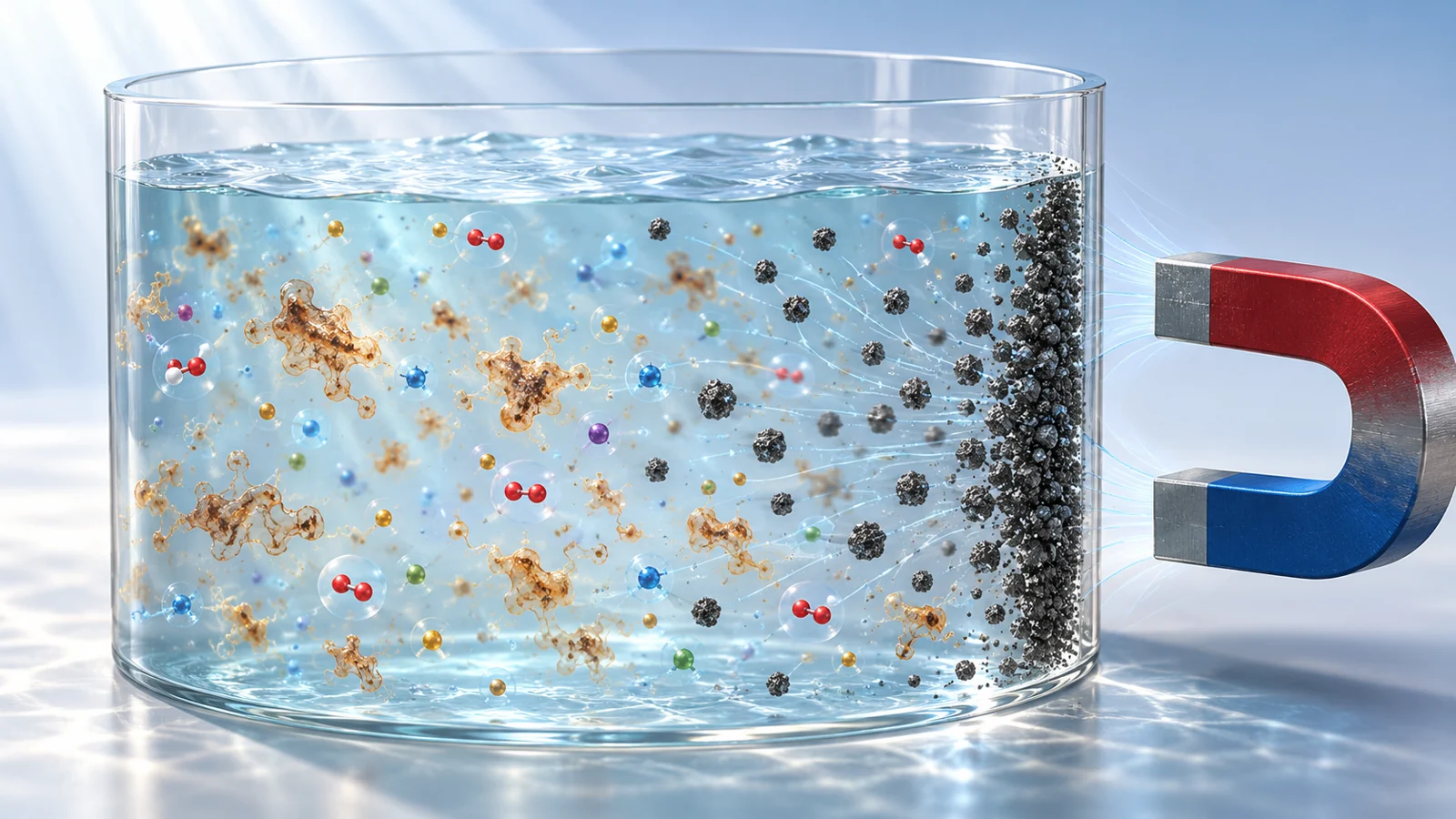
Solid catalysts are being developed to make treatment over a wider pH range more practical, with less sludge and easier recovery. Magnetic materials such as magnetite and ferrites are attractive because a magnet can help separate them from treated water. Their recovery and reuse are useful design features, not guarantees of lasting performance in every water or treatment cycle.
Other catalyst designs target different bottlenecks. A semiconductor–ferrihydrite composite is intended to speed the return of iron to its more reactive Fe(II) form. In a cited BiVO₄/ferrihydrite system, measurements indicated more surface Fe(II) and greater hydroxyl-radical generation after adding the semiconductor; light-generated electrons were proposed to drive that regeneration. This design focuses on keeping iron’s reaction cycle moving.
A zeolite–cyclodextrin system tackles peroxide use and pollutant contact instead. In the example summarized by the review, contaminants gathered near the catalyst, and the combined material was reported to store excess peroxide and release it when needed. The aim was to limit peroxide breakdown or wasteful reactions and make more of it available where pollutant degradation occurs. These are distinct engineering strategies, and results from separate studies do not rank them under matched conditions.
Water chemistry changes the reaction
Distilled water offers a much simpler chemical setting than urban wastewater. Natural organic matter (NOM), salts and other dissolved substances can interact with the catalyst, peroxide and reactive species. The review describes cases where NOM helped: iron bound to it was less likely to precipitate, and the resulting complexes could absorb more ultraviolet and visible light, potentially supporting reactions near neutral pH. A cited comparison also found complete E. coli inactivation within 120 minutes in both Milli-Q water and water from Lake Geneva in a hematite-based system; adding peroxide was associated with slightly faster inactivation in the natural water.
Other reported water matrices had the opposite effect. Humic and fulvic acids inhibited hydroxyl-radical formation in some experiments, and one comparison found four times lower radical formation in natural water than in pure water. The review also describes chloride accelerating peroxide decomposition in a zero-valent iron system, while phosphate inhibited it, apparently by forming a layer over reactive sites. The direction and size of a water-matrix effect therefore depend on which substances are present and how they interact with a particular catalyst.
The urban-wastewater result—2.43 log disinfection, versus 5.81 in distilled water—fits this practical challenge, but it does not identify a single cause for the gap or predict what every wastewater will do. Local water composition can change how much of the treatment chemistry remains available for its target. A material tested in clean water needs evaluation in the water it is meant to treat.
Killing bacteria is not the same as removing resistance genes
The review also distinguishes microbial inactivation from damage to free genetic material. In one separate experiment, a composite containing reduced graphene oxide, iron oxide and graphitic carbon nitride was used with peroxide and visible light to fragment plasmids carrying an ampicillin-resistance gene. Researchers observed plasmid changes and fragmentation after treatment.
That experiment measured damage to plasmid DNA, while the wastewater example measured E. coli disinfection. They are different targets and different outcomes. Reducing measured bacteria does not, on its own, show that viruses or antibiotic-resistance genes have been eliminated; the plasmid result likewise is not evidence of complete resistance control in wastewater.
What reusable iron catalysts could bring to wastewater treatment
If solid catalysts can maintain useful activity in real water, release little iron, and remain recoverable through reuse, iron-and-peroxide treatment could offer a more practical way to reduce some chemical and microbial contaminants without relying on acidic conditions and sludge-heavy treatment. That could give water-treatment operators another option for treating complex wastewater. The 2021 review describes promising material designs and varied experiments, but it does not demonstrate a durable, full-scale system across treatment sites. The potential depends on matching catalyst design to local water chemistry and confirming that recovery and performance hold up in practice.
Key Sources
- Primary source: Heterogeneous Fenton catalysts: A review of recent advances.
DOI or Journal Page · Review or Meta-Analysis · 2021-02-15
Keep exploring