
Research Signal – Source date 2021-02-12
Adding nanocellulose can strengthen rubber in one formulation and weaken it in another. The difference is not simply whether the cellulose came from a plant. Its amount, distribution and compatibility with the rubber all matter. A 2021 review of research across natural and synthetic rubbers describes promising results, but the reported gains belong to particular recipes and tests, not to rubber composites as a whole.
That distinction matters for any proposed replacement for carbon black, a widely used reinforcing filler. A material has to do more than improve one strength measurement: it must preserve the mix of properties a product needs, and work in a process that can be scaled.
Rubber needs more than strength
Carbon black has been used in rubber since the 1920s to improve mechanical properties. Silica is another established filler. The two do not produce identical results: the review describes carbon black as providing higher modulus, a measure of stiffness, while silica can improve properties such as tear strength and adhesion. Silica-filled tires have also been associated with lower rolling resistance, which can reduce energy lost as a tire rolls.
These examples show why “stronger” is not a complete specification. A rubber part may need to stretch, resist tearing, keep its grip, or limit heat buildup. A filler that raises stiffness but reduces stretch could help one product and hurt another. Replacing some conventional filler therefore means comparing a set of useful properties in the intended rubber and product, rather than treating a higher tensile strength as proof of a general substitute.
Tiny structures can form a reinforcing network
Nanocellulose is cellulose processed into very small structures. The review discusses cellulose nanocrystals, cellulose nanofibers and bacterial cellulose, among other forms. Their dimensions and properties vary with the source and the way the cellulose is extracted. Their small size gives them a large surface area relative to their volume, while the cellulose structures themselves can be mechanically strong.
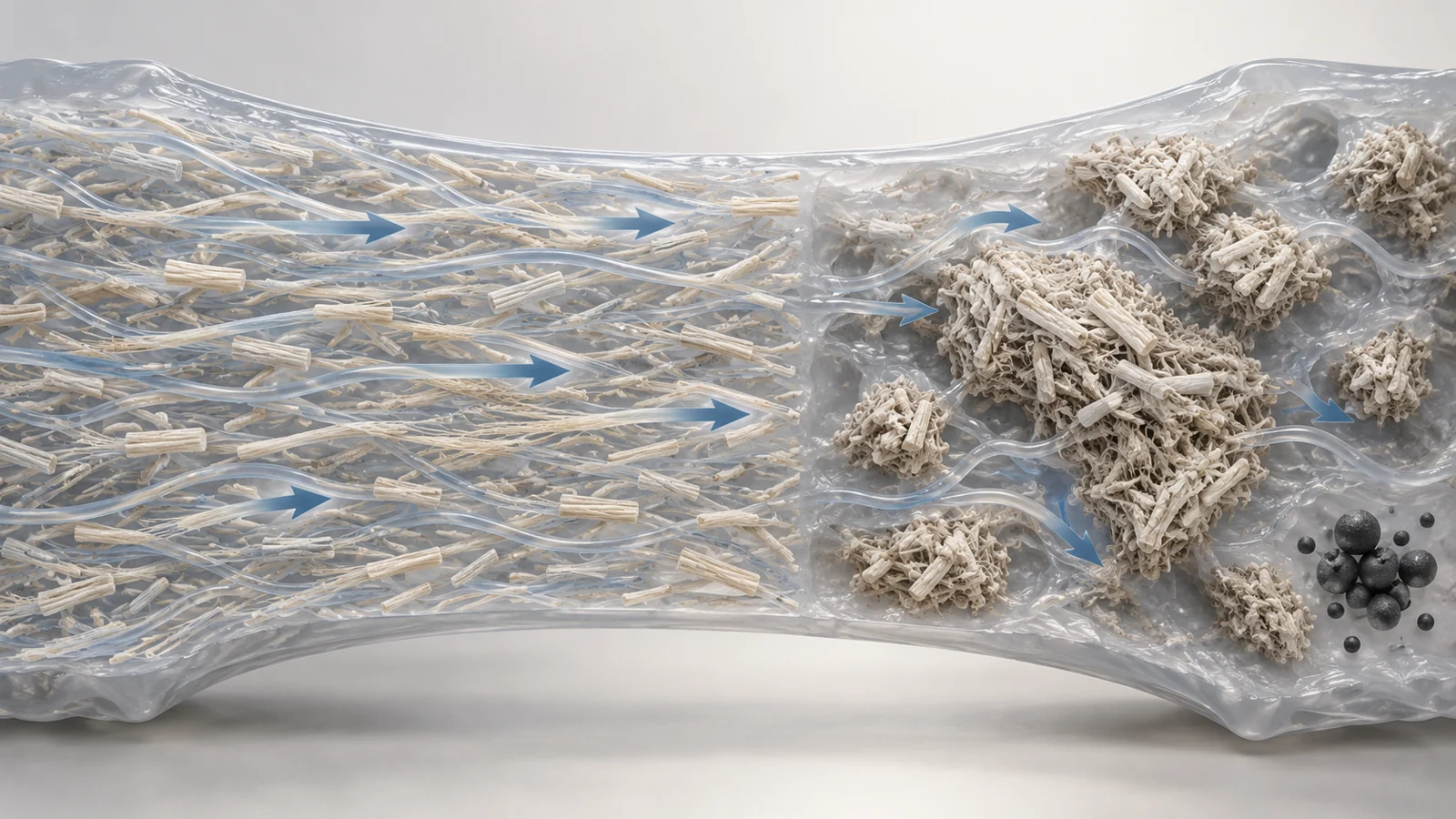
In rubber, well-dispersed nanocellulose can help carry stress through the material. At suitable concentrations, individual particles or fibers can interact to form a connected network. That network can share loads and make it harder for a tear to follow an easy path. The review describes these effects in natural rubber, including a cited investigation in which cellulose nanocrystals formed networks as their concentration increased. At 6 parts of cellulose nanocrystals for every 100 parts of rubber by weight, that study reported an eightfold increase in tensile strength. The result belongs to that investigation and its particular preparation; it is not a general multiplier for nanocellulose-filled rubber.
The same interactions can become a weakness when the filler is poorly dispersed. Cellulose tends to attract water, while many rubber matrices repel it. When the two materials do not mix well, the cellulose can clump. Instead of helping transfer stress across the rubber, a clump can leave gaps and concentrate stress at its edges, giving cracks a place to start. Fibers can also bundle together when their mutual attraction outweighs their contact with the surrounding rubber.
More filler can mean less stretch
The amount added changes the balance. Across the natural-rubber studies summarized in the review, tensile strength often increased, while elongation at break—the amount a sample stretches before snapping—tended to decrease. The material could become stiffer as nanocellulose restricted movement of the rubber chains. Beyond a suitable loading, agglomeration and defects can reduce mechanical performance instead of improving it.
Surface treatment or a compatibilizer, an ingredient that helps two materials work together, can improve contact between cellulose and rubber. These methods can delay dispersion problems or make more of the filler effective, but the review does not present them as a universal fix. The best result depends on the cellulose form, its treatment, the rubber matrix and the amount used.
A cited synthetic-rubber study illustrates how much preparation can matter. Researchers tested chemically modified nanocellulose in styrene-butadiene rubber (SBR). At 10 parts per hundred rubber, the modified material raised tensile strength from 30.0 to 32.5 MPa, a gain of about 8%. The review also reports that the modified filler increased stiffness and hardness up to a threshold loading. In that study, unmodified nanocellulose showed negative reinforcement potential, which the authors attributed mainly to agglomeration. These values describe that specific comparison, not all SBR formulations.
Partial substitution is a narrower claim
Some cited natural-rubber studies tested nanocellulose alongside carbon black. The review describes partial substitution with cellulose nanofibers at 5 parts per hundred rubber in one study and up to 15 in another; those systems performed substantially well mechanically compared with systems reinforced entirely by carbon black. This is evidence that partial substitution can work in particular natural-rubber formulations. It does not establish that nanocellulose can replace carbon black—or silica—across rubber products.
The synthetic-rubber findings involve different formulations and comparisons. In a cited SBR study, cellulose nanofibers at a moderate loading of 7 parts per hundred rubber brought tensile strength to about 8 MPa, almost three times the starting value. The review attributes the improvement to load sharing and a connected fiber network; higher loadings commonly reduced strength, consistent with aggregation and defects. In another SBR investigation, chemically modified nanocellulose at 10% by weight increased tensile strength sevenfold for cellulose nanocrystals and fivefold for cellulose nanofibers compared with neat SBR. Those results came from a different filler treatment and loading measure, so they cannot be directly ranked against the natural-rubber substitution studies.
Together, the examples show why a headline number is not enough to judge a filler. Each gain depends on its starting material, comparison group, cellulose type, loading and preparation. The review gathers results from multiple studies; it does not report a new rubber formulation tested by its authors.
Extraction has its own costs
Nanocellulose begins as cellulose in sources such as plant material. Getting it down to nanoscale structures can involve pretreatment to remove lignin and other non-cellulose components, followed by chemical or mechanical processing. Chemical routes can use acids, bases or solvents. Mechanical methods such as high-pressure homogenization and microfluidization break down fibers through shear and collisions, but can demand substantial energy; some approaches need repeated processing.
That makes the sustainability case more complicated than the feedstock alone. Renewable cellulose is a useful starting point, but it does not establish that the complete process has a lower environmental impact. Extraction chemicals, energy use and the demands of producing consistent material at scale all matter. The review identifies greener solvents and more economical extraction as challenges for further development.
A rubber product needs the right function
The applications discussed in the review extend beyond tensile strength. One cited project developed a prototype sports shoe sole using a blend of natural rubber and ethylene-vinyl acetate with cellulose nanofibers. The review describes surface modification of the fibers as part of the effort to reinforce the sponge-rubber material. It presents the sole as a prototype under development, not proof of commercial durability or performance over a product’s lifetime.
A contrasting example is rubber for barrier membranes. Studies reviewed in the paper tested nanocellulose-reinforced natural rubber for reduced absorption of organic solvents such as benzene, toluene and xylene. The results point to a possible role in separating solvents, where resistance to absorption and transport matters alongside mechanical integrity. This is a different product requirement from a shoe sole, and the material would need to meet the demands of its intended use.
What plant fibers could change in rubber products
If researchers can make nanocellulose disperse reliably, extract it with practical use of chemicals and energy, and tune each formulation to its job, rubber makers could have another way to reinforce selected products while reducing some conventional filler. That could support uses ranging from lightweight components to barrier materials, provided the needed stretch, tear resistance, durability and production consistency hold up in the finished product. The review’s cited results make that possibility worth investigating; they do not yet show that one nanocellulose recipe can serve as a drop-in replacement across the rubber industry.
Key Sources
- Primary source: Recent Developments in Nanocellulose-Reinforced Rubber Matrix Composites: A Review.
DOI or Journal Page · Review or Meta-Analysis · 2021-02-12
Keep exploring