
Research Signal – Source date 2021-02-01
In a mouse colon-tumor experiment, 67% of animals given a five-part immune regimen had tumors smaller than 300 cubic millimeters. Across the tested shorter combinations, that share never exceeded 22%. The result points to a carefully assembled set of treatments that addressed different immune barriers at once. It does not show that adding a fifth drug generally improves cancer treatment.
The study, published in 2021, tested the approach in mouse models whose tumors responded poorly to a checkpoint-blocking treatment. Its central question was how to start an immune attack, support the cells taking part, and reduce the suppression they encountered inside a tumor. The researchers called the five-part combination “pentatherapy.”
The full combination linked three different jobs
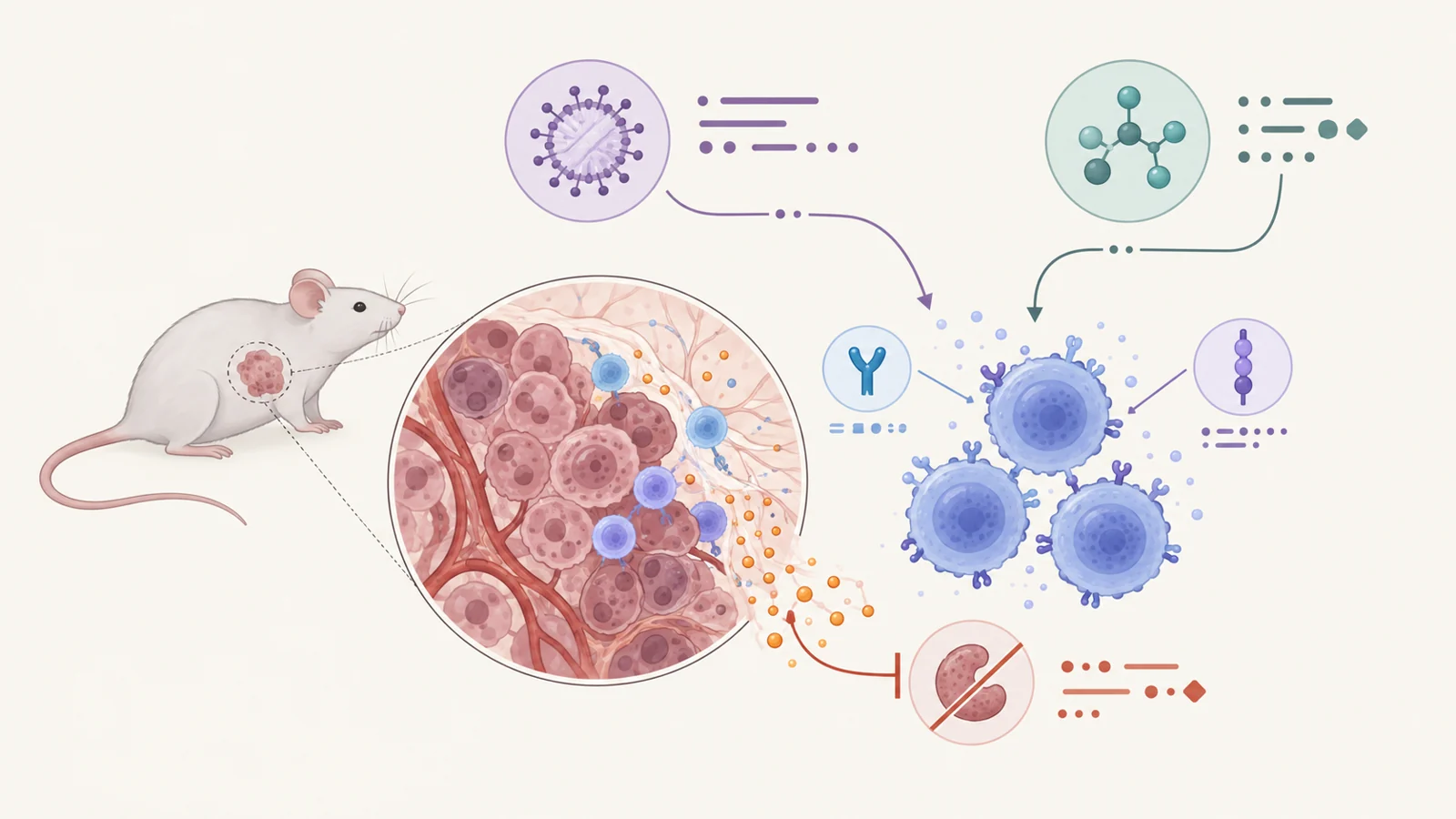
Two components aimed to activate tumor-directed immune cells. Ad-CEA is an adenovirus-based vaccine designed to present the tumor-associated CEA antigen and prompt a targeted T-cell response. N-803, an IL-15 superagonist, supports the stimulation and multiplication of immune cells, including memory CD8 T cells.
The researchers then added two immune-stimulating antibodies, targeting OX40 and GITR. These are signals found on T cells that can help expand or strengthen an activated response. The fifth component, epacadostat, inhibits IDO, an enzyme associated with an immunosuppressive tumor environment.
The reason to combine these jobs emerged from the first treatment pair. Ad-CEA plus N-803 slowed MC38-CEA tumor progression better than either treatment alone, improved median survival in that experiment, and increased CD8 T cells inside tumors. Depleting CD8 T cells reduced the survival advantage, connecting those cells to the observed effect.
But immune activation also came with increased expression of IDO in tumor samples. The authors treated that as a possible counter-response: the immune activity they had encouraged could coincide with a pathway that helps suppress activity in the tumor. The later regimen therefore paired T-cell activation with signals meant to expand the response and an IDO inhibitor intended to ease that local suppression.
In the direct comparison, the shorter versions—single agents and tested two-, three-, and four-agent combinations—had little to moderate effect. No more than 22% of animals in those groups had tumors below 300 mm³. With all five components, 67% were below that threshold, and tumor growth was significantly inhibited. Removing any one of the components weakened the effect in the reported comparisons. This supports the specific design in this model; it does not establish that each treatment is essential in every cancer or schedule.
Immune-cell measurements help explain the tumor result
The full regimen increased CD8 T cells in the spleen and inside tumors. More of the tumor-infiltrating CD8 cells carried granzyme B, a marker associated with their ability to kill target cells. The animals also had more CEA-specific T cells. Together, these measurements show more of the intended immune cells reaching the tumor and bearing signs of antitumor activity; they add detail to the growth measurements without proving that any one marker caused the response.
The researchers also examined CD4 T cells, which can support other immune responses. The regimen favored effector CD4 cells over regulatory T cells, or Tregs, which can restrain immune activity. Tumor-derived Tregs from treated mice were less able to suppress CD4 T-cell multiplication in an ex vivo test—a test performed on isolated cells outside the animal. That assay suggests a change in the Tregs’ suppressive function, beyond a shift in how many immune cells were present.
These findings fit the study’s proposed combination strategy: build an active T-cell response, then make the tumor environment less able to damp it down. They remain measurements in mice, and the experiments do not isolate every interaction among the five treatments.
The order of treatment was part of the design
The regimen was timed around the researchers’ expectations about immune activation. They gave the GITR-targeting antibody before vaccination, aiming to alter the tumor environment before the vaccine primed tumor-directed T cells. Ad-CEA vaccination then initiated that response. N-803 followed the first vaccine dose because, in the researchers’ rationale, antigen-experienced T cells would be more receptive to its stimulation. OX40 targeting was given alongside vaccination to support activated cells as OX40 expression rose after treatment.
The timing was informed by an experiment, not just a proposed schedule. Preliminary tests found that giving N-803 before or at the same time as the initial Ad-CEA dose did not improve survival. That observation does not establish an ideal schedule for people, but it shows why the sequence mattered to the design being tested. The result was a coordinated regimen rather than five treatments administered without regard to one another.
Smaller starting tumors were more often cleared
Tumor growth suppression and tumor clearance were not the same outcome. When treatment began against smaller MC38-CEA tumors, the reported cure rate was 90%. When it began later, against larger tumors, the cure rate was 35%. Growth was suppressed in both groups, but the difference shows that a treatment can slow tumors without eliminating them.
Mice that became tumor-free resisted a later challenge with MC38-CEA cells. In a further challenge with CEA-negative MC38 cells, 80% of the tested mice were protected. These results suggest that tumor-free mice retained immune protection in those experiments; they do not turn the mouse cure percentages into estimates for patients.
The researchers also tested related regimens in other settings. In a lung-cancer model, the five-part approach reduced tumor growth, and in a metastatic version it was associated with fewer lung nodules. In a breast-cancer model, the researchers used Ad-Twist, a vaccine targeting a different antigen, in place of Ad-CEA. That related regimen slowed primary tumor growth and reduced lung metastases. The substitution tested whether the broader design might extend across models; it does not show that the two vaccines are interchangeable or that one identical regimen worked across all three cancers.
Safety checks in the MC38-CEA animals were reassuring within their scope. A blinded pathologist reviewed tissue from several organs and found normal architecture and cellularity, while body weight, blood counts, and liver enzymes remained within the reported normal ranges. These observations describe the checks performed in treated mice. They cannot establish that the complete regimen would be tolerable in people or rule out effects beyond the measures used.
What coordinated immune treatment could change for resistant tumors
If this strategy can be adapted safely and shown to work in people, combining treatments that activate tumor-directed cells, support their expansion, and reduce local immune suppression could offer another way to approach tumors that respond poorly to checkpoint treatment. The practical challenge is whether the same carefully timed combination can produce meaningful benefit in human tumors without unacceptable harm. This mouse study supplies a rationale for that possibility, not evidence that the clinical benefit has been achieved.
Key Sources
- Primary source: Therapy of Established Tumors with Rationally Designed Multiple Agents Targeting Diverse Immune-Tumor Interactions: Engage, Expand, Enable.
DOI or Journal Page · Peer-Reviewed Paper · 2021-02-01
Keep exploring