
Research Signal – Source date 2021-01-28
In one set of laboratory release tests, a xylan-based carrier released only about 3–4% of its 5-fluorouracil under gastric conditions and 5–7% under intestinal conditions. With contents from two parts of rats’ large intestines—the cecum and colon—the reported release rose to 53–61%. The difference points to a role for colon-associated enzymes in breaking down the carrier and freeing the drug.
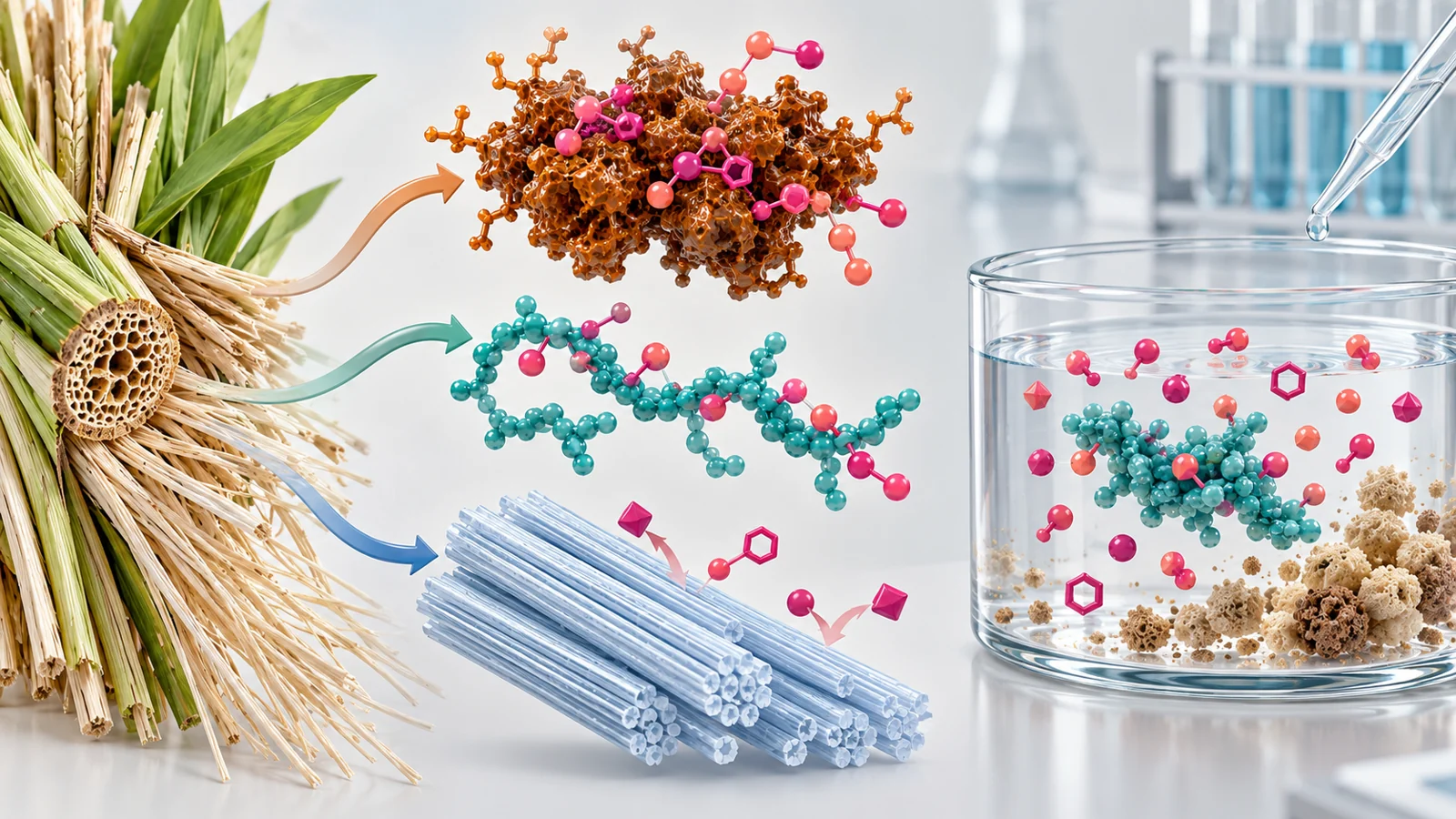
Those measurements come from earlier studies discussed in a 2021 review of drug carriers made from lignocellulosic biomass—the plant material built mainly from lignin, hemicellulose and cellulose. The review compares three particle types made from those constituents: lignin nanoparticles, xylan nanoparticles and cellulose nanocrystals. Their different structures and preparation routes affect how they interact with drugs. The results are formulation and laboratory evidence, not measurements of treatment in people.
Xylan holds drugs for a different kind of release
Xylan is a hemicellulose found in plant biomass. In the reviewed formulations, drugs could be attached to xylan through chemical links, often ester bonds, or combined with it through physical interactions. A chemical link can keep a drug attached until the carrier is broken down, which helps explain why some xylan formulations released little drug in more stomach-like or intestine-like tests.
The 5-fluorouracil example used rat gastrointestinal, cecal and colonic contents to represent different release environments. Its much greater release with cecal and colonic contents was consistent with enzymes from the colon’s microbial environment degrading xylan. The experiment supports a possible route to colon-directed release: the carrier can hold the drug through earlier test conditions and release more when exposed to the relevant contents.
That pattern is not a fixed property of every xylan formulation. In another example, a curcumin–xylan prodrug released heavily under acidic conditions because its ester link was readily broken. A later formulation used stearic acid to strengthen hydrophobic interactions around a 5-fluorouracil prodrug. In that test, it released about 28% at pH 7.4 and 58% under more acidic conditions (pH 5.0) over 60 hours, without an initial burst. The contrast shows why the drug, chemical linkage and modifications all matter; “xylan carrier” alone does not predict release behavior.
Producing xylan particles also takes extra work. Xylan has to be purified from other hemicellulose components before particle synthesis, and additional functionalization may be needed to form the intended links with a drug. The review describes this preparation as challenging, a practical constraint on developing formulations with consistent properties.
Lignin offers more than one kind of drug interaction
Lignin forms particles with water-attracting groups on the outside and more water-repelling parts within the aggregation. This amphiphilic arrangement—the combination of both tendencies—can let lignin nanoparticles interact with a range of drugs. Some drugs bind through hydrogen bonds, a type of molecular attraction, or through π–π stacking between ring-shaped parts of drug and lignin molecules. Positively charged drugs can also be attracted to the particles’ negative surface.
The way the particles are made affects their characteristics. The review describes acid precipitation, solvent shifting, dialysis, ultrasonication and homogenization among the methods studied. For example, the acid used in precipitation and the flow rate during preparation affected particle size or stability in reported work. The method therefore helps shape the carrier that a drug encounters.
Release varied across the lignin formulations reviewed. Resveratrol-, irinotecan- and curcumin-loaded particles released more than 80% of their drug in tests at pH 7.4, over different durations. Other drug-loaded particles had greater release at lower pH. These are not directly comparable performance scores: the drugs, particles and test conditions differed. They show instead that lignin’s broad set of interactions can be tuned, but the resulting release depends on the specific pairing and surroundings.
Cellulose surfaces can be adjusted to fit the drug
Cellulose nanocrystals are small, highly crystalline particles isolated from cellulose. Their surfaces carry hydroxyl and carboxyl groups that can help bind some water-soluble drugs. In studies summarized by the review, encapsulation efficiency—the proportion of drug added during preparation that the particles retained—ranged from 20% for procaine hydrochloride to 85% for imipramine hydrochloride. The spread is a reminder that a particle’s usefulness depends on which drug it is paired with.
Surface modification can change those interactions. Many drugs are hydrophobic, so researchers have tested treatments intended to make cellulose nanocrystals more compatible with them. In one reported comparison, a cationic surfactant—a positively charged surface treatment—bound well to negatively charged cellulose nanocrystals. The modified particles had a loading capacity of 65.49 milligrams per gram and an encapsulation efficiency of 87.32% in that study. These values describe that formulation, not a general advantage over lignin or xylan.
Making cellulose nanocrystals from plant material requires removing lignin and hemicellulose and isolating the crystalline cellulose. Acid hydrolysis is one established route, but it can generate substantial acidic waste, and residual acid on the particles can be difficult to remove. Sulfate groups left on the surface can help keep particles dispersed, yet the review notes that residual acidity and surface chemistry also need attention for drug-delivery uses. Manufacturing choices shape properties that later affect loading, stability and release.
What the laboratory evidence can tell us
The review gathers formulation studies, release tests and cell experiments. These can help explain how a particular carrier binds a drug, how much is released under specified conditions, and how cultured cells respond to an exposure. They do not establish that the same release pattern will occur inside a person, or that it will improve treatment. The cell findings are likewise specific to the tested particles, doses, exposure times and cell types; they cannot establish safety across other conditions or delivery routes.
The three materials also cannot be ranked from these examples. They were studied with different drugs, preparation methods and test environments, rather than in a single head-to-head comparison. The useful distinction is functional: xylan can be designed around breakdown in colon-associated conditions; lignin offers varied interactions through its mixed water affinity; and cellulose surfaces can be modified to change which drugs they bind.
What colon-specific release could change
If xylan formulations can reliably hold a drug through earlier parts of the digestive tract and release it in the intended colon environment, they could enable more localized delivery for conditions treated there. That possibility depends on reproducing the laboratory release behavior in the body, producing consistent particles, and showing that a formulation delivers a useful dose safely. The rat-content tests offer a reason to investigate that capability, not evidence that it is already available as a treatment.
Key Sources
- Primary source: A Review of Lignocellulosic-Derived Nanoparticles for Drug Delivery Applications: Lignin Nanoparticles, Xylan Nanoparticles, and Cellulose Nanocrystals.
DOI or Journal Page · Review or Meta-Analysis · 2021-01-28
Keep exploring