
Research Signal – Source date 2021-01-26
Winery waste can make a bioplastic harder to bend while making it easier to break by pulling. That sounds contradictory until the two measurements are separated: stiffness describes how much a material resists changing shape, while tensile strength describes how much pulling force it can withstand before failing. A 2021 critical review found that, across the composite studies it examined, more wine-derived filler generally raised stiffness and lowered tensile strength.
The result is a useful reminder that a plant-based ingredient does not improve every property at once. It also points to why winery leftovers are not interchangeable. Their composition affects both how they might be turned into polymer ingredients and how they behave as particles inside an existing plastic.
Two routes from winery residue to polymer
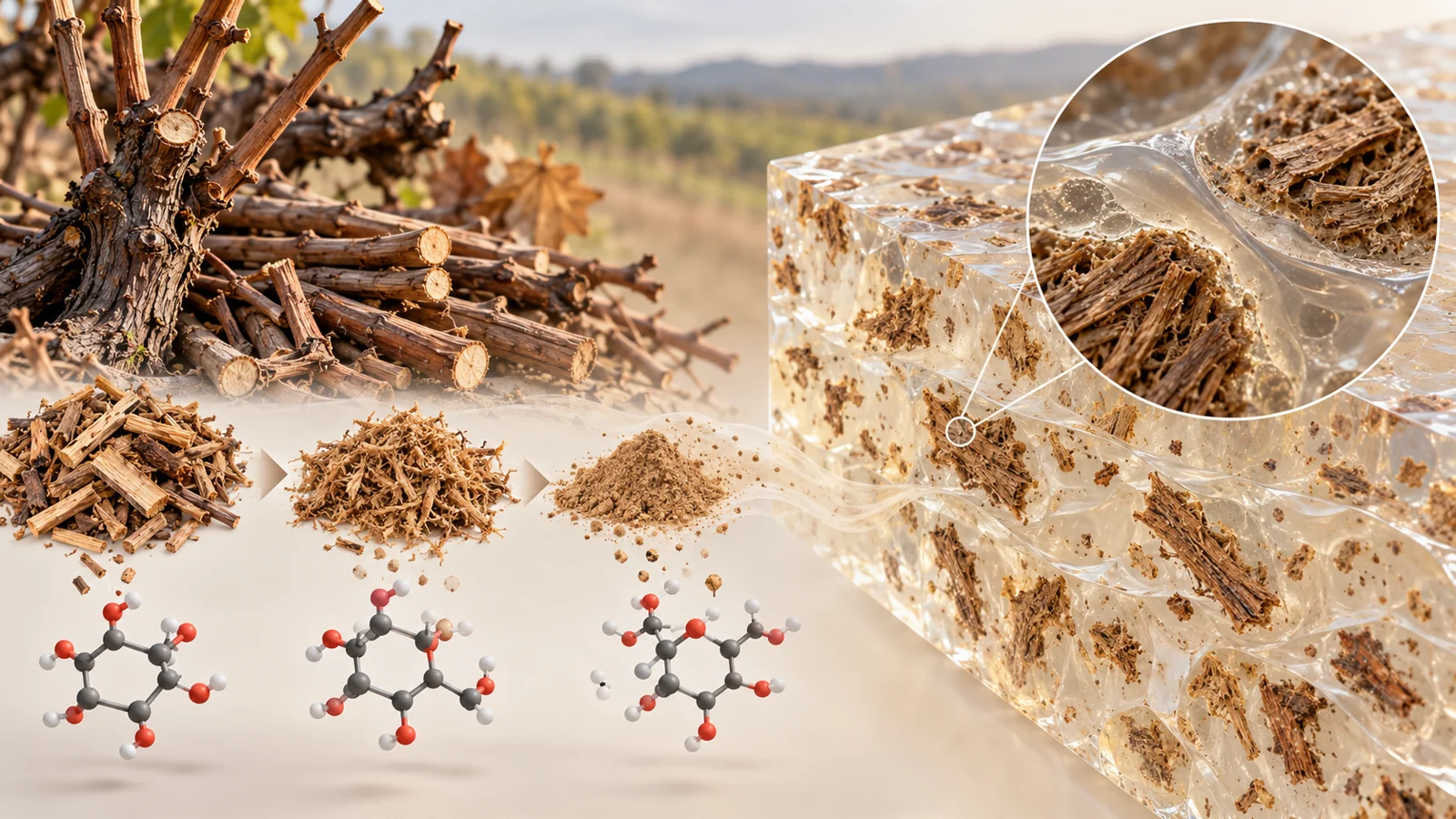
The review describes two broad uses. In one, residues provide sugars that microbes can ferment into ingredients such as lactic acid, or in some cases produce polymers directly. In the other, dried and ground residues are mixed into a polymer as fillers. The first route treats the waste as a chemical or biological starting material; the second adds solid particles to a material that already exists.
The distinction matters because the preparation is different. For woody residues such as vine shoots and grape stalks, plant fibers must be pretreated and broken into simple sugars before fermentation. Microbes can then use those sugars to make polymer ingredients or, in some cases, polymers, but the resulting liquid can also contain compounds that inhibit them. The review describes steps for removing those inhibitors; the treatment depends on the residue and desired product.
Vine shoots offer one example of the ingredient route. These pruning leftovers are rich in cellulose and hemicellulose, which can be converted into a sugar-rich hydrolysate. The review reports lactic-acid production from vine-shoot hydrolysate ranging from 15.5 to 43 grams per liter across cited studies. Those reported concentrations show that vine-shoot hydrolysate can serve as a fermentation feedstock under the cited study conditions. They do not, by themselves, show that collecting and processing it at industrial scale would be economical.
A winery’s leftovers have different starting chemistry
Vine shoots are woody pruning residues, while grape stalks are the stems separated during winemaking. Both contain cellulose, hemicellulose, and lignin, but their proportions differ. The review gives vine shoots as roughly 34% cellulose, 19% hemicellulose, and 27% lignin. Grape stalks contain about 20–30% cellulose and 15–20% hemicellulose, alongside 17–26% lignin and a substantial amount of tannins. Those tannins can complicate the use of stalks as fermentation feedstock because they are associated with the structural material and can inhibit microorganisms.
Grape pomace is a mixture of skins and seeds, sometimes with residual stalks. Its composition depends in part on whether it comes from red or white winemaking: red-wine pomace has already undergone fermentation, while white-wine pomace may retain more sugars and polyphenols. Wine lees, the sediment from fermentation, storage, or clarification, are different again. They include microbial material, insoluble carbohydrates, phenolic compounds, proteins, organic salts, and a liquid fraction containing ethanol and organic acids.
These differences help explain why one residue might suit fermentation while another might be more useful as a filler. They also make broad claims about “wine waste” misleading: the name covers materials with distinct chemistry, particle structure, and processing needs.
Why a filler stiffens a plastic but weakens it under tension
A stiff particle can make a composite resist bending or stretching out of shape. The review links increased elastic modulus—the measure of stiffness—to the relatively rigid plant material within the polymer. Cellulose-rich grape stalks, for example, increased the Young’s modulus of polylactic acid (PLA) by as much as 65% in one cited study. Vine shoots also raised the modulus of a different biopolymer, while grape pomace did not change it in that particular comparison. The result depended on the residue’s composition, not simply on its origin in winemaking.
Tensile strength depends on another part of the material: how well the particles bond to the polymer around them. The review says this strength generally declined as filler content rose in the PLA, polyhydroxyalkanoate, and polybutylene succinate composites it considered. Wine-derived fillers are highly hydrophilic, meaning they interact readily with water, while the polymer matrices in these examples are less so. If the interface between particle and polymer is weak, pulling force does not pass smoothly across it; small separations can become points where a crack begins.
The review discusses both surface treatments and coupling agents as ways to improve that bond. The wine-filler studies it cites had not surface-treated the residues, although some tested coupling agents added during extrusion. Whether surface treatment improves these particular composites remains to be shown. More filler is therefore not automatically better: a formulation can gain stiffness while losing strength under tension.
Other mechanical tests reinforce the point that performance depends on what is measured. In cited PLA composites, grape stalks or grape pomace raised flexural modulus—the resistance to bending—while flexural strength fell by about 40% in the reported formulations. Yet one study found that adding 20% grape pomace raised PLA impact strength by around 50%, from 20 to 30 joules per square meter. Another found impact strength improved at lower pomace loadings and then declined at higher ones. A material can respond differently to bending, pulling, and sudden impact, so no single measurement settles whether a blend is suitable for a particular use.
Heat and logistics can narrow the options
The filler also has to withstand the heat used to process the polymer. The review reports degradation temperatures of roughly 200–270 °C for wine by-products, compared with about 330 °C for PLA, 340 °C for polybutylene succinate, and 290 °C for polyhydroxybutyrate. In cited examples, grape pomace lowered the degradation temperature of PLA composites, and adding pomace or lees lowered it in particular polybutylene succinate blends. The exact change varied with material and formulation.
This creates a practical constraint: a residue that performs well in a laboratory blend may degrade under processing conditions, especially when production runs at higher temperatures. The review calls for testing wine fillers in polymers processed at lower temperatures; it does not show that those combinations solve the heat constraint. Feedstock handling matters too. Before grinding, vine shoots and grape stalks have very low apparent density, so moving bulky material from fields to processing sites could add transport costs. Grinding near the source is one possibility the review raises, but the laboratory results do not establish how well that approach would work at scale.
Water behavior depends on the intended use
Plant-based fillers can also change how water moves through a composite. In a cited study, adding vine shoots or grape pomace increased water-vapor permeability in polyhydroxybutyrate-co-valerate (PHBV) composites by as much as five times compared with the neat polymer. The review links the higher permeability to the hydrophilic character of the residues; vine-shoot composites were more permeable than pomace composites in that comparison. For packaging that must limit water vapor, such a change could be undesirable. The study authors suggested that the more permeable blends might instead suit horticulture or packaging for products that respire.
Permeability and biodegradation are separate properties. Permeability measures how readily water vapor passes through a material; it does not show how quickly the material breaks down. In a different set of tests, PHB containing wine lees biodegraded almost twice as fast as neat PHB in soil and marine water when the composite included 40 parts lees per hundred parts polymer. The review describes this as a result for that formulation and those test environments. It cannot be generalized to every wine-waste composite or taken as evidence of how a finished product will behave after disposal.
What winery waste could make possible in bioplastics
If feedstock preparation, particle bonding, heat stability, and residue transport can be managed for a specific application, winery leftovers could provide either fermentation sugars for polymer ingredients or lower-cost filler within some bioplastics. That could give agricultural residues another use while reducing reliance on edible feedstocks or virgin polymer material in selected products. The 2021 review makes those routes plausible research directions, but its compiled laboratory studies do not establish lower final prices, large-scale economics, or commercial adoption. The potential is specific to the residue, polymer, processing conditions, and job the material needs to do.
Key Sources
- Primary source: Wine By-Products as Raw Materials for the Production of Biopolymers and of Natural Reinforcing Fillers: A Critical Review.
DOI or Journal Page · Review or Meta-Analysis · 2021-01-26
Keep exploring