
Research Signal – Source date 2021-01-21
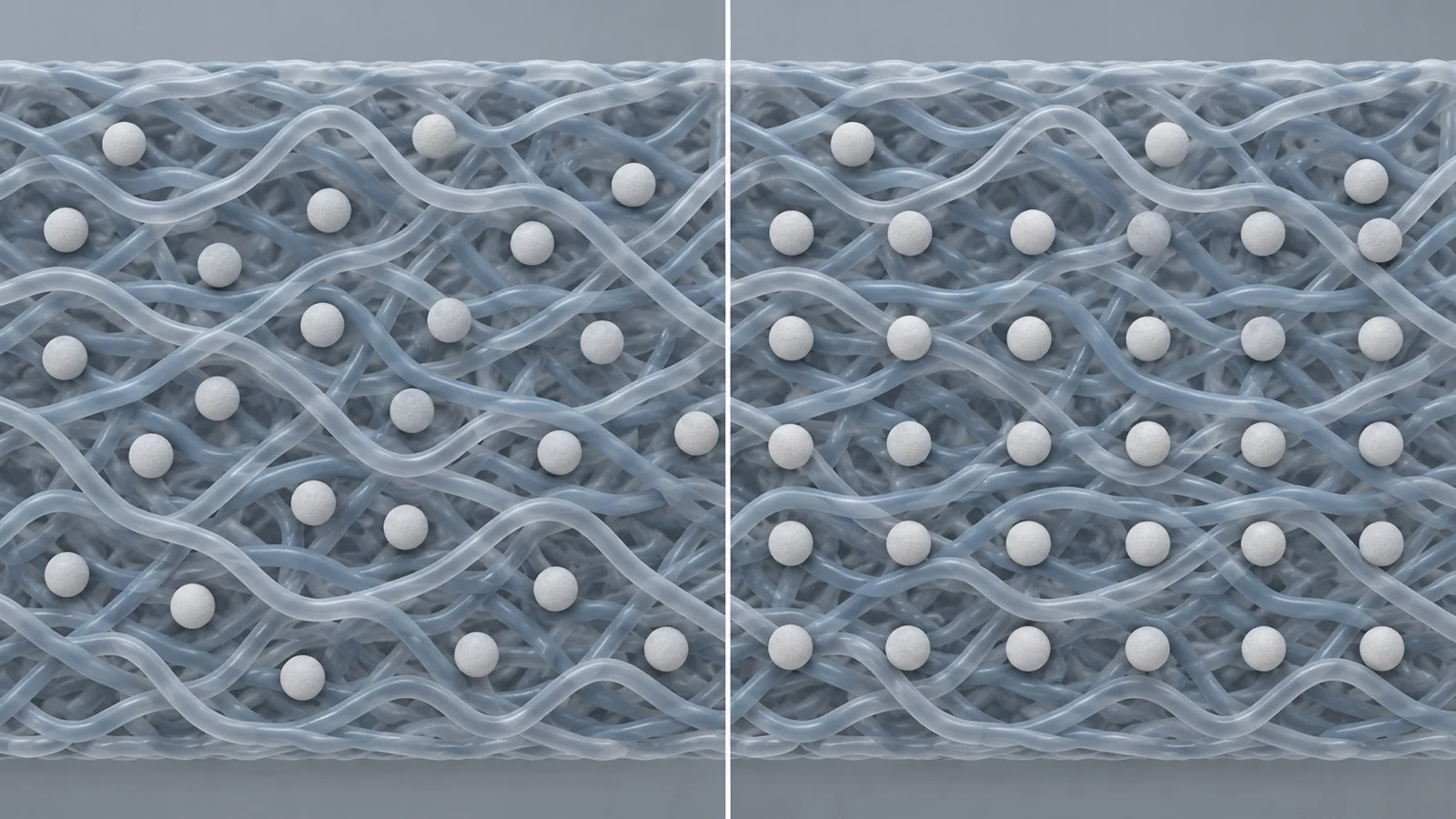
A material’s ingredients do not tell the whole story. In a composite, tiny added particles can be scattered through the surrounding material or gathered into an ordered arrangement. Their positions affect how the particles and the surrounding material interact, so the same ingredients may not have the same possibilities when organized differently.
That idea is the focus of a 2021 review on polymer nanocomposites. Polymers are materials made of long chains of molecules; in these composites, nanoscale fillers—particles much smaller than a speck of dust—are mixed into the polymer. The review considers how researchers might control where those fillers sit, and what they could learn by trying to do so.
The arrangement adds another design choice
A random composite has fillers distributed without a regular pattern. An ordered composite would place them in a more structured arrangement, such as an array. The contrast is about organization within the material, alongside the choice of ingredients themselves.
The review’s authors argue that nanoscale ordering may produce functions that random composites cannot access. The reasoning is that a regular arrangement changes how the two components are positioned in relation to one another. It could therefore open a design route beyond choosing a different polymer or filler.
This is a proposed opportunity, not a reported performance result for a named material. The review’s abstract identifies ordering as a promising direction, but the evidence available here does not give a measured comparison between an ordered composite and a random version. The point is the research question: can a useful arrangement be created and controlled well enough to make a difference?
Getting fillers into place is the hard part
The challenge is not simply to imagine a pattern. Researchers need ways to produce ordered arrays of tiny fillers within a polymer matrix, the continuous material surrounding them. The authors identify methods for generating such arrays as an underexplored area.
That makes control over placement central to the research task. If the fillers do not reliably form the intended arrangement, it is difficult to tell whether a material’s behavior comes from the design or from an uncontrolled distribution. The review highlights the need to develop ways to guide assembly, without establishing a particular fabrication method as the answer.
Ordering also raises questions that go beyond making a new composite. What forces favor one arrangement over another? What steps or changes in the material allow that arrangement to form? Answers could help researchers understand how polymers and nanomaterials assemble together.
Assembly can reveal how soft materials organize
Two scientific ideas help describe those questions. Thermodynamics concerns which arrangements are favored under particular conditions; kinetics concerns the processes and pace by which an arrangement forms. Put simply, one asks what configuration is favored, while the other asks how the material gets there.
The authors connect efforts to organize fillers with learning more about both. That knowledge could inform composite design, while also deepening understanding of soft matter systems more broadly—the family of materials whose structure and behavior can be shaped by interactions among their components.
The review synthesizes research efforts and points to a direction for further work. Its central contribution here is the design argument and the questions it raises, rather than independent validation of a specific ordered composite, a quantified advantage, or a device application.
How ordered fillers could expand material design
Dependable control over nanofiller arrangement could give materials researchers another way to design composite functions, alongside selecting the ingredients. If researchers can reliably construct ordered structures and demonstrate the functions they are meant to enable, the same work could improve understanding of how polymers and nanomaterials assemble. Both capabilities depend on turning a promising arrangement into a reproducible material and showing what it does.
Key Sources
- Primary source: Ordered polymer composite materials: challenges and opportunities.
DOI or Journal Page · Review or Meta-Analysis · 2021-01-21
Keep exploring