
Research Signal – Source date 2021-01-20
Cold changes the polymers considered for lightweight rocket tanks in conflicting ways. A 2021 review of prior studies reports that measured strength, stiffness and fracture toughness often rose as temperature fell, while impact resistance and the ability to stretch before breaking fell sharply.
Fracture toughness, impact resistance and fracture strain measure different responses: resistance to crack growth in a test, the ability to withstand a sudden blow, and how far a specimen stretches before breaking. A strong, stiff specimen can carry a substantial load in one test without resisting every kind of damage a tank wall must withstand. Fiber-reinforced plastic offers low weight and design flexibility, but containing a cold propellant safely depends on more than a favorable strength reading.
A cured resin can be strong and vulnerable at once
Many composite tanks use a polymer matrix to bind reinforcing fibers. In a common thermoset such as epoxy, the resin begins as a mixture that cures into a network of linked chains. The links, called crosslinks, give the material rigidity and stability. They also restrict how much the chains can move, and that constraint becomes more pronounced in the cold.
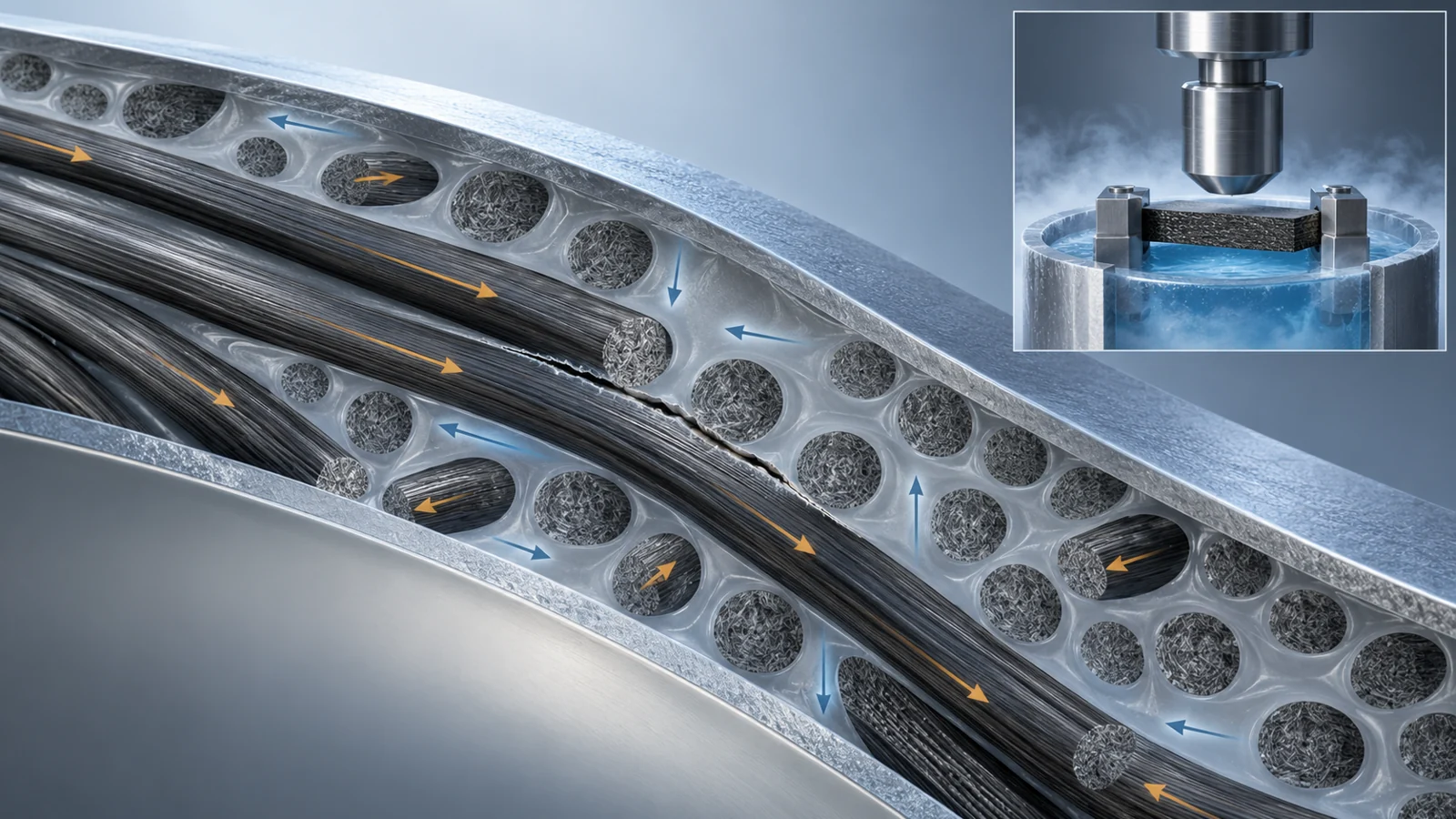
The reinforcing fibers and polymer do not necessarily contract by the same amount as temperature drops. In a carbon-fiber composite, that mismatch can leave residual stress in the resin. Stress can concentrate around interfaces and small defects, allowing microcracks to begin even before the overall structure reaches its ultimate strength. The review connects this problem to an earlier X-33 reusable launch vehicle tank failure, where fuel leaked after fractures formed in the tank wall amid high thermal stress associated with the different contraction of polymer and carbon fiber. That history illustrates a design challenge; it does not show that any modification discussed in the review would have prevented the failure.
Improving one property is not automatically a solution to the others. The review describes nanoclay-modified epoxy with hydrogen permeability reported at 70% below that of the base resin. Yet in a separate fracture test at 123 K, nanoclay-reinforced epoxy had lower measured fracture toughness than unmodified epoxy. A barrier improvement and crack resistance are distinct performance questions, and the result for one formulation cannot stand in for the other.
Rubber can help toughen brittle thermosets, but it brings its own tradeoffs. The reviewed studies found that adding rubber could lower the glass transition temperature—the point at which a polymer’s behavior shifts—and reduce interlaminar shear strength, a measure of how well layers resist sliding apart. A modifier therefore needs evaluation across the properties that matter for the intended structure, rather than a single headline result.
Thermoplastics change the manufacturing equation
Thermoplastics differ from cured epoxies because their chains are not locked into the same permanent crosslinked network. They can be melted and consolidated again, which supports reprocessing and recycling. The review notes that high-performance engineering thermoplastics can offer several times the fracture toughness of epoxies, along with a broader range of mechanical properties and no curing stage.
Those advantages do not settle the choice for a large cryogenic tank. High-performance thermoplastics can be costly, and their processing can be complicated. Conventional molding methods also have limits for making large composite structures. Prepreg technology and automated tape laying were described as promising routes to larger thermoplastic structures, but the review found relatively little reported research on high-performance engineering plastics for cryogenic use at the time it was written.
Lower-cost options raise different questions. One study summarized in the review examined polypropylene composites whose matrix and reinforcement had the same chemical composition, a design intended to reduce contraction mismatch between constituents. At 77 K, the review reports tensile strengths of 268 and 37 megapascals for two different fiber layouts—more than a sevenfold difference between those specimens. Those specimen results illustrate how strongly architecture can affect a measurement; they do not qualify a finished tank or establish a best material across use conditions.
A tank must survive more than one pull test
A tank experiences thermal and mechanical demands together. It must contain cryogenic fuel while the structure cools, and reusable vehicles add repeated loading to the engineering problem. In fiber-reinforced composites, microcracks may start under combined thermal and mechanical loads below the material’s ultimate strength. Interfaces between resin and fibers, as well as between composite layers, become part of the containment question.
Fatigue findings in the review show why a one-time strength test is not enough. In tests of woven fiber composites, separation between layers grew more slowly under repeated loads at 77 K and 4 K than at room temperature. In other 77 K tests, specimens of two thermoplastics—PEEK and polycarbonate—lasted fewer loading cycles as the tensile part of each cycle increased, a change that can promote cracks.
These findings come from different materials, specimen designs and loading conditions. They do not form a direct comparison of complete tanks, and a favorable result under one test condition cannot establish how a tank will behave over its service life. The practical question is whether a material system can retain containment through its actual combination of cooling, loading and repeated use.
Liquid oxygen brings a chemical test
Mechanical toughness alone cannot establish suitability for a liquid oxygen environment. A material must also be assessed for chemical compatibility: how readily and to what degree it may react with oxygen. The review describes standardized impact testing in which a specimen is exposed to liquid oxygen and struck. Reactions such as burning, explosion, visible ash or charring count as a response in the test.
The concern is that impact can create intense local heating at the specimen surface. The reviewed research describes this hot spot as a possible start to thermal degradation and oxidation reactions. Highly active radicals formed at the surface can sustain a chain reaction in oxygen. This is a separate hazard from cracking caused by contraction mismatch, even though a real material must handle both mechanical and chemical demands where liquid oxygen is present.
In epoxy examples summarized by the review, a phosphorus-containing additive called DOPO was associated with improved results in liquid oxygen impact tests. The proposed explanation is that products formed after an impact could partly shield the resin from oxygen and interrupt the reactive chain that can lead to burning. Results also varied with the epoxy resin and curing agent, so compatibility must be tested for the whole formulation.
What this could change for cryogenic fuel tanks
A lightweight composite tank that remains tough, seals reliably through repeated loading, can be manufactured at useful scale and meets liquid oxygen compatibility requirements where needed could leave more launch-vehicle mass available for payload and support reusable designs. The review points to that capability as a possibility, not an achieved outcome: its evidence combines prior tests across different polymers and conditions, rather than a flight-ready tank qualification. The benefit depends on bringing structural durability, containment, fabrication and chemical compatibility together in the same application.
Key Sources
- Primary source: A Review of the Polymer for Cryogenic Application: Methods, Mechanisms and Perspectives.
DOI or Journal Page · Review or Meta-Analysis · 2021-01-20
Keep exploring