
Research Signal – Source date 2021-01-20
A material can capture metal ions from water and still create a separate environmental concern. A 2021 review of cellulose–polyethyleneimine composites describes one formulation that adsorbed contaminants effectively in a complex water matrix, yet reduced growth of a model marine alga. The review attributes that result to some polyethyleneimine escaping from the material into the water.
This is a specific example, not evidence that every composite of these polymers harms aquatic life. It does show why performance cannot be judged by how much contaminant a material captures alone: what stays in the material, and what enters the surrounding water, also matters.
A sturdy structure with metal-binding sites
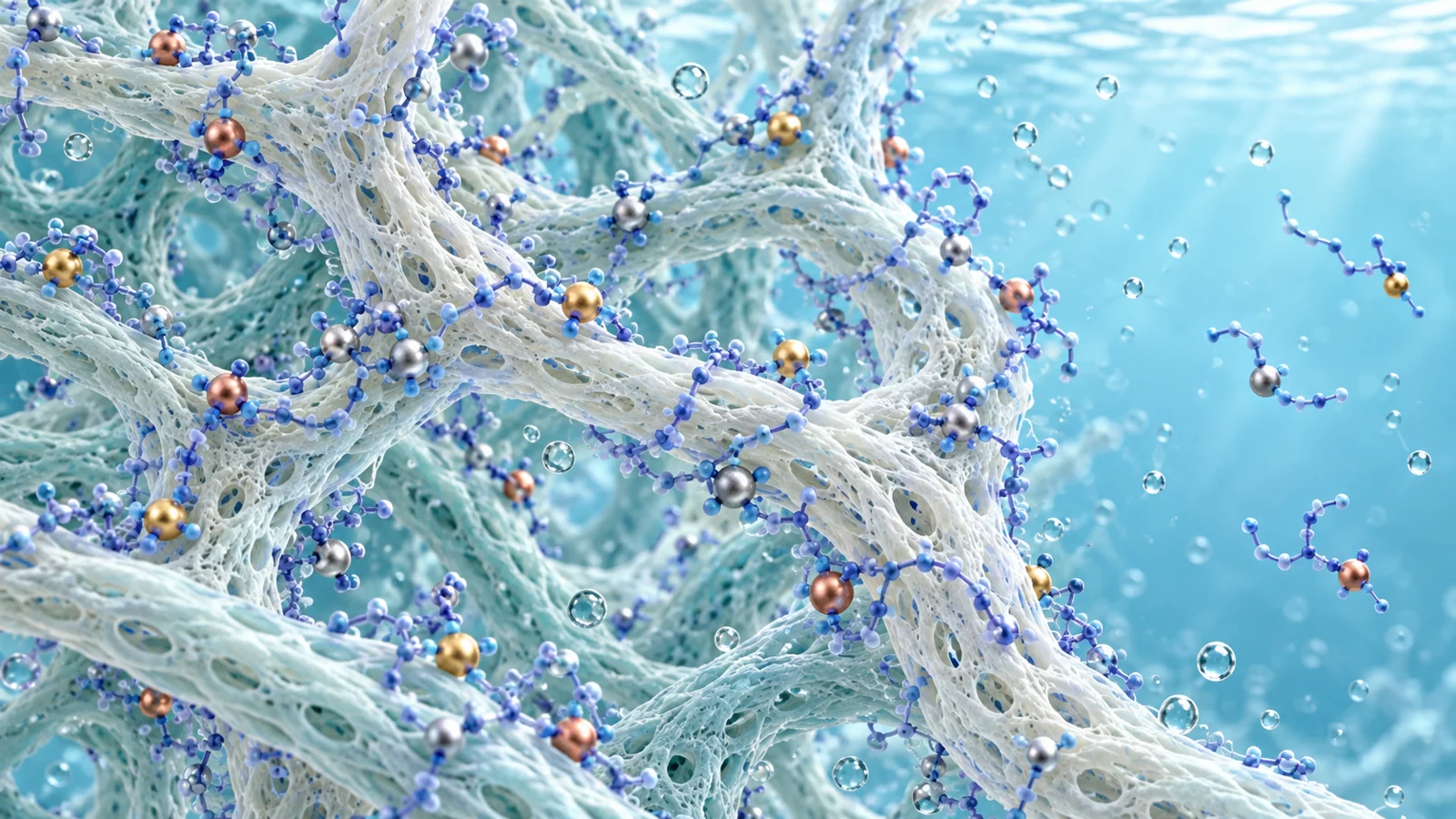
Cellulose and polyethyleneimine (PEI) have different jobs in these composites. Cellulose provides a structure that can remain mechanically stable in water. PEI is rich in amine groups, which can bind metal ions. In plain terms, the cellulose forms the support, while the attached PEI supplies many of the sites that can hold metals.
The review describes these materials as especially relevant to water remediation, including removal of heavy metal ions and organic contaminants. Their design combines the structural contribution of cellulose with PEI’s ability to interact with contaminants. Researchers have made composites in different forms and from different cellulose sources, using varied cross-linking methods to hold the components together.
The binding sites help explain why these materials can take up metals, but uptake does not mean every metal will be captured equally. Nor does a result in one water mixture necessarily predict how the material will behave in another.
Capturing several metals can still favor copper
A cellulose–PEI material discussed in the review was tested against copper, cobalt, nickel, and cadmium. The material adsorbed the metals, but competition tests with several metals present showed a marked preference for copper. The review also discusses other examples, including composites that adsorbed arsenic in its two reported forms.
A preference in a mixed-metal test is useful information: it suggests that the ions present can affect which ones the material captures most readily. But copper preference in that experiment is not a general measure of cleanup across contaminated waters. The metals, their relative amounts, and other substances in a particular water source can differ. A material’s performance against one ion—or in one mixture—cannot stand in for every contamination problem.
Securing the polymer addresses one release route
The algal result in the review came from a formulation whose adsorption remained high in a complex matrix. In exposure tests, however, the material reduced growth of the model marine alga Dunaliella tertiolecta. The review says the researchers linked this effect to partial release of branched PEI (bPEI) into the water.
They describe several changes to that formulation: adding citric acid to fix the PEI more firmly in the cellulose matrix, reducing excess PEI in the synthesis, and improving purification. The review reports that the revised approach was followed by further exposure tests with algae and mussels. These changes address polymer release in the formulation under discussion; they do not establish ecological safety for all cellulose–PEI materials or waterways.
The result makes material stability part of the environmental question. A composite can retain its intended contaminant-binding function while some of its polymer enters the water. How firmly the components remain attached, and how well excess material is removed, can therefore matter alongside adsorption performance.
Production choices have trade-offs
Holding PEI in place requires choices about how the composite is made. The review notes that two cross-linkers used in reported preparation routes have been described as highly toxic to humans and animals. Their toxicity matters when assessing production; during use, the review separately flags the release of PEI itself as a risk.
The review also discusses a thermal preparation route that uses citric acid, while noting an energy burden associated with freeze-drying in the process. That step contributed to energy consumption in a laboratory-scale life-cycle assessment discussed by the authors. A cellulose ingredient, by itself, therefore cannot establish that the overall material is environmentally preferable. The ingredients, processing steps, energy use, stability, and potential releases all shape the production-impact question.
Water conditions change both performance and exposure
Many experiments described in the review tested adsorption in purified water containing a single contaminant. Such tests can show whether a material binds a target under controlled conditions, but they leave other questions open. In more complex water, dissolved substances can interfere with interactions between the composite and the target contaminant. The surrounding mixture can also affect what organisms encounter if material components are released.
The reported complex-matrix result illustrates why these are separate questions. Adsorption remained high in that test, while partial bPEI release was associated with reduced algal growth. Strong contaminant uptake therefore did not, on its own, answer the exposure question. Results from one complex matrix also cannot establish how a composite will behave in every natural water environment.
The review’s broader point is to consider realistic conditions early in material development, including both performance and potential ecological effects. For water-treatment proposals, that means asking how well the composite captures contaminants in relevant mixtures and what remains in the water after contact, as well as how the material is produced.
What safer metal capture could mean for water treatment
If cellulose–PEI materials can retain their binding polymer, capture relevant metals in complex water, and be produced without unacceptable environmental costs, they could offer a route to water treatment that uses a stable cellulose structure and PEI’s metal-binding sites. That possibility depends on the material holding up beyond controlled adsorption tests: its performance under realistic conditions, the substances it releases, and the impacts of making it all need to support the proposed use. The review describes promising design options, not a deployed treatment product or a settled environmental benefit.
Key Sources
- Primary source: Synthesis and Application of Cellulose-Polyethyleneimine Composites and Nanocomposites: A Concise Review.
DOI or Journal Page · Review or Meta-Analysis · 2021-01-20
Keep exploring