
Research Signal – Source date 2021-01-14
PHB has a difficult pairing of traits: it melts at about 170–180°C, yet shaping it generally requires temperatures around 180–190°C, where it can degrade rapidly. At the same time, its highly ordered crystalline structure makes it stiff and brittle. The first problem narrows the time and temperature window for processing; the second limits how much the finished material can bend or stretch.
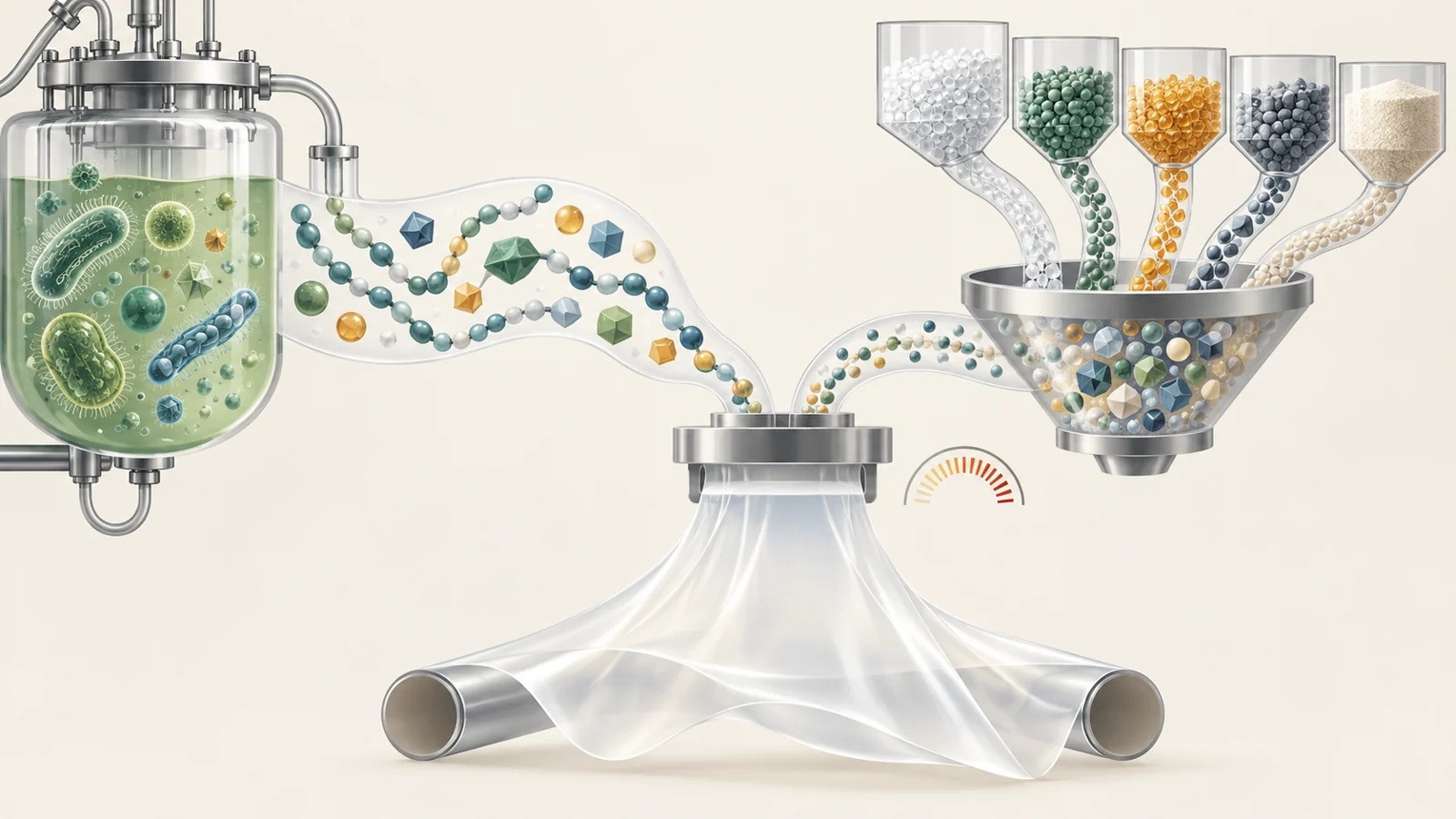
A review published in 2021 surveys two broad ways researchers have tried to improve the material. Microbes can be guided to build PHB copolymers with different chemical building blocks, or manufacturers can modify the polymer after it has been produced, using plasticizers, additives or blends. These approaches address related weaknesses through different routes, and each can bring its own processing or performance tradeoffs.
Why heat and brittleness collide
PHB is a biodegradable polyester that microorganisms make to store carbon and energy. Its resemblance to familiar petroleum-derived plastics makes it an appealing alternative, but the properties that make it solid and stiff also complicate its use. High crystallinity—the extent to which polymer chains pack into ordered regions—contributes to brittleness and low stretch before breaking.
Heat creates a separate constraint. PHB’s melting point is close to the temperatures needed to shape it. Near that range, heat can quickly break its long polymer chains into shorter ones. The review notes that acceptable time in processing equipment may be limited to only a few minutes. A material that needs enough heat to flow but degrades under that heat is difficult to process using conventional methods for thermoplastics.
Researchers have therefore looked at both the polymer’s composition and what can be added or combined with it. The review presents these as ways to tune properties, not as one formulation that resolves heat sensitivity, brittleness and production cost all at once.
Microbes can alter the building blocks
A microbe’s feedstock can affect which molecular building blocks enter the polymer. Some microbial pathways use sugars; others use related carbon sources such as fatty acids. By supplying different precursors, researchers can encourage microbes to produce copolymers—chains containing more than one kind of building block—instead of PHB alone.
One example is PHBV, a copolymer containing hydroxyvalerate (HV) units along with the hydroxybutyrate units in PHB. Adding HV can lower the material’s melting temperature and improve flexibility and ductility, properties relevant to films and fibers. The review describes a general relationship between greater HV content, lower melting temperature and improved stretch, though the material’s behavior depends on its composition.
The effect on crystallinity is not a simple on-off switch. PHBV can retain substantial crystallinity across a broad range of compositions because its two types of units can sometimes crystallize together. The amount of HV therefore matters, but it does not by itself predict that the polymer will become entirely disordered or soft.
Less crystal order can bring a new processing snag
A different copolymer, PHBHHx, includes hydroxyhexanoate (HHx) units. These side branches make the chain less regular, lowering crystallinity and melting temperature. Yet reduced crystallinity does not automatically make a material easier to manufacture: the review reports that PHBHHx crystallizes more slowly than PHB, which can complicate efficient processing.
That slow solidification has prompted a separate search for crystallization aids. In one reported example, ultrafine talc improved PHBHHx crystallization and increased stiffness without changing the film’s barrier properties. Zinc oxide also improved crystallization, but strongly affected opacity; the resulting film blocked ultraviolet light. These examples show how an additive may solve one processing problem while changing another property that matters to a particular use.
Additives and blends change the material after synthesis
Plasticizers work differently from changing the microbial recipe. They help polymer chains move more freely, often lowering the glass-transition temperature—the point at which a polymer shifts from a more rigid state toward greater mobility—and reducing stiffness. Some plasticizers are chemically bound into polymer chains; others are added as separate molecules that interact with the polymer without reacting with it.
For a blend of PHB with a second polymer, PLA, the review reports that plasticizers increased how far the material could stretch before breaking. It also notes interest in natural plasticizers because additives can migrate out of a material, a concern with possible health or environmental implications. The effect depends on the plasticizer, its amount and the polymers it is combined with; one formulation’s performance cannot stand in for every blend.
Blending polymers provides another route. Physical mixing brings polymers together without deliberately joining their chains. Reactive blending uses a reaction to improve how the components work together. In one reported blend of PHB with another polymer, PCL, free-radical initiators—chemicals that start reactions—improved mechanical and thermal properties compared with a blend made by physical mixing alone. The review links the improvement to some polymer chains joining or branching. The result shows that the way a blend is made can matter alongside its ingredients.
Film tests depend on the formulation
The review describes PHBV as a candidate for films and fibers with different degrees of elasticity, depending on HV content. It also summarizes a food-contact test of PHBV films with 3 mol% HV—about three HV units per 100 polymer building blocks. After contact with several food-simulating liquids at 40°C for 10 days, the films’ mechanical properties and water-vapor permeability were preserved, with an exception in 95% ethanol.
That is a result for a particular composition and set of test conditions. It does not establish food-contact suitability for every PHB-based material or intended use. Elsewhere, the review describes changes during storage that can shift PHBV from a more elastic state toward brittleness, and reports that drawing and heat-setting after fiber formation improved fiber properties in another example. Processing history and the conditions under which a film or fiber is tested shape what those results can tell us.
Feedstock choices affect cost and composition
The cost of the starting carbon source is a major factor in PHA production. The review cites estimates of roughly $6–15 per kilogram for biopolymer, compared with $0.23–0.48 per kilogram for polyethylene and polypropylene. These are estimates reported in the 2021 review, not current market prices. The review also identifies raw materials and recovery as major cost drivers, with carbon sources accounting for more than half of total costs in the cited analysis.
Waste-derived feedstocks could make the inputs less expensive, but the starting material can also affect what microbes produce and how much polymer accumulates. In examples summarized by the review, waste glycerol was used with added acids to produce PHBV with different HV contents. A feeding strategy that avoided high acid concentrations achieved up to 25% HV and around 5 grams of polymer per liter; another approach using a selected mutant strain reached an HV content of up to 36.7%. The reported composition and accumulation varied with the feed and conditions. One set of glycerol-based results also involved low molecular weight polymer, showing why output quality matters alongside the price of the input.
The review presents these as approaches under investigation, not proof that waste-derived production is commercially competitive. A lower-cost feedstock is useful only if the resulting polymer’s composition, yield and properties fit the intended application and the production process remains workable.
What improved PHB could bring to packaging
If researchers can combine reliable melt processing with copolymer compositions and post-synthesis modifications suited to particular uses, PHB-based materials could support a wider range of biodegradable packaging films and fibers. A film designed for flexibility may need a different balance of crystallinity, barrier performance and processing behavior than a fiber or a more rigid package.
The potential is practical: more control over those properties could make biodegradable materials useful in packaging roles that are difficult for brittle, heat-sensitive PHB to serve. Reaching that capability depends on formulations performing under relevant use and test conditions, and on production costs becoming workable beyond the examples gathered in the review.
Key Sources
- Primary source: <i>In vivo</i> and <i>Post-synthesis</i> Strategies to Enhance the Properties of PHB-Based Materials: A Review.
DOI or Journal Page · Review or Meta-Analysis · 2021-01-14
Keep exploring