
Research Signal – Source date 2021-01-12
A drug aimed at a tumor’s blood supply might also change the conditions that immune cells face around the cancer. That possibility led researchers to pair vessel-targeting medicines with checkpoint inhibitors in advanced stomach and gastroesophageal junction cancers. Early trials reported responses, but the rates varied widely across studies, and they do not establish that these combinations extend survival.
The evidence here comes from a review published in January 2021. Its authors searched medical literature, major conference proceedings, and ClinicalTrials.gov, with the last reported search update on December 17, 2020.
Blood-vessel signals can affect immune cells
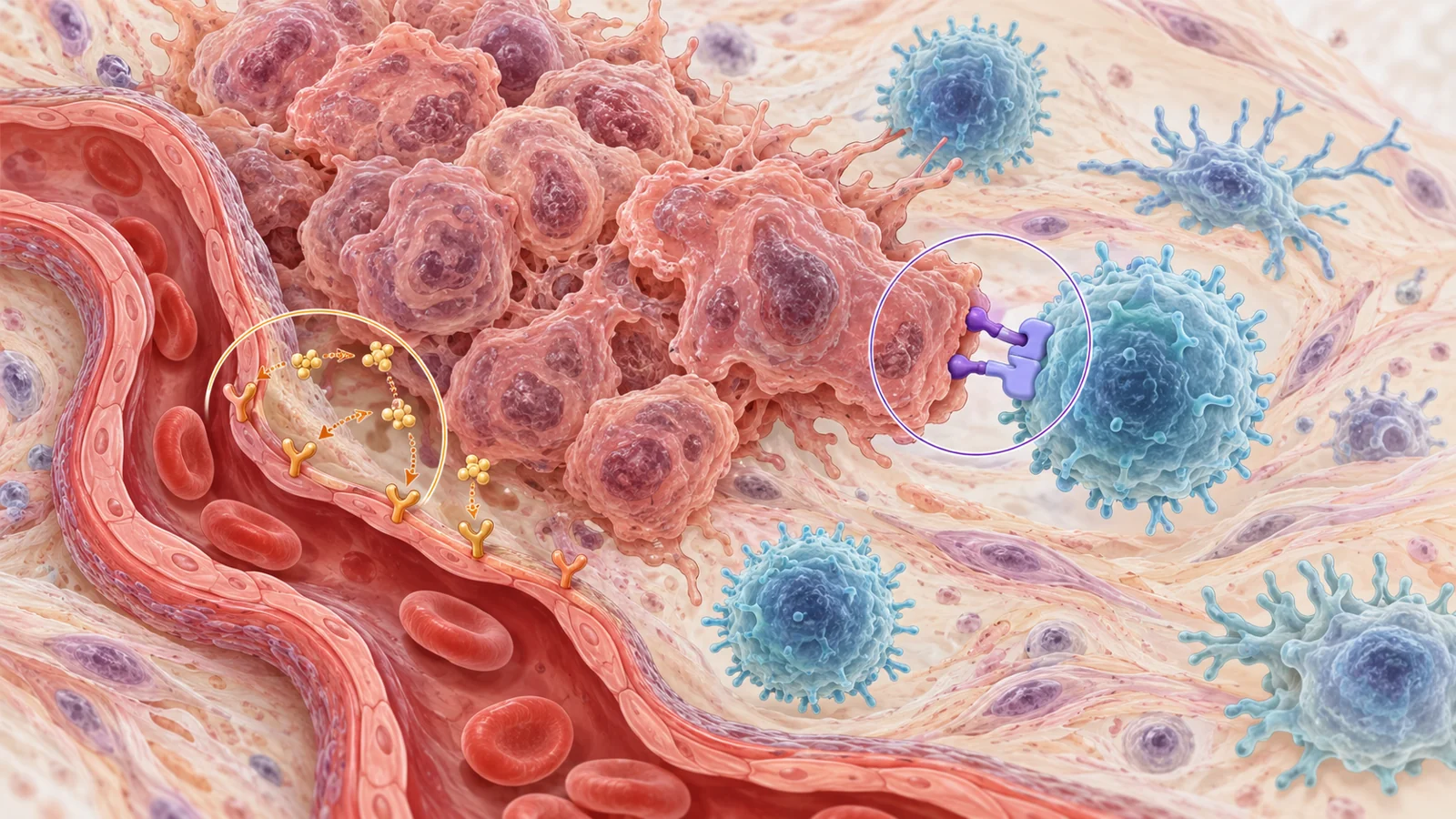
Tumors can grow abnormal, leaky blood vessels. One driver is vascular endothelial growth factor, or VEGF, a signal that promotes blood-vessel growth. The review describes VEGF as having an additional role: it can help create an environment that makes an immune attack harder.
In laboratory and other tumor-model research, VEGF-related signaling was linked to fewer immune cells reaching tumors and more cells that suppress immune activity. It can also interfere with dendritic cells, which help the immune system recognize targets. Other vessel-related signals may contribute to this immune-suppressing environment too.
This biology offers a reason to test the two drug types together. A vessel-targeting drug blocks VEGF or its receptors; a checkpoint inhibitor blocks signals that restrain immune cells, such as the PD-1 pathway. The proposed pairing could affect both the surroundings that immune cells enter and the brakes on their activity. The preclinical findings make the idea plausible, but they do not show that changing tumor vessels caused the responses observed in patients.
What each approach had shown alone
Ramucirumab blocks VEGFR2, a receptor that responds to VEGF. For people with advanced gastric or gastroesophageal junction cancer who had already received an initial treatment, the review reports median survival of 5.2 months with ramucirumab alone, compared with 3.8 months with best supportive care. With ramucirumab plus paclitaxel, median survival was 9.6 months, compared with 7.4 months with paclitaxel alone. Other vessel-targeting drugs, including regorafenib and cabozantinib, had shown more modest single-agent activity in early trials.
Checkpoint inhibitors target immune signals such as PD-1 that can hold back immune-cell activity. Pembrolizumab had shown benefit as a later-line treatment for a selected group whose tumors expressed PD-L1, a marker measured with a combined positive score. Results in other settings were mixed, including trials that did not find an advantage over chemotherapy. Researchers were therefore interested in combinations that might extend checkpoint treatment’s reach.
Response rates varied across early trials
In a phase I/II study, ramucirumab plus nivolumab was tested as second-line treatment for advanced gastric cancer. An objective response—tumor shrinkage or disappearance measured under the study’s criteria—was reported in 26.7% of patients. Disease control, which also counts cases where disease did not worsen, was reported in 62.2%. The study’s six-month progression-free survival measure was 37.4%, meeting the phase II target. Progression-free survival refers to the period patients live without their cancer worsening. No dose-limiting toxicities were observed in the small phase I portion.
Other ramucirumab combinations had different results. In a phase Ib study of previously treated gastric and gastroesophageal junction cancers, ramucirumab plus pembrolizumab produced a 7% response rate and 44% disease control rate. A separate phase Ia study of ramucirumab plus durvalumab reported a 21% response rate.
Lenvatinib, a multi-kinase drug that targets VEGF receptors, was paired with pembrolizumab in a 29-patient study. Fourteen participants had not received chemotherapy, while 15 had received chemotherapy without benefit. The response rate was 69%, and disease control was 100%; median progression-free survival across the study was 6.9 months. The mixed treatment histories matter when interpreting that result: it is not a response rate for one uniform treatment setting.
These are results from separate, small studies with different drugs, patient groups, and treatment histories. The percentages cannot establish which combination works best. A tumor response or a period without worsening is also different from evidence that a treatment helps people live longer. The review said mature survival results for the combination approach were still awaited.
Side effects belong in the same picture
In the ramucirumab–nivolumab study, 33 of 46 patients had a grade 3 or 4 treatment-related adverse event, meaning a serious or severe side effect attributed to treatment. In the lenvatinib–pembrolizumab study, grade 3 treatment-related events occurred in 48% of patients. Common examples were high blood pressure, protein in the urine, and low platelet counts; the review reported no grade 4 or 5 treatment-related events in that study.
The response percentages therefore tell only part of the story. The side effects make tolerability relevant to whether a combination could be useful and for whom, alongside any benefit it might provide.
Patient selection is still unresolved
Researchers have looked at tumor features such as PD-L1 expression, a high number of mutations, and a pattern of genetic instability called MSI-high for clues to checkpoint-treatment response. The review describes links in other settings, including treatment with checkpoint drugs alone and some combinations with chemotherapy. Those clues have not been shown to identify who benefits when a vessel-targeting drug is added.
The combination may depend on more than a marker linked to checkpoint response alone. Researchers would need to determine whether particular markers identify patients more likely to benefit from blocking both pathways, and how those markers relate to side effects. That information could help avoid assuming that results from one type of regimen apply to another.
What a proven combination could mean for stomach cancer
A proven combination could offer another treatment route for some people with advanced gastric or gastroesophageal junction cancer, pairing an immune drug with a medicine that targets tumor blood-vessel signaling. Larger trials would need to show a meaningful clinical benefit and clarify which patients are most likely to benefit, with the added side effects taken into account.
Key Sources
- Primary source: The integration of immune checkpoint inhibitors with VEGF targeted agents in advanced gastric and gastroesophageal adenocarcinoma: a review on the rationale and results of early phase trials.
DOI or Journal Page · Review or Meta-Analysis · 2021-01-12
Keep exploring