
Research Signal – Source date 2021-01-04
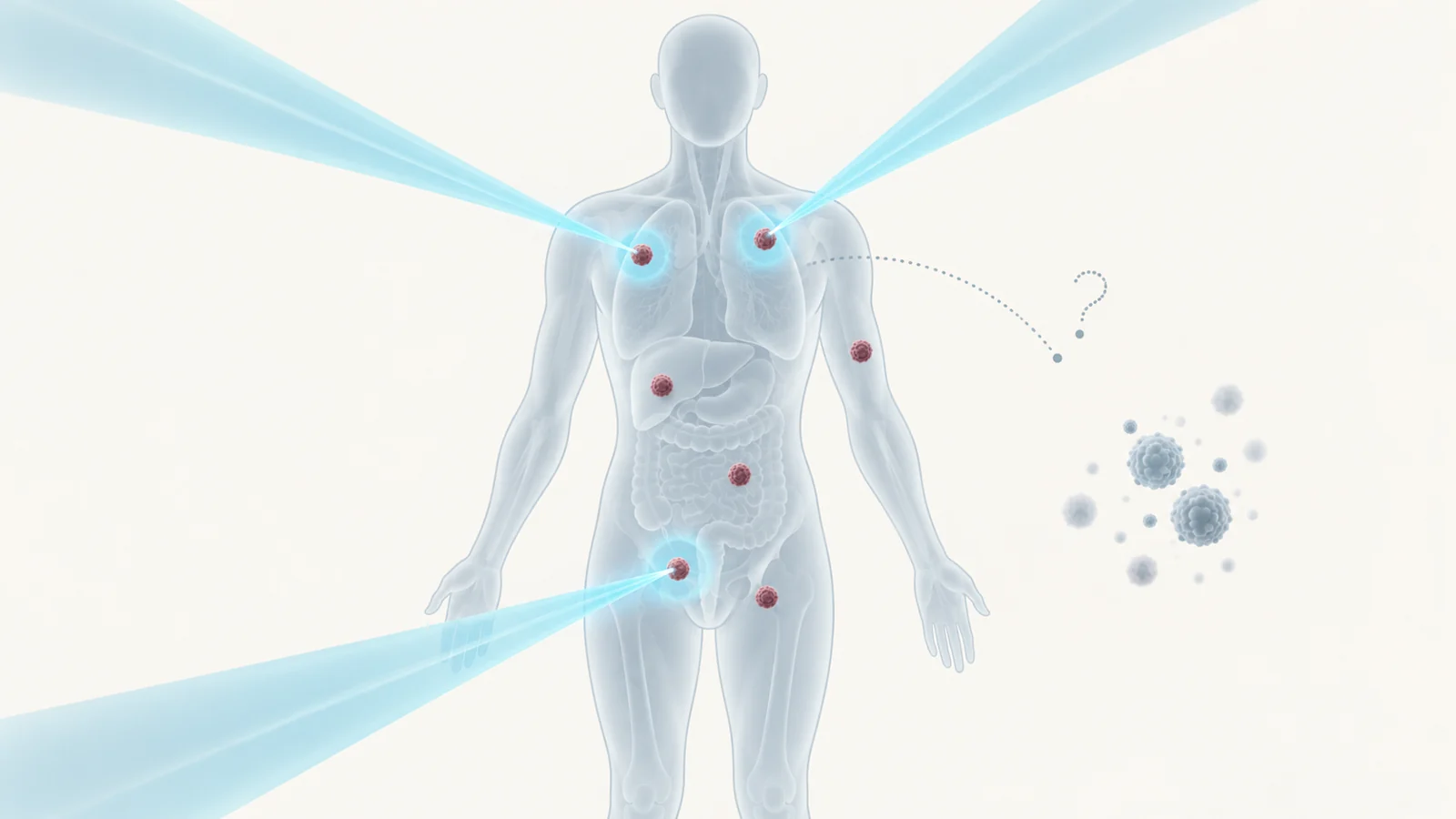
Cancer that has spread to only a few distant sites may sometimes be approached with treatment aimed directly at those sites. Yet controlling the visible tumors does not necessarily control cancer elsewhere in the body. A 2021 review considers whether adding immunotherapy to focused radiation might help address that gap—and why the idea remains promising rather than proven.
Treating the sites doctors can target
Oligometastatic cancer describes a limited amount of cancer that has spread to distant parts of the body and is progressing relatively slowly. In some patients, this pattern may leave room for metastasis-directed treatment: an attempt to destroy the known metastatic sites locally, with the possibility of cure in some cases.
Much of the research discussed in the review focused on stereotactic body radiation therapy, or SBRT. It delivers an ablative, highly focused radiation dose to a tumor site. Because treatment is directed at particular locations, its reach is different from that of a systemic treatment, which is intended to act throughout the body.
That difference helps explain the concern. Even when radiation treats the targeted metastases, cancer may still progress at distant sites. The review says SBRT’s benefit in oligometastatic disease had not yet been confirmed in phase III randomized controlled trials, and distant failure remained a significant problem. Treating known sites can therefore leave an unresolved question about disease beyond them.
A possible role for immune checkpoint blockade
Immune checkpoint blockade (ICB) is a type of immunotherapy that helps the body’s immune defenses act against cancer. It is systemic, so researchers have considered whether it could complement radiation aimed at a limited number of tumors.
The review gives a biological rationale for pairing the treatments. The immune system continually balances antitumor surveillance—the recognition and control of cancer cells—with suppressive conditions in and around a tumor. The tumor microenvironment is that local setting, including the surrounding conditions that influence how immune cells behave. Both radiation and ICB can affect this balance. The authors therefore speculate that the treatments’ effects on this immune balance might reinforce each other when combined.
That is a proposed interaction, not an established clinical effect. The review also notes a practical limit to ICB on its own: only a minority of patients respond, and most of those who do eventually progress. Pairing it with local treatment is one way researchers have explored whether its reach or effect might be improved, but the supplied evidence does not show that the combination prevents cancer from returning elsewhere.
Early observations leave the central outcome open
The review reports that combining SBRT with ICB appeared safe in studies with short follow-up. It also describes preliminary prospective data that support the possibility of efficacy. These are reasons to investigate the combination further, but they answer different questions: short-term safety observations do not establish long-term safety, and early indications of activity do not show a lasting benefit.
Because this is a narrative review synthesizing prior work, it is not itself a new trial testing whether the combination improves survival or produces cures. The evidence provided here does not establish how large any benefit might be, which patients might benefit, or whether the pairing reduces distant failure over time. Those are important distinctions when a plausible mechanism and early clinical observations could otherwise sound like evidence of a proven treatment effect.
The balance of benefit and harm remains unresolved
Combining treatments can only be useful if any added cancer control justifies the added harms. The review calls for more research to confirm both safety and efficacy and to find ways to maximize the treatment’s therapeutic ratio: the balance between benefit and harm.
The best way to use the pairing remains an open question. The supplied evidence does not identify an optimal schedule or establish which patients should receive both treatments. A convincing assessment would need to show not only that the treatments can be delivered together, but that their combination offers a durable advantage worth its risks.
What combining radiation and immunotherapy could change
If future evidence shows durable benefit with an acceptable balance of harm, the combination could offer a way to treat a limited number of metastatic sites locally while helping control cancer beyond the areas reached by radiation. For some patients, that could mean fewer distant failures and a broader form of cancer control. The review presents this as a possibility to test; its early evidence does not establish that this outcome has been achieved.
Key Sources
- Primary source: The role of immunotherapy in combination with oligometastasis-directed therapy: a narrative review.
DOI or Journal Page · Review or Meta-Analysis · 2021-01-04
Keep exploring