
Research Signal – Source date 2021-01-01
A material name does not tell you what a tissue-engineering support looks like or how it was made. In a 2021 brief review, poly(glycerol sebacate), or PGS, appears in several physical forms and with properties that researchers can adjust. So when the review discusses PGS in research on nerve, cartilage and heart tissue, it is not describing one fixed material design.
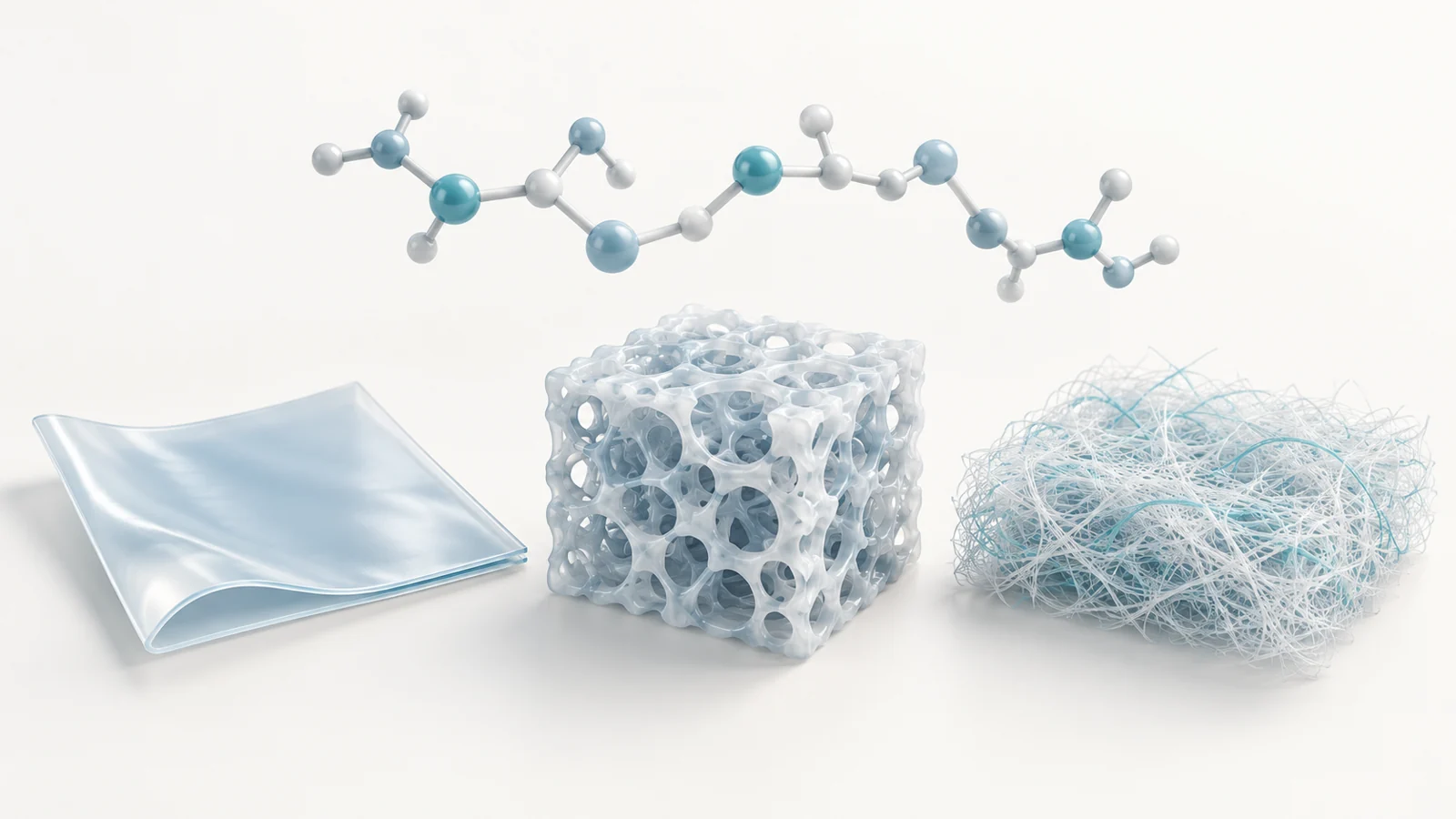
The distinction matters because the shape and chemistry are part of what researchers are considering. The review presents PGS as an aliphatic polyester of interest for tissue engineering. It describes films, porous scaffolds and nonwovens, and also discusses proposed uses in polymer blends and composite materials. The abstract gives a view of this design range, but not enough detail to identify a best version for a particular tissue.
The same polymer can take different physical forms
A two-dimensional film is a flat sheet. A porous scaffold is a structure with spaces through it. A nonwoven is a mat made from fibers arranged and joined without being woven into a regular fabric. These forms give PGS different physical structures; the review abstract does not assign a particular advantage or tissue target to any one of them.
PGS may also be combined with other materials. In a polymer blend, materials are mixed together; in a composite, different materials are brought together in one material system. The review names both as proposed approaches, without specifying in its abstract which combinations perform best or how they compare with PGS alone.
Chemistry can be adjusted as well
Shape is only one part of the design range. The review says PGS’s physicochemical properties—its physical and chemical characteristics—can be significantly adjusted during synthesis and through later modifications. It names cross-linking and copolymerization among those routes.
Cross-linking adds links between polymer chains. Copolymerization forms a polymer using more than one kind of building block. These are ways to change the material, not evidence by themselves that a particular version will repair tissue better. The abstract does not give comparative performance measures for the different forms or modifications.
Nerve, cartilage and cardiac tissue are areas of interest
The review’s authors discuss regenerative potential for PGS in soft-tissue engineering, including research concerning nerve, cartilage and cardiac tissue. Those examples show why a material that can be presented in multiple forms and adjusted chemically has attracted interest across more than one tissue area.
The evidence available here is the review abstract, not a report of a new trial. It does not provide the underlying studies’ designs, sample sizes or comparative outcomes. It therefore cannot establish which PGS formulation is best for any of the named tissues, a clinical benefit for patients, or a product ready for use. Those conclusions would require evidence beyond what the abstract supplies; this boundary does not imply that the complete review contains no further details.
What tailored supports could mean for soft-tissue repair
A future possibility is that researchers could develop material supports suited to different damaged soft tissues—for example, distinct designs for nerve, cartilage or heart research. That capability would matter only if particular forms and chemistries show reproducible repair performance and appropriate safety in further testing. The 2021 abstract describes the design range that motivates this research; it does not establish that such tailored supports are already effective treatments.
Key Sources
- Primary source: Brief review on poly(glycerol sebacate) as an emerging polyester in biomedical application: Structure, properties and modifications.
DOI or Journal Page · Review or Meta-Analysis · 2021-01-01
Keep exploring