
Research Signal – Source date 2023-10-16
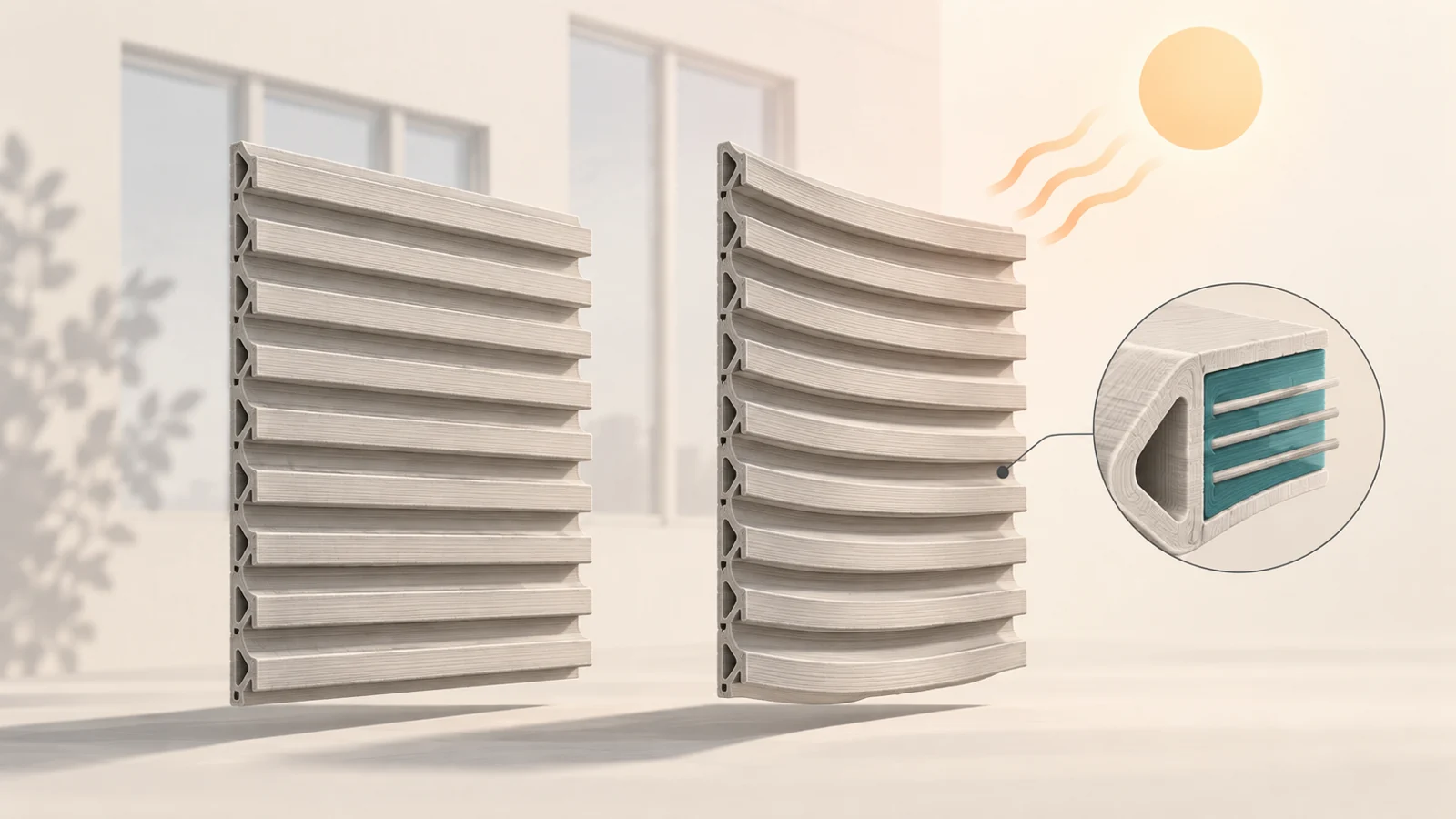
A printed building component need not keep the shape it has when it leaves the printer. With a suitable material and design, heat or moisture could trigger a later change in its form. Imagine a shading element whose material bends as conditions change, altering its position outside a window. The useful achievement would be a response that serves the building and its occupants reliably.
A systematic review published on October 16, 2023, examines this possibility through the emerging field of 4D printing. It brings together conceptual and empirical research on civil engineering and construction, covering responsive materials, proposed applications and practical obstacles. Its account describes research directions and preliminary applications, rather than establishing that adaptive building systems are ready for routine construction.
The central question is how a material’s response could become a useful building function—and whether the resources required to produce and maintain it would be justified by what it does.
What happens after printing
The fourth dimension in 4D printing is time. An object is manufactured in three spatial dimensions, then changes its shape or properties in response to a stimulus. There is no additional spatial printing axis. The intended response comes from the combination of material behavior, the printed design and any conditioning needed to prepare the part.
The review describes several ways to obtain that response. Hydrogels contain substantial amounts of water and can swell or shrink as their environment changes. Their changing volume provides a route to movement. Shape-memory polymers work differently. They can recover a predetermined form when a suitable trigger, often heat, activates their response. One mechanism depends on swelling or shrinking; the other draws on a material’s ability to recover a programmed shape.
Printing is therefore one step in establishing the finished component’s behavior. Depending on the material and process, a part may need cleaning to remove supports or residue, ultraviolet curing to solidify a resin, or thermal conditioning to program its shape-memory behavior. The review describes heating a part, holding it in a desired shape and cooling it so that it retains that temporary form until a later stimulus triggers transformation.
For a designer, the sequence connects several choices. The material determines which stimulus can produce a response. The printed geometry helps determine how that response becomes a change in form. Post-processing establishes the properties or programmed state needed for the component to function. A useful design must connect those choices to the conditions the component will actually encounter.
A natural fiber and a responsive polymer have different jobs
Cellulose, hemp and flax appear in the review as possible ingredients for 4D-printing materials. Their appeal includes renewability and favorable strength relative to weight. But incorporating a natural fiber does not, by itself, give a printed component a controlled response to heat or moisture.
In the composites discussed by the authors, different constituents can perform different jobs. A natural fiber can reinforce the material, while a shape-memory polymer supplies the programmed response. Combining them requires attention to how the mixture prints, how strong it becomes and whether it can still undergo the intended transformation. Reinforcement and responsiveness have to work together in the finished part.
The same distinction matters when describing environmental attributes. Renewable fiber content says something about an ingredient’s origin. It does not establish that the whole composite is renewable, recyclable or biodegradable. Those properties depend on the other constituents and how they are combined. A material can offer a useful role for plant-derived fibers while still requiring a separate assessment of its manufacture and eventual disposal.
The environmental balance extends beyond the printer
Precise manufacturing could reduce offcuts and unnecessary material use. Complex printed geometries could also allow engineers to use material more efficiently while meeting a component’s performance needs. These are potential benefits of how an object is made. They are distinct from any benefit that its later movement might provide inside or outside a building.
The production side carries burdens of its own. The review identifies energy consumption as a significant concern, with requirements varying by printing technology and object complexity. Material extraction, processing and disposal also contribute to environmental impact. Cleaning, curing and thermal conditioning belong in that accounting wherever the chosen process requires them. A component’s environmental assessment cannot end when material leaves the print nozzle.
Use in a building adds another part of the balance. If a responsive element performs a useful function over a sufficiently long life, that service could help justify the resources spent making it. Frequent replacement would add fresh manufacturing and disposal demands. Renewable or recycled ingredients might improve one part of the balance without resolving the others.
This makes sustainability a comparison between complete ways of providing a building function. Material savings, production energy, service performance and replacement all matter. The possibilities discussed in the review should not be read as a quantified carbon, energy or cost advantage over a specified conventional alternative. Such an advantage would depend on the particular component, its manufacturing process and the conditions of use.
A larger component changes the engineering problem
Scaling up introduces physical difficulties that are easy to overlook when watching a small object change shape. The review highlights the challenge of distributing heat uniformly, maintaining consistent material properties and controlling deformation as parts become larger. If different regions respond differently, achieving the intended overall shape becomes harder. The problem concerns coordinated behavior throughout a component, as well as the size of the printer.
Construction materials must also reconcile competing demands. They need to be processable during printing and sufficiently firm afterward, while retaining their responsive capabilities. A part intended to carry loads must combine those capabilities with strength and structural integrity. For exposed components, durability under changing environmental conditions is another essential requirement. A material’s ability to transform once does not establish repeated reversible operation or dependable performance over a building’s service life.
The authors describe large civil-structure applications as preliminary and identify prolonged real-world performance as an unresolved issue. Their examples therefore warrant care: a proposed application or experimental component cannot establish the safety and reliability of an entire construction system. The review brings together a varied body of work, not a uniform set of construction-scale performance comparisons.
Cost complicates the transition as well. Large printers, their maintenance and specialized materials can be expensive, while developing materials that preserve both structural performance and programmed behavior requires further investment. The review also points to a more limited route for application: smaller responsive elements made separately and integrated into larger, otherwise conventional structures. That approach gives the material a specific job without requiring every part of a building to transform.
What this could change
Responsive shading is one such job. If a printed facade element could change its form predictably in response to sunlight or temperature, it could alter shading as outdoor conditions change. That would connect a material-level response to a practical building function: managing how much sunlight reaches the interior.
For occupants, useful adaptation could mean more comfortable indoor conditions. For building operators, it could help reduce the energy needed to manage indoor temperatures. Those benefits would depend on a durable, controllable response whose environmental value survives the costs of production and replacement.
The opportunity is to give a particular building component a capacity it does not ordinarily have—a material response suited to changing conditions. If engineers can make that response dependable and environmentally worthwhile, a relatively small printed element could contribute to how a much larger building uses energy and supports the people inside it.
Key Sources
- Primary source: A systematic review of the role of 4D printing in sustainable civil engineering solutions.
DOI or Journal Page · Review or Meta-Analysis · 2023-10-16
Keep exploring