
Research Signal – Source date 2023-10-24
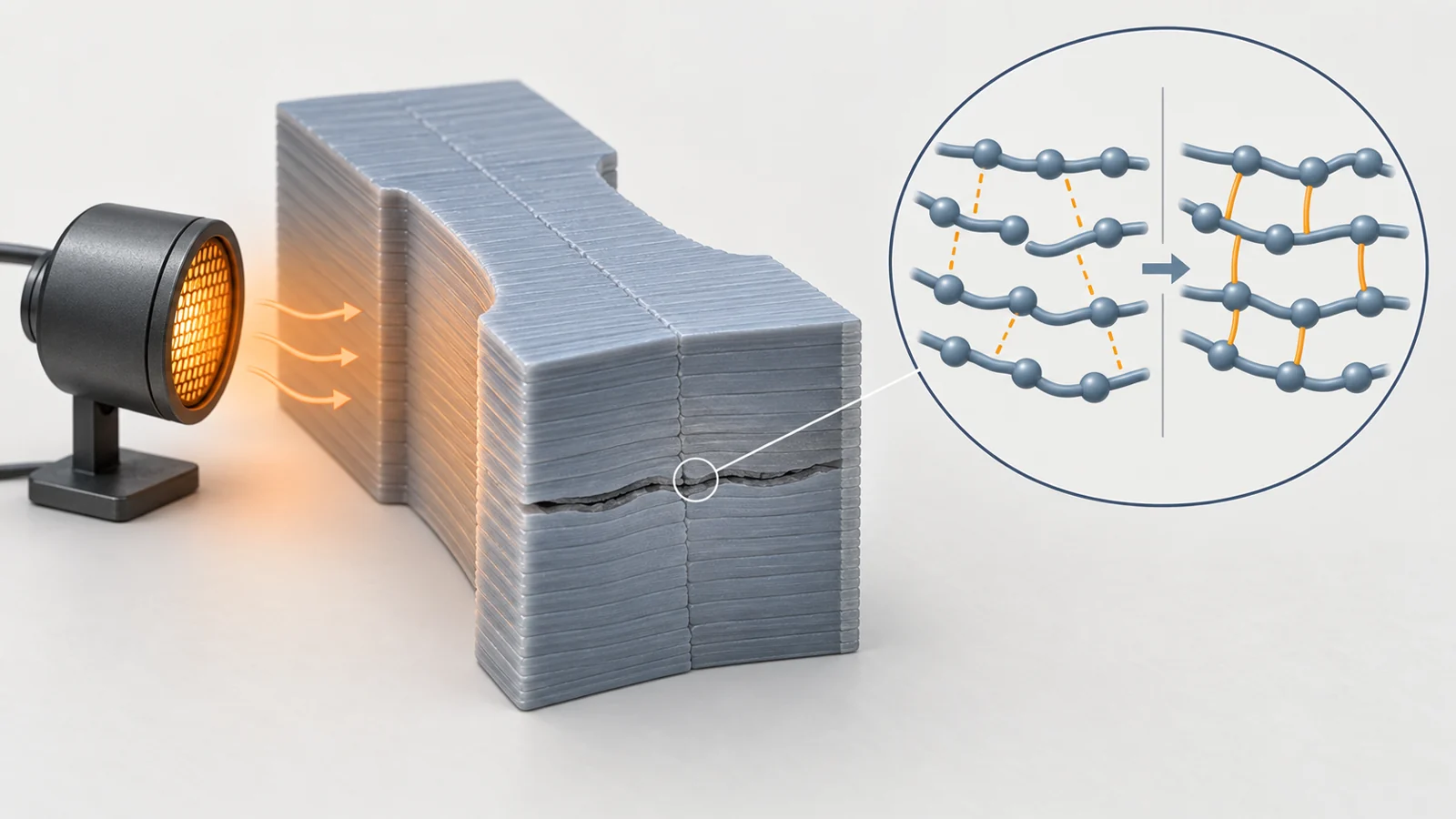
A crack in a printed plastic part can interrupt both its structure and its usefulness. A material described as self-healing offers a way to reconnect the damaged region. But what reconnects, how much assistance it needs, and which properties return depend on the particular material. Some repair mechanisms release an agent stored inside the plastic. Others allow connections between polymer chains to form again, sometimes after hours of heating.
Before any of that can help a printed object, the material must survive becoming one. It has to pass through a nozzle or harden under light, retain its intended shape, and preserve the chemistry that makes repair possible. A review published on October 24, 2023, Self-Healing Polymeric Materials and Composites for Additive Manufacturing, brings those manufacturing demands together with the mechanisms of healing.
Its examples span different materials and laboratory tests. They show why a repaired surface, recovered strength, and restored electrical behavior are different kinds of success—and why the most useful result depends on the job the object needs to do.
Where the repair comes from
One approach puts a reserve of healing material inside the plastic. Tiny capsules embedded in the surrounding polymer break when a crack reaches them, releasing an agent into the damaged region. The crack itself can trigger the response. Because the repair agent moves into the gap, the surrounding polymer does not have to become mobile enough to reconnect on its own. The review describes this as a route to healing in relatively stiff materials.
That local reserve is finite. Once a capsule releases its contents, it cannot provide the same supply again. The available volume also restricts the damage it can address. A material containing these capsules can therefore respond automatically to a crack while still having a limited capacity for further repair at that location.
Another approach builds reversible connections into the polymer network itself. Polymers consist of long molecular chains; connections within and between those chains help give a material its structure. If suitable connections can separate and reform across a damaged interface, the material has a route to rejoining without drawing on a capsule of stored agent.
These connections can include reversible chemical bonds or weaker attractions such as hydrogen bonds. Different interactions demand different repair conditions. Heating can help chains move and connections rearrange, while some formulations can reconnect at room temperature. Stronger connections generally take more energy to reorganize; weaker ones can reform more readily but are also more sensitive to their surroundings.
The location of the mechanism and the need for assistance are separate questions. A repair mechanism built into the polymer is called intrinsic, but that does not mean it works unaided. Conversely, an embedded capsule can respond to damage without an external trigger. Neither arrangement makes missing material grow back.
Three ways to make the shape
The manufacturing methods in the review place distinct demands on these materials. In fused deposition modeling, a printer feeds a continuous plastic filament into a heated nozzle. The softened material is deposited in successive layers, cooling and solidifying as the shape grows. A healing formulation used this way needs to flow during deposition and form a coherent solid afterward. How neighboring strands and layers join is part of the resulting material’s performance.
Direct-ink writing also builds a shape through a nozzle, but uses an ink rather than a continuous filament melted at the print head. The ink must flow readily enough to be extruded without excessive pressure, then stop spreading and support the developing structure. The review discusses shear-thinning behavior, in which an ink becomes easier to move under the forces applied during extrusion. Its behavior after leaving the nozzle matters just as much as its passage through it.
This route opens possibilities for thermosets, polymer networks that are ordinarily difficult to reshape once formed. The review describes a directly printed formulation with thermally reversible chemical connections that allowed healing and reprocessing. Making such an ink still requires careful control of flow and shape retention; adding reversible chemistry does not automatically make a material printable.
Light-based printing imposes another set of requirements. Here, a liquid resin hardens where ultraviolet or visible light reaches it. Stereolithography uses a laser that scans across the layer, while digital light processing exposes a patterned area at once. The resin must let the curing light penetrate to the intended depth and remain fluid enough for successive layers to form.
A formulation that works in one process may therefore be unsuitable for another. Easy extrusion, stability after deposition, and controlled light curing are different physical demands. The healing mechanism has to fit the way the object is made, as well as the properties required of the finished part.
Reconnecting layers can also help build the object
Reversible connections can be useful before a part suffers damage in service. Layered manufacturing creates interfaces, and poor adhesion between deposited layers can leave a printed object vulnerable to cracking or deformation. The review describes materials designed to strengthen those contacts through the same kinds of interactions that support healing.
In one reported approach, reversible chemistry allowed a polymer to become a lower-viscosity liquid above a particular temperature, helping it flow during filament printing. Other formulations used combinations of coordination interactions and hydrogen bonding to improve adhesion. These examples connect the molecular design of the material to the quality of the joins created by the printer.
The idea extends to assembly. The review describes separately printed blocks joined into larger, more complex objects using a material with room-temperature healing behavior. That gives reconnection a manufacturing role beyond repairing an accidental crack. Printing smaller pieces and joining them afterward can offer a way to construct shapes that would otherwise be harder to produce in one build, including shapes requiring more supporting structures during printing.
What a recovery percentage actually tells you
One example in the review makes the conditions especially concrete. A polyurethane elastomer containing reversible disulfide bonds was printed using digital light processing. After damage, the healed samples recovered 95% of their original strength following 12 hours at 80 °C, or 176 °F. Repeated healing was also described for that material.
The temperature and waiting time belong to the result. This was strength recovery after a specified treatment, not immediate repair at room temperature. The percentage also concerns a particular measured property. It does not by itself establish that the surface, dimensions, stiffness, or every other feature returned to its original state. Nor does it establish how many repair cycles a finished product could reliably tolerate.
The review gathers experiments involving different polymers, damage scenarios, activation conditions, and measurements. Their recovery percentages cannot be treated as a ranking of interchangeable materials. A useful reading keeps the property and the procedure together: what was restored, after what damage, and with what assistance?
An electrical example broadens the meaning of successful healing. The review describes a directly printed hydrogel micro-supercapacitor, a small energy-storage device, whose network used dynamic borate ester connections and hydrogen bonds. Following multiple physical damage and healing cycles, measurements of its electrochemical behavior showed little change in the reported cyclic voltammetry and charge–discharge curves.
Those measurements address whether the device can recover aspects of its electrical operation. That is a different question from how much pulling force a repaired sample withstands. For an energy-storage component, reconnecting the material becomes particularly useful when the connection also restores its ability to function electrically.
A repaired sample still has to withstand use
Service places demands on a material between repair events. The review notes that weak, reversible connections can compromise mechanical strength, recovery after stretching, and resistance to creep—the gradual deformation that can occur under a sustained load. A part might reconnect after a cut yet still struggle to hold its intended shape over time.
Increasing the number or density of connections can improve structural stability. However, a tightly connected network can also restrict the molecular movement needed for healing. The relevant question for a finished object is whether its structure remains dependable through ordinary loading as well as through a repair cycle.
Repair conditions also need to fit the object. The heated elastomer example illustrates why temperature and duration matter when judging a candidate for use alongside other materials or components. A successful material test establishes a repair route; turning that route into a workable product requires the rest of the object to tolerate the treatment too.
The authors describe a field still at the laboratory stage, with repaired damage not necessarily accompanied by complete restoration of the original surface. They also identify compatibility between healing agents and surrounding polymers, and the difficulty of scaling manufacturing, as obstacles. These are substantial steps between a demonstration and a dependable product. Longer service life and reduced waste remain possible consequences, rather than measured general benefits of printed self-healing plastics.
What this could change
Printed wearable electronics offer a concrete possibility. If a small energy-storage component could repeatedly recover useful electrical behavior after physical damage, a damaged component might be repairable instead of requiring replacement. The hydrogel micro-supercapacitor described in the review provides a laboratory example of the functional recovery such a capability would need.
Reaching that point would require the recovery to persist under practical use and repair conditions, with a structure that remains stable and can be manufactured consistently. If those requirements can be met, printing could give designers both control over a component’s shape and a way for it to regain a useful function after damage. The potential benefit would come from returning a working component to service.
Key Sources
- Primary source: Self-Healing Polymeric Materials and Composites for Additive Manufacturing.
DOI or Journal Page · Review or Meta-Analysis · 2023-10-24
Keep exploring